
India joins the “Tropical Forest Forever Facility (TFFF)” as Observer Ahead of COP30
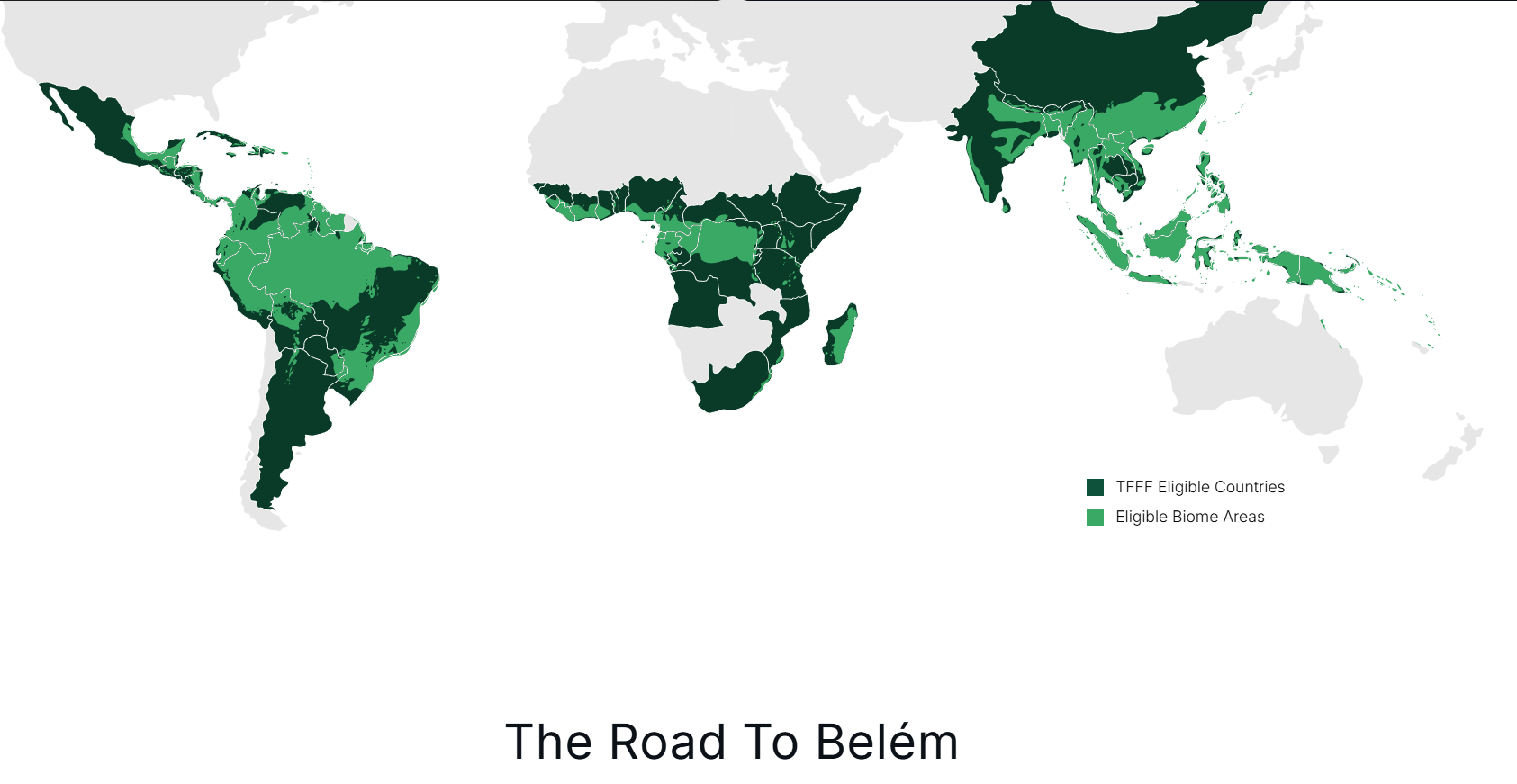
In News
Event: Leaders’ Summit in Belém, Brazil (ahead of COP30, November 2025)
Key development: India announced it will join the Tropical Forest Forever Facility (TFFF) as an Observer.
Aim: To support a global initiative that financially rewards tropical countries for conserving forests and limiting global carbon emissions.
About the Tropical Forest Forever Facility (TFFF)
Specification | Details |
Full Name | Tropical Forest Forever Facility (TFFF) |
Launched at | Leaders’ Summit, Belém, Brazil (November 2025) |
Linked to | COP30 (to be hosted by Brazil in 2025) |
Objective | To incentivize tropical forest protection through annual payments to countries maintaining forest cover |
Headquarters / Secretariat | TFFF Secretariat (to coordinate financing and monitoring) |
Financing Mechanism | Backed by the Tropical Forest Investment Fund (TFIF) |
Nature of Initiative | Budget-neutral nature financing model — combines private investment with ecosystem conservation |
India’s Role | Joined as an Observer, not a full funding member (yet) |
How the TFFF Works
Financial Incentive Structure
Tropical countries receive annual payments for every hectare of forest protected (not acre)—
→ $4 per hectare per year.
Investment Model
Countries or investors contribute funds to the Tropical Forest Investment Fund (TFIF).
The fund invests in emerging market bonds and green sectors — avoiding fossil fuels, coal, or deforestation-linked industries.
Returns from investments are used to:
Pay countries for conservation.
Repay investors their principal in full (making it budget-neutral).
Purpose
To align climate finance with forest protection goals.
Encourage sustainable debt-free financing models for developing tropical nations.
Performance-Based Payments
Parameter | Details |
Eligibility | Tropical countries with annual deforestation below 0.5% |
Payment Formula | USD $4 per hectare per year of forest area conserved |
Deforestation Penalty | Payments suspended if rate rises above threshold |
Degradation Discount | 25:1 ratio for fire-affected areas |
Deforestation Discount | 100:1–200:1 ratio depending on forest loss extent |
Beneficiaries | National governments, Indigenous Peoples, and Local Communities (IPLCs) |
IPLC Allocation Indigenous Peoples and Local Communities | Minimum 20% of all payments directed to them |
Monitoring & Verification
Participating nations must use advanced remote sensing and satellite imagery for annual forest cover assessments.
Compliance criteria include:
Transparent, auditable monitoring systems
Fair resource allocation mechanisms
Deforestation rate below 0.5% at entry
Adherence to TFFF Charter’s governance and accountability norms
Eligibility Criteria for Participation
Condition | Requirement |
Forest Type | Broadleaf tropical & subtropical forests |
Deforestation Rate | Below 0.5% annually |
Performance Rule | Cannot exceed rate at entry |
Governance | Must sign the TFFF Charter and demonstrate transparency |
Equity Provision | At least 20% benefits to IPLCs |
Exclusions | High-income nations and monoculture forest areas are not eligible |
Key Differentiators from Existing Mechanisms
Feature | TFFF | REDD+ / Carbon Credit Systems |
Financing Type | Self-sustained, investment-based | Donor and project-based |
Incentive Type | Annual performance-based payments | Carbon offset or emission-based payments |
Permanence | Long-term funding stream | Short project cycles |
Focus | Rewards conservation success | Rewards emission reductions |
Leadership | Global South-led | Donor-driven (Global North-led) |
Equity | 20% mandatory allocation to local/indigenous communities | Often limited trickle-down benefits |
Scale and Reach
Can potentially support over 70 Tropical Forest Countries (TFCs).
Covers ~1 billion hectares of tropical forests (Amazon, Congo Basin, Southeast Asia, Indian forests).
Potential to conserve nearly 20% of global forest carbon sinks.
Founding and Supporting Members
Country / Entity | Status / Commitment |
Brazil | Host nation and initiator; pledged $1 billion |
Colombia | Contributed $250 million |
India | Joined as Observer (no financial commitment yet) |
France, China, UAE | Expressed support but no financial contribution yet |
Other participants | UK, Norway, South Africa, EU, etc. (attended the Summit) |
Key Goals of TFFF
Combat Deforestation
Provide direct monetary incentives for preserving forests instead of clearing them.
Climate Mitigation
Tropical forests absorb ~30% of global CO₂ emissions annually.
Protecting them is central to staying within the 1.5°C target.
Equitable Climate Finance
Supports developing nations in conserving forests without sacrificing economic growth.
Promote Sustainable Investment
Direct global finance toward green bonds and non-fossil sectors.
Statements and Key Outcomes at the Belém Summit (2025)
Brazilian President Luiz Inácio Lula da Silva:
Urged countries to:
Create a roadmap to end fossil fuel dependence.
Triple renewable energy capacity and double energy efficiency by 2030 (aligned with COP28 pledges).
Announced “Belém Commitment” to:
Quadruple sustainable fuel use by 2035.
Promote debt-for-climate swaps to aid developing nations.
India’s Position :
Called TFFF a “significant step” for collective forest preservation.
Reiterated India’s approach of “equitable climate responsibility”.
Emphasized affordable finance, technology access, and capacity-building as key for developing nations to meet targets.
Highlighted:
India’s non-fossil power capacity: 50% of installed capacity.
Forest and tree cover expansion, with 2.29 billion tonnes of CO₂-equivalent sink created (2005–2021).
TFFF’s Global Relevance
Forest nations (Amazon, Congo Basin, Indonesia, India) host >70% of global tropical forests.
Forests are key to:
Carbon sequestration
Regulating rainfall patterns
Preventing biodiversity collapse
However, many forest-rich nations are low-income and face pressure from agriculture, logging, and mining.
The TFFF bridges this gap by rewarding preservation economically — a form of “climate-positive capitalism.”
Significance for India
Strategic Alignment with South-South Cooperation
Joining TFFF as an Observer keeps India part of Global South climate coalitions led by Brazil and Indonesia.
Access to Green Finance
Opens future pathways for performance-based forest finance.
Strengthens Climate Diplomacy
Positions India as a constructive player in pre-COP30 negotiations.
Supports National Missions
Complements India’s National Forest Policy (1988), Green Credit Initiative (2023), and LiFE Mission.
Moral Leverage in COP30 Negotiations
Enhances India’s voice for equitable financing and technology transfer for developing countries.
Challenges Ahead
Challenge | Explanation |
Equity & Access | Whether smaller tropical nations will benefit equally. |
Financing Risk | Investment returns depend on global bond markets. |
Verification & Monitoring | Measuring genuine forest protection remains complex. |
Affordability for Developing Countries | Need for concessional financing rather than private capital reliance. |
Dependence on Developed Nations | Global North must deliver climate finance pledges ($100 billion/year). |
Prelims Practice MCQs
Q. With reference to the Tropical Forest Forever Facility (TFFF), consider the following statements:
It aims to pay tropical countries annually for conserving forests.
It is financed through the Tropical Forest Investment Fund, which avoids investments in fossil fuels.
India is a founding member and primary financial contributor.
Which of the statements given above is/are correct?
A. 1 and 2 only
B. 1 only
C. 2 and 3 only
D. 1, 2 and 3
✅ Answer: A. 1 and 2 only
Explanation:
India has joined as an Observer, not as a founding financial contributor.
TFFF rewards nations for preserving forests and invests in green, non-fossil sectors.
Q2. The “Belém Commitment”, recently in news, is associated with:
A. Expansion of renewable energy and sustainable fuels by 2035.
B. Elimination of single-use plastics in tropical countries.
C. Establishing carbon border tax mechanisms in G20.
D. Conservation of marine biodiversity beyond national jurisdictions.
✅ Answer: A.
Q3. Which of the following correctly describes the “budget-neutral nature finance model” used by the TFFF?
A. Governments fund the initiative through carbon taxes.
B. Investors’ funds are invested, and only profits are used for conservation payments while principal is repaid in full.
C. Central banks provide grants based on emission intensity.
D. Forest nations contribute directly to a global climate insurance pool.
✅ Answer: B.