
India joins U.S.-led Pax Silica tech alliance
Context
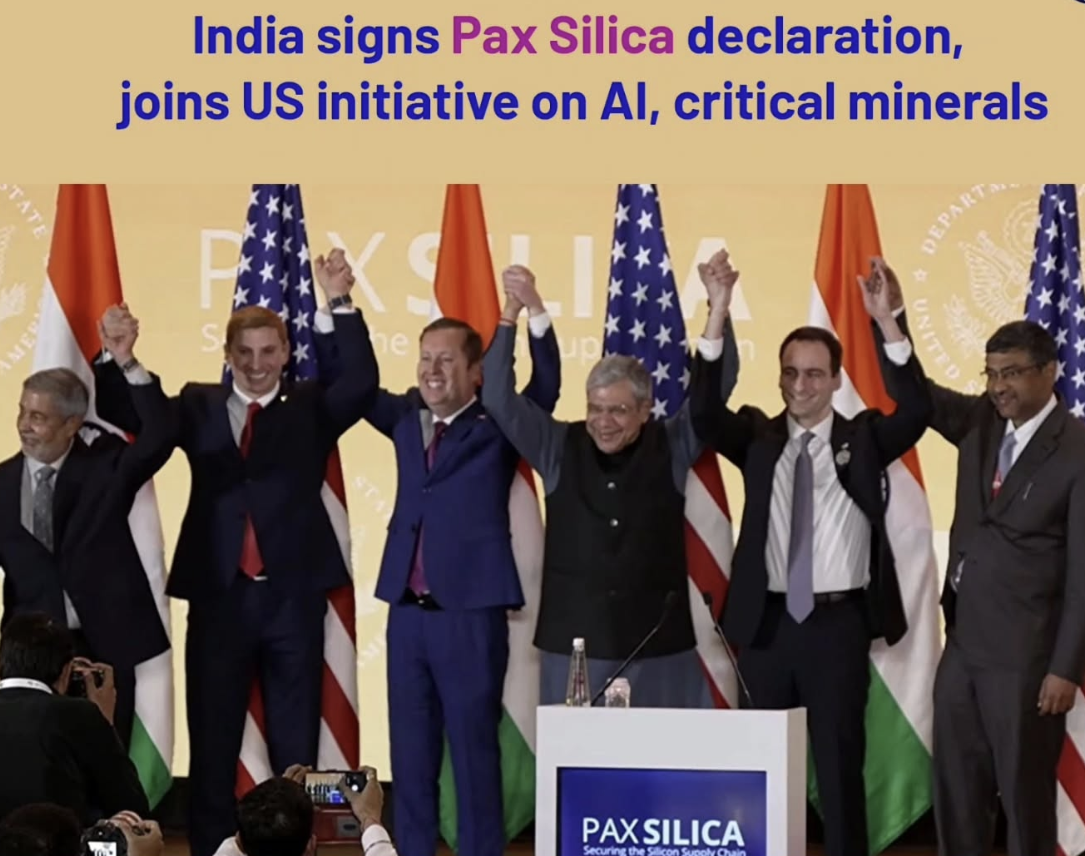
India has formally joined the Pax Silica initiative, a U.S.-led multilateral grouping aimed at building resilient supply chains for electronics and critical minerals.
Union IT Minister Ashwini Vaishnaw signed the declaration alongside U.S. Undersecretary of State Jacob Helberg during the AI Impact Summit in New Delhi.
What is Pax Silica?
Pax Silica is a strategic economic alliance spearheaded by the United States to:
Diversify and secure supply chains for semiconductors and electronics
Reduce dependence on China for refined rare earth elements
Strengthen trusted technology partnerships
The inaugural summit was held at the United States Institute of Peace in Washington, D.C.
The following countries are formal members of the Pax Silica alliance:
Australia
Greece
India
Israel
Japan
Qatar
Republic of Korea
Singapore
United Arab Emirates
United Kingdom
United States
Non-signatory participants
The following entities participate in discussions but are not formal signatories:
European Union
Canada
Netherlands
Taiwan
Strategic context
1. Rare earth leverage
China has exercised significant influence as a dominant processor of rare earth elements — key inputs for:
Semiconductors
Electric vehicles
Defence equipment
Renewable energy systems
Recent export restrictions by Beijing have heightened concerns about weaponised interdependence.
2. Economic security and sovereignty
U.S. officials framed Pax Silica as a response to:
Over-concentrated global supply chains
Economic coercion
Technological vulnerabilities
The reference to the 2020 Mumbai blackout — allegedly linked to cross-border cyber sabotage — underscores the security dimension of technology supply chains.
Why India’s entry matters
(A) Talent and manufacturing base
India brings:
A large skilled workforce in electronics and IT
Expanding semiconductor manufacturing ambitions
Growing electronics exports
(B) Strategic autonomy
India seeks:
Reduced vulnerability to supply disruptions
Diversified critical mineral access
Trusted partnerships in emerging technology ecosystems
(C) Alignment without alliance
India’s participation reflects:
Issue-based alignment with the U.S.
Continued strategic balancing rather than formal bloc politics
Critical minerals and electronics: Why important?
Critical minerals (e.g., rare earth elements, lithium, cobalt) are essential for:
Microchips
Electric mobility
AI hardware
Renewable energy infrastructure
Defence technologies
Electronics supply chains today are globally fragmented but heavily concentrated in East Asia.
Resilience requires:
Diversified mining and processing
Trusted manufacturing ecosystems
Secure logistics and technology standards
Geopolitical implications
China factor
Pax Silica implicitly aims to reduce China’s leverage in global supply chains.Tech geopolitics
Supply chains are now seen as instruments of national power.Minilateralism trend
Smaller, purpose-driven coalitions (like Pax Silica) are emerging alongside traditional multilateral institutions.India–U.S. convergence
Expands cooperation beyond defence into high-technology and economic security.
Conclusion
India’s entry into Pax Silica marks a significant step in the evolving geopolitics of technology and minerals. As global supply chains become arenas of strategic competition, partnerships built on trust, diversification, and resilience are increasingly central to economic security.
For India, the move strengthens its ambition to emerge as a key node in the global electronics and critical minerals ecosystem while carefully navigating great-power competition.
Prelims Practice MCQs
Q. With reference to the Pax Silica initiative (as of February 20, 2026), consider the following statements:
India formally joined the initiative during the AI Impact Summit in New Delhi.
All participants in Pax Silica are formal signatories to the declaration.
The initiative focuses on strengthening supply chains for electronics and critical minerals.
How many of the statements given above are correct?
(a) Only one
(b) Only two
(c) All three
(d) None
Answer: (b) Only two
Explanation:
Statement 1 is correct — India formally joined on Feb 20, 2026.
Statement 2 is incorrect — The EU, Canada, Netherlands, and Taiwan participate without being formal signatories.
Statement 3 is correct — The initiative focuses on electronics and critical mineral supply chains.
Q. Which of the following countries are formal signatories to Pax Silica ?
Australia
Netherlands
Israel
Singapore
Canada
Select the correct answer:
(a) 1, 3 and 4 only
(b) 1, 2 and 5 only
(c) 1, 3, 4 and 5 only
(d) 1, 2, 3, 4 and 5
Answer: (a)
Explanation:
Australia, Israel, and Singapore are formal signatories.
Netherlands and Canada participate but are not formal signatories.