
India–Oman CEPA: analysis
Background
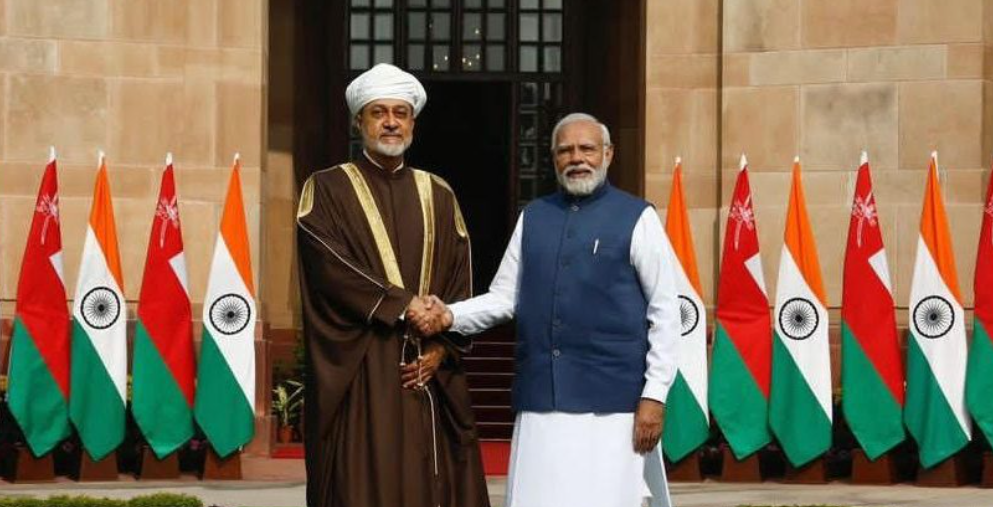
India and Oman signed a Comprehensive Economic Partnership Agreement (CEPA) in Muscat.
Signed by Piyush Goyal and Qais bin Mohammed Al Yousef.
Signed in the presence of Narendra Modi and Haitham bin Tarik.
Salient features of the CEPA
1. Market access and tariff liberalisation
Oman’s commitments
Duty-free access to 98.08% of tariff lines
Covers 99.38% of India’s exports to Oman
India’s commitments
Liberalised tariffs on 77.79% of tariff lines
Covers 94.81% of India’s imports from Oman
2. Sectoral coverage
Indian sectors gaining full tariff elimination
Gems and jewellery
Textiles and apparel
Leather and footwear
Sports goods
Plastics and furniture
Agricultural products
Engineering goods
Pharmaceuticals and medical devices
Automobiles
Sensitive sectors excluded by India
Dairy products
Tea and coffee
Rubber and tobacco
Gold and silver bullion
Jewellery
Scrap of base metals
Shows India’s calibrated approach—export promotion without harming domestic producers.
Services and labour mobility
Mode 4 commitments (Movement of natural persons)
Intra-Corporate Transferees (ICTs) quota increased from 20% to 50%
Contractual Service Suppliers
Stay extended from 90 days to 2 years
Further 2-year extension possible
Mode 4 refers to the movement of natural persons across countries to supply services temporarily. It is one of the four modes of service supply defined under the General Agreement on Trade in Services (GATS) of the World Trade Organization (WTO). Meaning of Mode 4
Who comes under Mode 4?
What Mode 4 does NOT include
Example
| ||
General Agreement on Trade in Services (GATS) modes
Mode | What it means | Example |
Mode 1 | Cross-border supply | Online consultancy |
Mode 2 | Consumption abroad | Medical tourism |
Mode 3 | Commercial presence | Foreign company branch |
Mode 4 | Movement of professionals | Indian engineer working abroad temporarily |
Significance
First time Oman has offered such wide-ranging Mode 4 commitments
Benefits Indian professionals in:
IT and IT-enabled services
Engineering
Healthcare
Technical and professional services
Trade data (2024–25)
India’s exports to Oman: $4.06 billion
About 0.93% of India’s total exports
India’s imports from Oman: $6.5 billion
About 0.91% of India’s total imports
Strategic and geopolitical importance
First bilateral trade agreement Oman has signed since its US FTA (2006).
India’s second CEPA with the Gulf Cooperation Council (GCC):
First was with United Arab Emirates in 2022.
Oman acts as a gateway for India to:
GCC region
Eastern Europe
Central Asia
Africa
Broader significance for India
Enhances trade diversification beyond traditional partners
Boosts labour-intensive manufacturing exports
Strengthens services exports and overseas employment
Supports Make in India and Global Value Chain integration
Reinforces India’s economic presence in the West Asian region

Prelims Practice MCQs
Q. With reference to the India–Oman Comprehensive Economic Partnership Agreement (CEPA), consider the following statements:
Oman has offered duty-free access to more than 98% of its tariff lines to India.
India has offered duty-free access to more than 90% of its tariff lines to Oman.
The agreement covers both goods and services, including labour mobility.
Which of the statements given above is/are correct?
A. 1 and 2 only
B. 1 and 3 only
C. 2 and 3 only
D. 1, 2 and 3
Correct answer: B
Explanation:
Statement 1 is correct: Oman offered duty-free access to 98.08% of tariff lines.
Statement 2 is incorrect: India liberalised 77.79% of tariff lines, not over 90%.
Statement 3 is correct: CEPA includes services and enhanced labour mobility (Mode 4).
Q. Which of the following sectors are expected to benefit from full tariff elimination under the India–Oman CEPA?
Gems and jewellery
Pharmaceuticals and medical devices
Dairy products
Engineering goods
Select the correct answer using the code below:
A. 1, 2 and 4 only
B. 1 and 3 only
C. 2 and 3 only
D. 1, 2, 3 and 4
Correct answer: A
Explanation:
Gems and jewellery, pharmaceuticals, and engineering goods receive full tariff elimination.
Dairy products are excluded as sensitive items by India.
Q. In the context of international trade agreements, Mode 4 refers to:
A. Cross-border supply of services
B. Consumption of services abroad
C. Commercial presence of service providers
D. Movement of natural persons supplying services
Correct answer: D
Explanation:
Mode 4 under GATS deals with temporary movement of professionals.
India–Oman CEPA significantly expands Mode 4 commitments.