
India’s carbon credit plan: CCUS vs agricultural carbon markets
Context
The Union Budget 2026 announced a ₹20,000 crore “carbon credit programme”, creating confusion about its actual purpose. While public discourse suggested a new income stream for farmers, official policy documents indicate that the allocation is primarily meant for industrial decarbonisation through CCUS (Carbon Capture, Utilization and Storage).
This has led to a fundamental policy debate:
Is India prioritising industrial emissions reduction, or
Is it enabling agriculture-based carbon markets?
Understanding the two competing interpretations
1. CCUS for “hard-to-abate” industries
The programme is anchored in the R&D roadmap released by the Department of Science and Technology (DST).
Nature of CCUS
Captures CO₂ from point sources (factories, power plants)
Either:
Reused in industry, or
Stored underground
Target sectors
Power
Steel
Cement
Refineries
Chemicals
These sectors are called “hard-to-abate” because:
Emissions are process-based, not just energy-based
Cannot be fully reduced by renewables alone
Key insight
The ₹20,000 crore is meant for:
Technology deployment
Industrial decarbonisation
Not income transfers
2. Carbon credits for farmers
Farmers can earn money by:
Soil carbon sequestration
Agroforestry
Regenerative agriculture
This is based on:
Growth of voluntary carbon markets
Existing pilot projects by:
Private companies
State governments
Why this idea gained traction
Budget used the broad term “carbon credit programme”
Agriculture already seen as:
Climate solution provider
Carbon sink
Root cause of confusion
The confusion arises from conflation of two fundamentally different mechanisms:
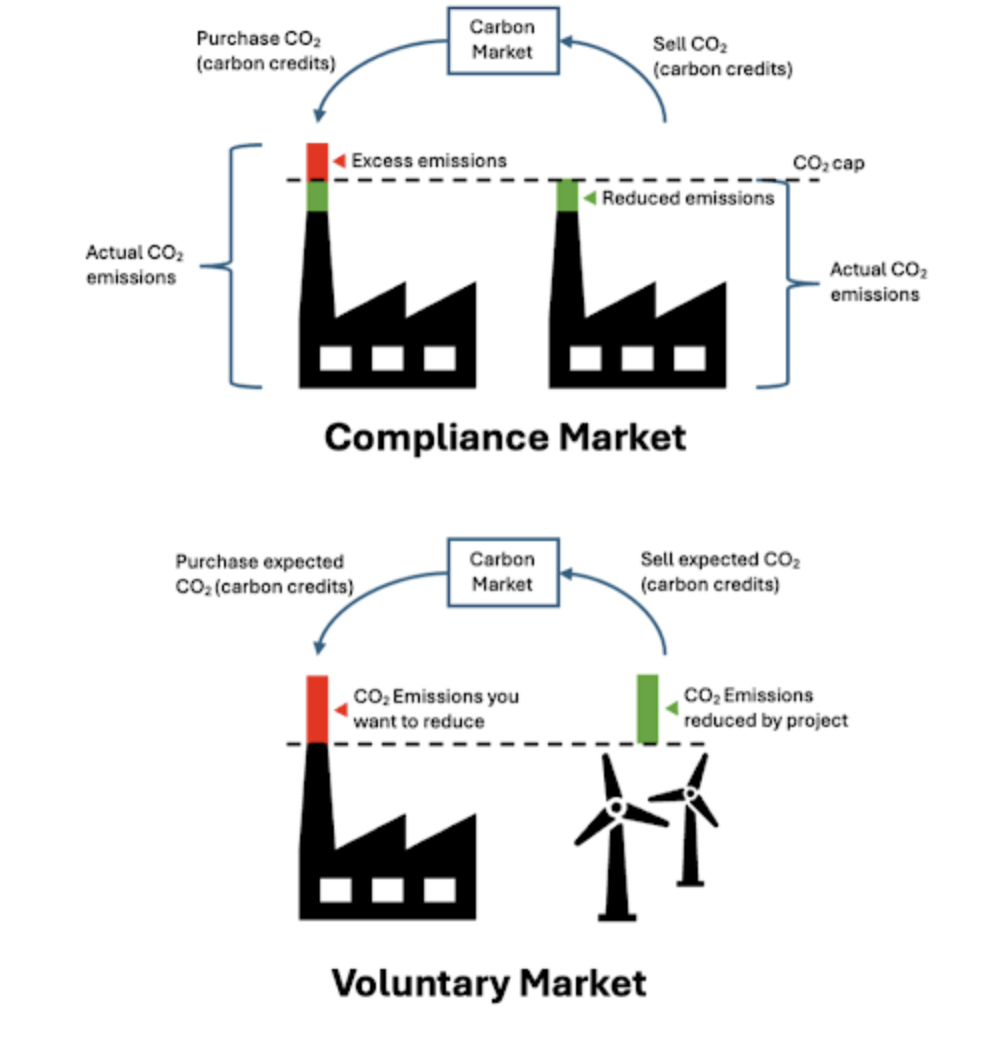
Component | CCUS (Industrial) | Agricultural carbon credits |
Type | Emission reduction | Carbon removal (CDR) |
Source | Point-source (factories) | Diffuse (soil, crops) |
Technology | High-tech, capital-intensive | Nature-based practices |
Beneficiaries | Industries | Farmers |
Market | Compliance / policy-driven | Voluntary carbon markets |
Key conceptual distinction
1. CCUS → Preventing emissions
Works at the source
Example:
Capturing CO₂ from a steel plant chimney
2. CDR (Carbon Dioxide Removal) → Removing existing CO₂
Works through natural processes
Agriculture plays a major role:
Soil carbon storage
Biochar
Agroforestry
Why agriculture is excluded from CCUS roadmap
The DST roadmap explicitly excludes agriculture because:
Emissions are:
Diffuse (spread across land)
Biological (methane, nitrous oxide)
Not suitable for:
Point-source capture technologies
Thus:
Agriculture ≠ CCUS-compatible sector
It belongs to CDR domain
Policy implications
1. Communication gap
Use of term “carbon credit programme” created:
Public misunderstanding
Unrealistic expectations among farmers
2. Industrial decarbonisation priority
Industry contributes ~25% of India’s emissions
CCUS is essential for:
Achieving net-zero targets
Sustaining economic growth
3. Untapped agricultural opportunity
Even though not part of this budget:
Agriculture offers:
Massive carbon sequestration potential
Scope for farmer income diversification
But requires:
Separate policy framework
Measurement, reporting, verification (MRV) systems
Market credibility
Way forward: dual-track climate strategy
Need for a multi-sectoral approach:
Track 1: Industrial (CCUS)
Large-scale funding
Technology deployment
Regulatory support
Track 2: Agriculture (carbon markets)
Dedicated policy
Incentives for farmers
Integration with:
Soil health programmes
Climate-resilient agriculture
Prelims PracticeMCQs
Q. With reference to Carbon Capture, Utilization and Storage (CCUS), consider the following:
It is suitable for sectors where emissions are diffuse and biologically generated.
It is primarily used in hard-to-abate industries.
It involves capturing carbon at the point of emission.
Which of the statements are correct?
(a) 2 and 3 only
(b) 1 and 2 only
(c) 1 and 3 only
(d) 1, 2 and 3
Answer: (a) 2 and 3 only
Explanation:
Statement 1: Incorrect → CCUS works for point sources, not diffuse emissions
Statement 2: Correct → Used in steel, cement, power
Statement 3: Correct → Captures carbon at emission source
Q. Which of the following best distinguishes CCUS from Carbon Dioxide Removal (CDR)?
(a) CCUS removes carbon from atmosphere while CDR prevents emissions
(b) CCUS is nature-based while CDR is technology-based
(c) CCUS prevents new emissions while CDR removes existing atmospheric carbon
(d) Both are identical mechanisms
Answer: (c)
Explanation:
CCUS → Prevention at source
CDR → Removal from atmosphere
Q. The exclusion of agriculture from CCUS strategy is primarily due to:
(a) Lack of financial viability
(b) Political considerations
(c) Diffuse and biologically mediated emissions
(d) Absence of carbon in agriculture
Answer: (c)
Explanation:
Agricultural emissions:
Methane, nitrous oxide
Spread across fields
Not suitable for capture technologies
Q. Consider the following statements regarding carbon markets in India:
Agricultural carbon credits are part of compliance carbon markets.
Voluntary carbon markets allow private participation.
Soil carbon sequestration can generate tradable credits.
Which of the statements are correct?
(a) 2 and 3 only
(b) 1 and 2 only
(c) 1 and 3 only
(d) 1, 2 and 3
Answer: (a) 2 and 3 only
Explanation:
Statement 1: Incorrect → Agriculture mainly in voluntary markets, not compliance
Statement 2: Correct
Statement 3: Correct