
India's exports Conundrum
Context
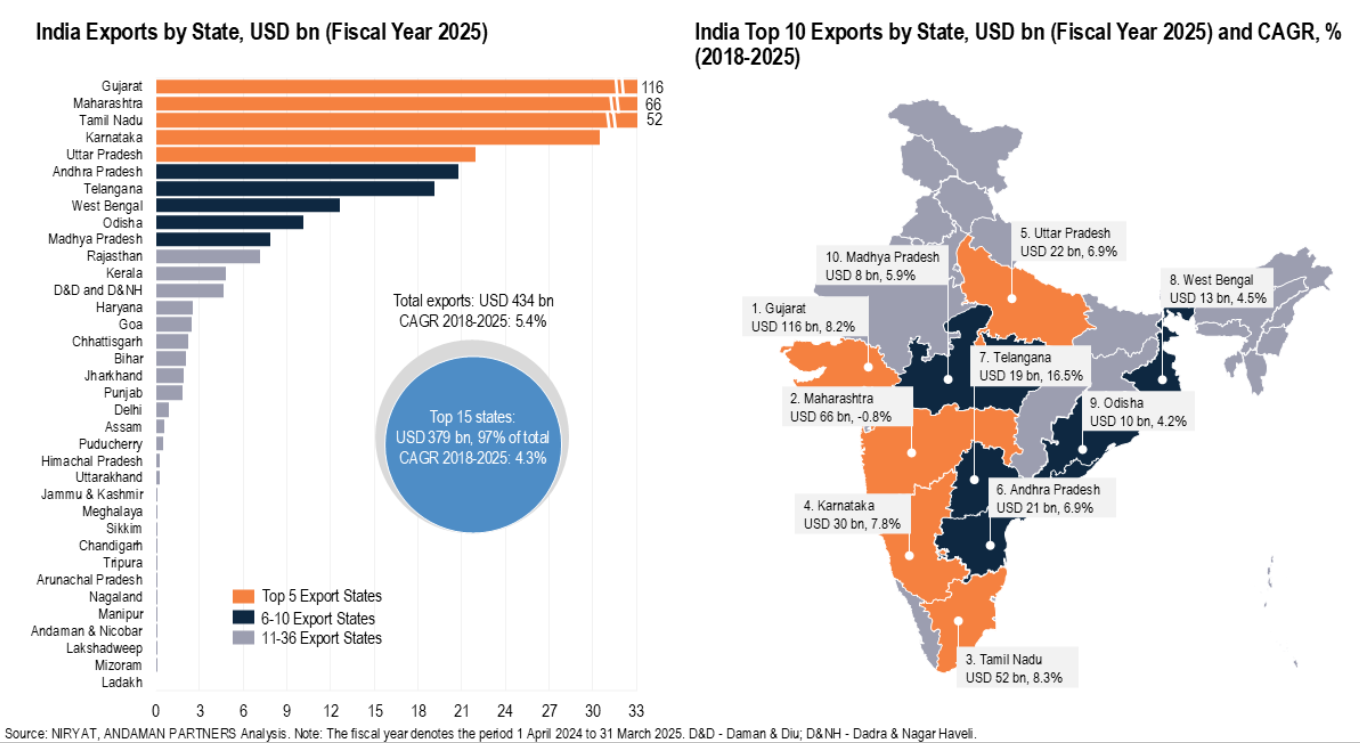
India’s export performance looks strong at the national level, but this success is highly concentrated geographically. A small group of States dominate exports, while large parts of the country remain disconnected from global trade and industrial growth.
Core-periphery pattern in India’s exports
Export concentration
Top five States: Maharashtra, Gujarat, Tamil Nadu, Karnataka, Uttar Pradesh
Together account for nearly 70% of India’s exports
Five years ago, their share was about 65%, showing rising concentration
This creates a core-periphery structure:
Coastal and industrial States integrate deeper into global value chains
Northern and eastern hinterland States lag behind
Measuring concentration
Rising Herfindahl-Hirschman Index (HHI) for export geography
Indicates exports are becoming more agglomerated, not dispersed
Herfindahl–Hirschman Index (HHI) The Herfindahl–Hirschman Index (HHI) is a statistical measure of concentration. It shows how much a market, sector, or activity (such as exports) is dominated by a few players or regions. | ||
Key insight: National averages hide growing regional divergence.
Global context: Why lagging States are not catching up
Shrinking space for labour-intensive exports
Global merchandise trade volume growth has slowed to 0.5–3% (WTO data)
Top 10 exporters control ~55% of global trade (UNCTAD, 2023)
Capital is no longer chasing cheap labour alone.
Instead, it seeks:
High economic complexity
Dense supplier networks
Reliable logistics and institutions
World Trade Organization
UN Trade and Development
Shift from volume to value in exports
Economic complexity logic
Sophisticated products (machinery, automobiles, electronics) cluster in dense “core” product spaces
Regions exporting simple, low-complexity goods face high entry barriers to upgrade
Result:
Advanced regions keep moving up the value chain
Backward regions get locked out
Capital deepening and the broken employment link
End of the old development pathway
Earlier theory assumed:
Exports → Industrialisation → Mass factory employment
This link is now broken.
Evidence from industry
Annual Survey of Industries (ASI) 2022–23:
Fixed capital growth: ~10.6%
Employment growth: ~7.4%
Fixed capital per worker: ₹23.6 lakh
This shows capital deepening: more machines per worker, fewer jobs per unit of output.
Capital deepening means each worker is using more machines, tools, and technology than before. | ||
Labour market confirmation
PLFS findings
Manufacturing employment share stuck at ~11.6–12%
No major shift of workers from agriculture to factories
Employment elasticity of exports has collapsed
Meaning: Export growth no longer guarantees job creation.
Capital over the worker
Wage share in Net Value Added (NVA) is declining
Productivity gains in automated sectors accrue mainly to capital owners
Explains:
High GDP growth in export States
Limited mass prosperity
Even fast-growing sectors like electronics exports (PLI-driven, +47% YoY) remain spatially sticky, concentrated in districts such as Kancheepuram and Noida due to logistics and complexity requirements.
Financial roots of regional divergence
Credit-Deposit (CD) ratio divide
Export hubs (Tamil Nadu, Andhra Pradesh): CD ratio > 90%
Hinterland States (Bihar, eastern Uttar Pradesh): CD ratio < 50%
This implies:
Savings from poorer States are lent to richer industrial regions
A form of internal capital drain
Weak state capacity, low financial depth, and human capital deficits reinforce this vicious cycle.
Prelims Practice MCQs
Q. The rising Herfindahl-Hirschman Index (HHI) of India’s exports indicates:
a) Greater diversification of exports
b) Declining role of coastal States
c) Increasing concentration of exports in few States
d) Equal regional participation in trade
Answer: c
Explanation: A higher HHI reflects greater concentration, not dispersion.
Q. Why is export growth no longer generating mass industrial employment in India?
a) Decline in global demand
b) Capital deepening and automation
c) Excessive labour regulations
d) Rise of services exports
Answer: b
Explanation: Fixed capital is growing faster than employment, reducing labour absorption.
Q. A low Credit-Deposit ratio in hinterland States mainly indicates:
a) Excessive borrowing
b) Capital flight to other regions
c) Higher household consumption
d) Strong industrial investment
Answer: b
Explanation: Deposits are mobilised locally but lent elsewhere.