
India’s Fusion Power Plans – Roadmap by Institute for Plasma Research (IPR) Gandhinagar
Background
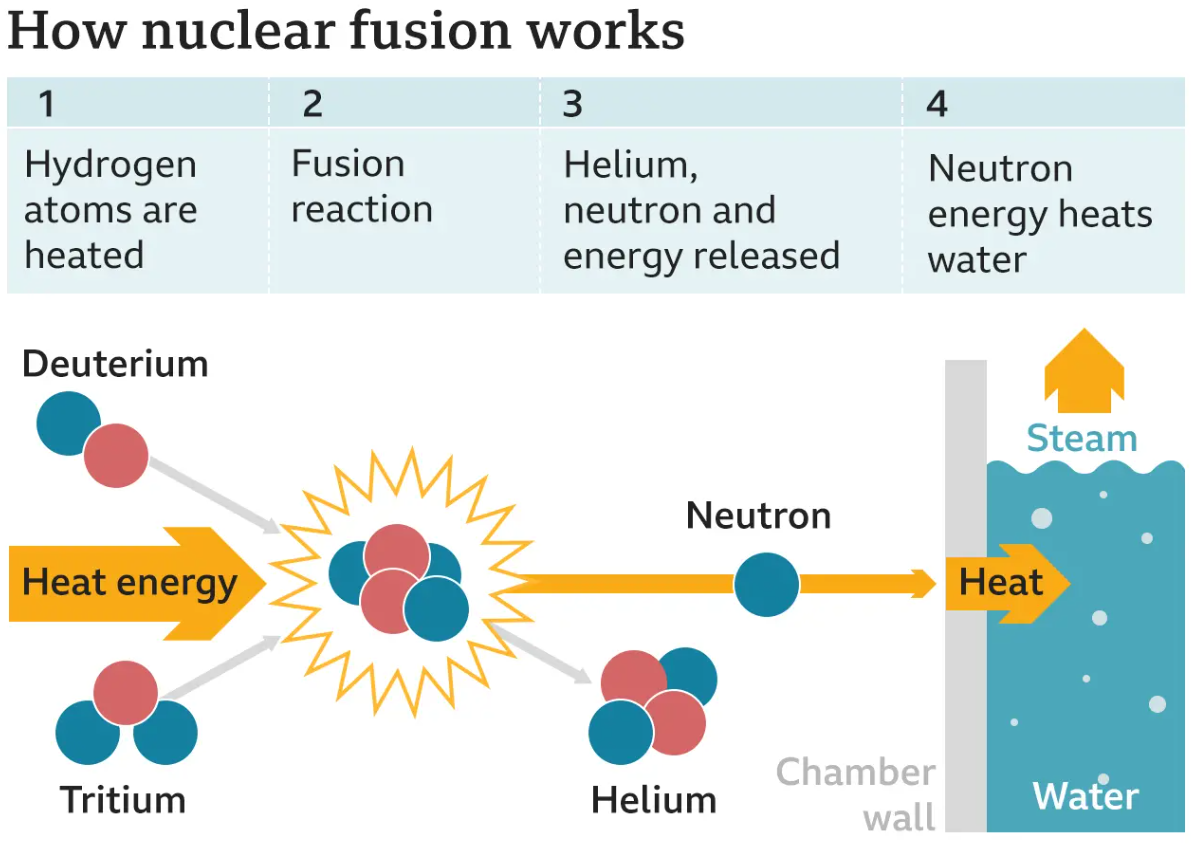
“Fusion is the process where two small, light atoms come together to form a bigger, heavier atom. When this happens, a huge amount of energy is released” (like in stars).
Fusion is cleaner than fission (less radioactive waste).
Requires extreme conditions:
Inertial confinement uses powerful lasers to blast a capsule with X-rays to initiate fusion.
Magnetic confinement works by recreating some of the conditions inside stars.(plasma controlled by strong magnetic fields).
India is part of the ITER Project (France) → magnetic confinement.
The ratio of the output power to the input, called the Q value, determines efficiency.
Current Indian Capacity
SST-1 Tokamak (IPR, Gandhinagar):
Research-only machine.
Produced plasma for ~650 milliseconds (can go up to 16 minutes).
Does not generate electricity.
Proposed Roadmap
SST-Bharat (Steady-state Superconducting Tokamak – Bharat):
SST-1 is a research machine and not meant to generate electricity. SST-Bharat is presented as the next step beyond this experimental base.
India’s first planned fusion electricity generator.
Output-to-input power ratio (Q value) target: 5.
Will be a fusion-fission hybrid:
100 MW from fission.
30 MW from fusion.
Total: 130 MW.
Cost: ₹25,000 crore.
Long-term goal:
By 2060 → Full-scale demonstration reactor.
Q = 20 (commercially viable).
Power output: 250 MW.
Global Context
ITER aims to achieve a Q of 10. Future fusion power plants are expected to achieve a value of 20 to be commercially feasible.
Digital Twinning: To strengthen the new roadmap, the researchers have proposed digital twins — virtual replicas of physical systems that mimic real-time conditions inside a tokamak
ITER (France): aims for Q = 10.
UK STEP programme: prototype fusion plant by 2040.
US start-ups: claim grid-connected fusion by 2030s.
China’s EAST: record plasma duration.
India’s timeline: 2060 → slower, cautious approach.
Challenges
Technical: Sustaining plasma (needs 100 million °C vs Sun’s 15 million °C).
Economic: Fusion power is very costly (R&D, construction, operation).
Policy:
India’s funding modest (public sector only).
Private sector absent, unlike US/EU/China.
Competes with other priorities:
Net Zero 2070.
Solar, wind, and fission expansion.
Innovation Pathways
Digital twins: virtual replicas to simulate tokamak conditions.
Machine learning: assist plasma confinement.
Radiation-resistant materials: to withstand extreme conditions.
Superconducting magnets, plasma modelling, high-temp engineering → spin-offs for industry and defence.
Significance
Even if commercial fusion is delayed:
Boosts scientific capabilities.
Strengthens technological autonomy.
Strategic dividends (materials, magnets, plasma tech).
Enhances India’s role in global fusion research.