
India’s Updated Climate Targets (NDC)
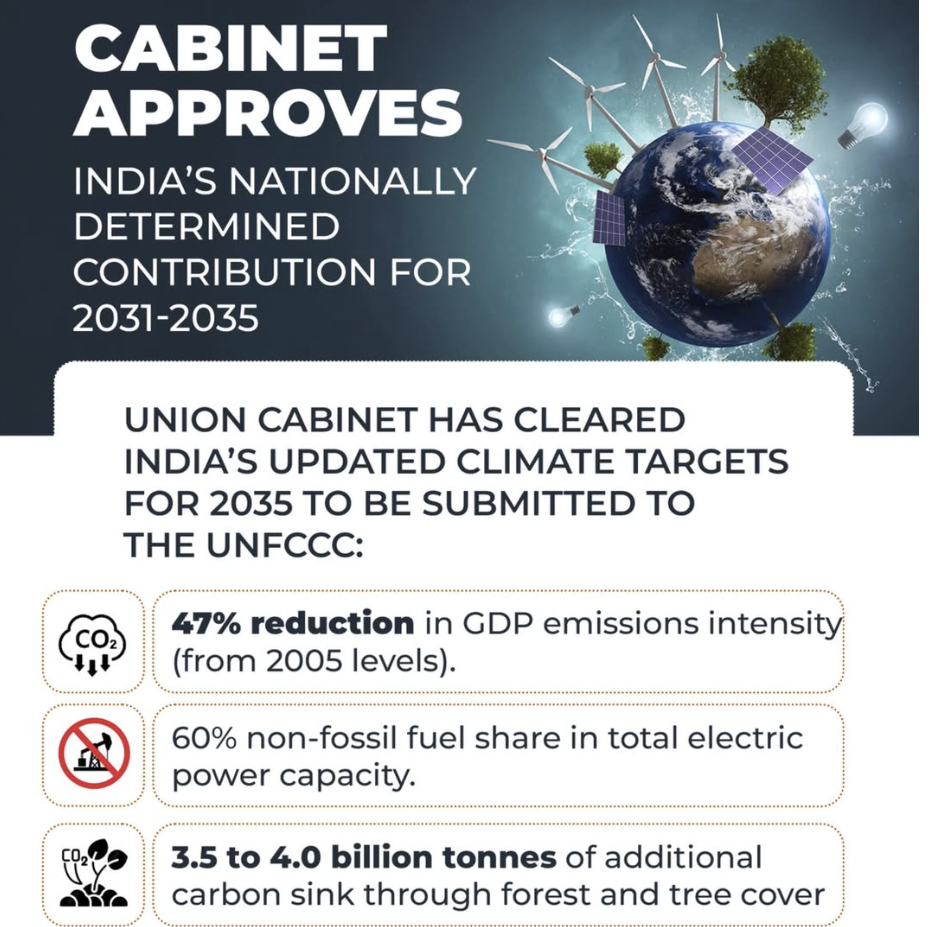
1. What is NDC?
United Nations Framework Convention on Climate Change (UNFCCC) requires countries to submit climate action plans.
These are called Nationally Determined Contributions (NDCs).
They are voluntary commitments under the Paris Agreement.
2. India’s Updated Targets (2035)
60% installed electricity capacity from non-fossil sources
47% reduction in emissions intensity (from 2005 level)
Carbon sink: 3.5–4 billion tonnes CO₂ equivalent
3. Existing Targets (2030 – Updated in 2022)
50% installed capacity from non-fossil sources
44% reduction in emissions intensity
Carbon sink: 2.5–3 billion tonnes CO₂ equivalent
4. Current Status
~52% installed capacity already non-fossil (target achieved early)
But only ~25% actual electricity generation is non-fossil
Emissions intensity reduction: ~36% achieved (2005–2020)
Carbon sink created: 1.97 billion tonnes CO₂ equivalent
Forest & tree cover: 24.6% (2021)
Target: 33% (National Forest Policy)
- Under its Climate Action framework, India’s NDC is operationalized through the National Action Plan on Climate Change (NAPCC) and its nine national missions, as well as the State Action Plans on Climate Change (SAPCC). The framework is implemented in convergence with various schemes and programs of the central and State Governments ensuring a coordinated, whole of government approach for climate-resilient and low-carbon development.
5. Key Concepts
Installed Capacity vs Generation
Installed capacity ≠ actual electricity produced
Renewable sources (solar/wind) are intermittent
Carbon Sink
Forests absorb CO₂ → reduce net emissions
India relying heavily on afforestation
Emissions Intensity
Measures emissions per unit of GDP
Lower intensity = more efficient, cleaner economy
Common but Differentiated Responsibilities
Developed countries bear greater responsibility
India uses this principle in negotiations
Global Stocktake (GST) (UPSC CAPF 2024 PYQ)
The Global Stocktake is a periodic review mechanism established under the Paris Agreement in 2015.
Established under Article 14 of the Paris Agreement
The Global Stocktake (GST) is a critical UNFCCC mechanism under the Paris Agreement designed to assess collective progress toward long-term climate goals every five years. It evaluates mitigation, adaptation, and finance, identifying gaps to accelerate action. The first GST concluded at COP28 in 2023, urging accelerated action to keep 1.5°C within reach.
6. Conference of Parties (CoP)
Annual climate meeting under UNFCCC
Example: CoP30 (Brazil, Belém)
Decisions on global climate policy
Prelims Practice MCQs
Q. With reference to India’s updated NDC targets, consider the following:
India aims to achieve 60% non-fossil fuel installed capacity by 2035.
India aims to reduce emissions intensity by 47% from 2015 levels.
India aims to create a carbon sink of up to 4 billion tonnes.
Which of the above are correct?
(a) 1 and 3 only
(b) 1 and 2 only
(c) 2 and 3 only
(d) 1, 2 and 3
Answer: (a)
Explanation:
Statement 1 → Correct
Statement 2 → Wrong (base year is 2005, not 2015)
Statement 3 → Correct
Q. Which of the following best describes “emissions intensity”?
(a) Total emissions produced by a country
(b) Emissions per unit of GDP
(c) Emissions per capita
(d) Emissions from fossil fuels only
Answer: (b)
Explanation:
Emissions intensity = emissions/GDP
Indicates efficiency of economy, not absolute emissions
Q. Consider the following statements:
Installed electricity capacity and actual electricity generation are always equal.
Renewable energy sources contribute equally to capacity and generation.
Which is/are correct?
(a) 1 only
(b) 2 only
(c) Neither 1 nor 2
(d) Both 1 and 2
Answer: (c)
Explanation:
Installed capacity ≠ generation
Renewables (solar/wind) are intermittent → lower generation share