
Indian Wolf (Canis lupus pallipes)
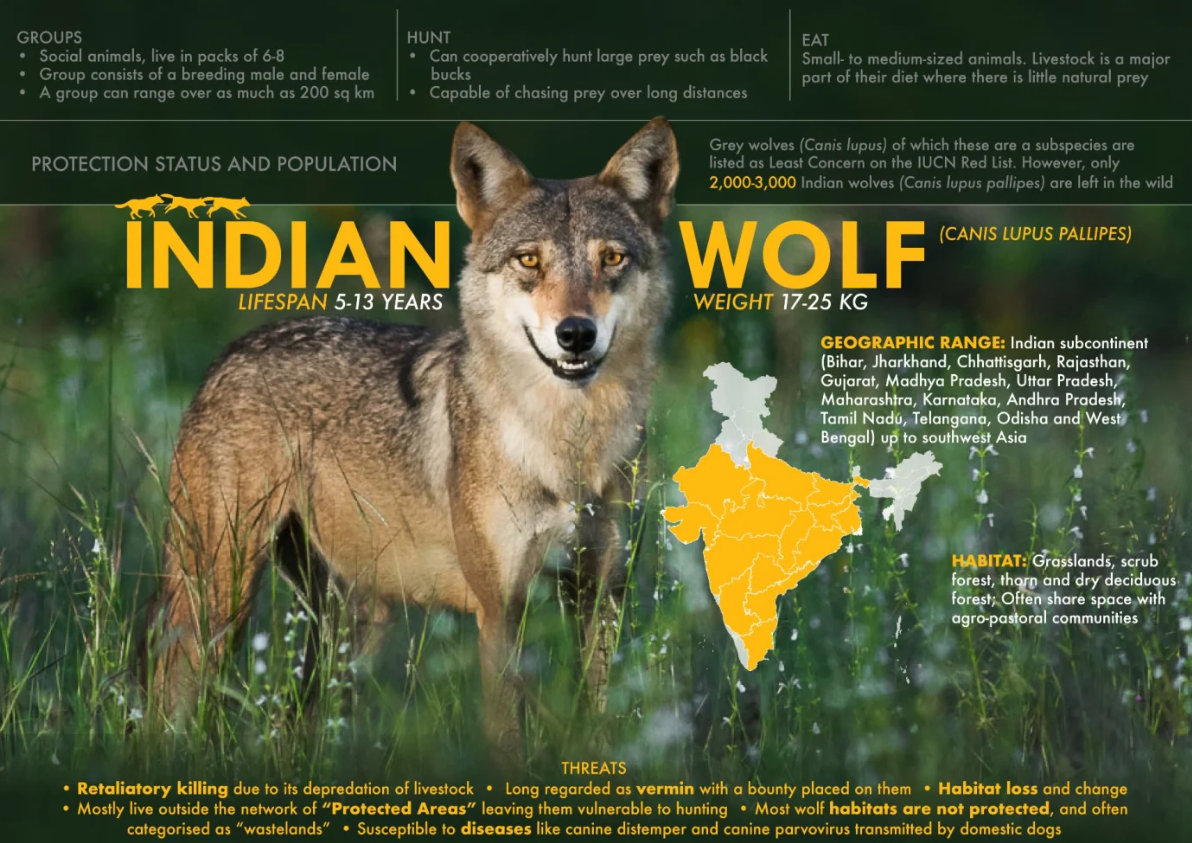
1. Current Context
The International Union for Conservation of Nature (IUCN) is likely to reclassify the Indian wolf as a new species, distinct from the grey wolf (Canis lupus).
India and Pakistan together host around 3,000 individuals.
The species has now been listed as “Vulnerable” on the IUCN Red List.
2. Taxonomy and Lineage
Earlier considered a subspecies of the Grey Wolf, the Indian wolf is now recognised to possess the oldest living lineage among wolves worldwide.
Scientific name: Canis lupus pallipes.
Distribution: Semi-arid scrublands and grasslands of India and Pakistan.
3. Key Ecological Features
Habitat: Open dry scrublands, grasslands, and semi-arid regions.
Diet: Predominantly preys on small ungulates and livestock due to depleted wild prey base.
Behaviour: Shy, elusive, not known to attack humans except in rare cases.
4. Conservation Status
Category | Details |
IUCN Status | Vulnerable (under revision for separate species recognition) |
Indian Wildlife (Protection) Act, 1972 | Schedule I – highest legal protection |
Estimated Population | ~3,000 (India & Pakistan) |
5. Major Threats
Habitat Loss:
Conversion of grasslands for solar farms, highways, and renewable energy projects (e.g., Adani Solar Farm, Kutch).
Retaliatory Killings:
Poisoned by villagers for livestock predation.
Prey Base Depletion:
Decline of blackbuck and chinkara populations.
Human–Wolf Conflict:
Notable incidents in Bahraich (Uttar Pradesh) in 1996 and 2024–25; 6 deaths, 30 injured.
Prelims Practice MCQ
Q. Which of the following correctly describes the unique evolutionary position of the Indian wolf?
A) It is a hybrid between the grey wolf and the Asiatic wild dog.
B) It represents the oldest living lineage of wolves globally.
C) It evolved from the Himalayan wolf population during the Pleistocene era.
D) It is the only surviving wolf species found exclusively in tropical regions.
Answer: B
Explanation:
Genetic research indicates that the Indian wolf has the oldest surviving lineage among all wolf species, preceding the diversification of the modern grey wolf.
Q. Consider the following threats faced by the Indian wolf:
Poisoning due to livestock predation conflicts
Loss of habitat due to renewable energy projects
Depletion of wild prey base
Poaching for fur trade
Which of the above are major current threats to the Indian wolf population?
A) 1, 2 and 3 only
B) 1, 3 and 4 only
C) 2 and 4 only
D) 1, 2, 3 and 4
Answer: A
Explanation:
Poaching for fur is not a major threat in India. The key pressures include retaliatory poisoning, habitat loss (solar farms, highways), and prey depletion in semi-arid grasslands.