
Indo-Bhutan River Commission Demand by West Bengal CM
Context:
-
West Bengal CM Mamata Banerjee has reiterated the demand for an Indo-Bhutan River Commission with West Bengal as a member.
-
The demand arises due to recurring flooding in north Bengal districts like Jalpaiguri, Alipurduar, and Malda caused by rivers flowing from Bhutan (notably Sankosh River) and Nepal, as well as the Teesta from Sikkim.

Key Issues Highlighted
-
Transboundary Rivers Impact
-
Bhutan’s Sankosh River floods Jalpaiguri and Alipurduar.
-
Other rivers from Bhutan, Nepal, and Sikkim’s Teesta increase flood risks in north Bengal.
-
Damodar Valley Corporation (DVC) water releases contribute to “man-made floods” in south Bengal.
-
-
Terrain Vulnerability
-
CM described Bengal’s terrain as “like that of a boat,” highlighting its low-lying deltaic geography, prone to overflow from rivers such as the Ganga, which also carries water inflows from UP and Bihar.
-
-
Centre-State Dynamics
-
CM accused the Centre of neglecting Bengal’s flood concerns, stating that no flood-control funds were allocated to Bengal in the Union Budget, while Assam received support.
-
Emphasis that flood disasters have inter-regional effects and require national-level planning.
-
Current Indo-Bhutan Flood Management Framework
-
As per the Ministry of Jal Shakti (reply in Parliament):
-
No proposal for a formal Indo-Bhutan River Commission.
-
Existing mechanisms include:
-
Joint Group of Experts (JGE) on flood management.
-
Joint Technical Team (JTT) on flood management.
-
Joint Experts Team on flood forecasting.
-
-
These teams meet regularly to discuss trans-border river issues.
-
Significance of Proposed Indo-Bhutan River Commission
-
State Representation: Would allow West Bengal to directly participate in transboundary flood management decisions.
-
Integrated Flood Governance: Move beyond expert-level technical talks to a permanent institutional mechanism.
-
Bilateral & Federal Coordination: Strengthen India-Bhutan cooperation while addressing Centre-State concerns.
-
Disaster Preparedness: Helps Bengal manage impending flood dangers in both north and south regions.
Major Rivers Originating in Bhutan and Flowing into India
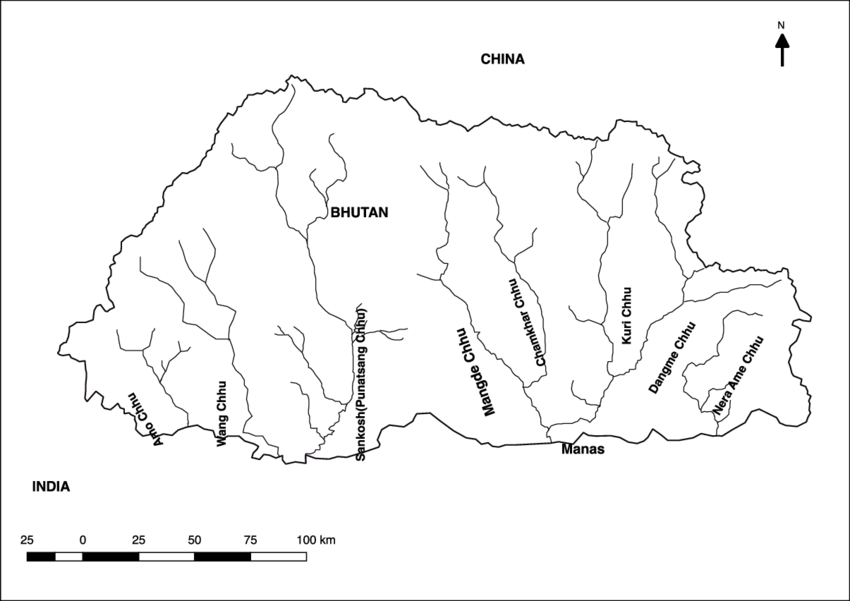
Bhutan is home to several transboundary rivers that play a crucial role in the hydrology, irrigation, ecology, and flood dynamics of eastern India, particularly Assam and West Bengal.
Key Rivers
-
Manas River (Drangme Chhu)
-
Largest river system of Bhutan.
-
Flows through southern Bhutan → western Assam, India → joins Brahmaputra.
-
Known for Manas National Park (UNESCO site) along its course in Assam.
-
-
Sankosh River (Puna Tsang Chhu)
-
Originates in northern Bhutan.
-
Flows into Assam and West Bengal, forming a boundary between some districts.
-
Eventually merges with the Brahmaputra.
-
Causes recurring floods in Jalpaiguri and Alipurduar (West Bengal).
-
-
Raidak River (Wang Chhu)
-
Crosses Bhutan → India (Cooch Behar, West Bengal) → Bangladesh.
-
Tributary of the Brahmaputra.
-
Supports irrigation and agriculture in North Bengal and Bangladesh.
-
-
Torsa River (Amo Chhu)
-
Major river of western Bhutan.
-
Enters India through West Bengal (Jalpaiguri, Cooch Behar).
-
Joins the Brahmaputra.
-
Known for frequent floods in Dooars region of Bengal.
-