
INSV Kaundinya
Context
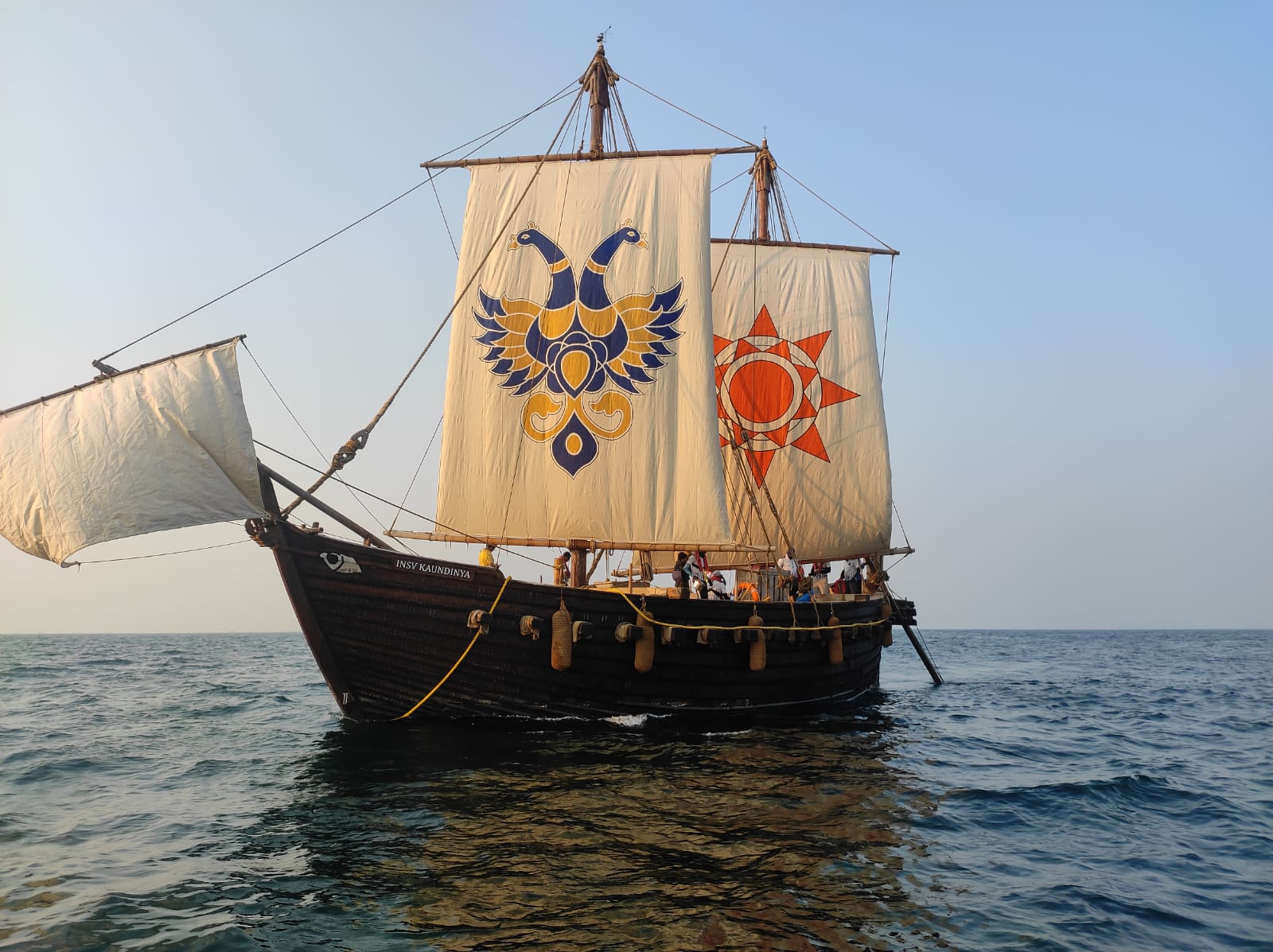
INSV Kaundinya is an Indian Navy sailing vessel constructed using the ancient sewn ship technique. It represents a revival of India’s maritime heritage and indigenous shipbuilding knowledge.
Maiden voyage from Porbandar to Muscat, Oman
Historical Inspiration
The design is based on a 5th century CE merchant ship depicted in the murals of Ajanta Caves, specifically Cave 17.
These murals provide rare visual evidence of early Indian ocean-going vessels engaged in long-distance trade.

The vessel is named after Kaundinya (also known as Kaundinya I).
He was a legendary first-century Indian mariner who sailed to Southeast Asia.
According to tradition, he married Queen Soma and became the second king of Funan, an early polity located largely in present-day Cambodia.
The name symbolises India’s ancient maritime links with Southeast Asia.
Shipbuilding Technique: Sewn Construction
Ancient Indian ships often avoided metallic nails to prevent corrosion, especially in saline marine environments.
Instead, natural fibres such as coir were used to stitch wooden planks together.
This method is part of a wider global tradition of sewn boats but has strong indigenous roots in India.
Literary Evidence
The use of natural fibres and sewn construction is mentioned in Yukti Kalpataru,
an 11th century encyclopedic text on Indian craftsmanship, architecture, and technology.This provides textual validation of India’s advanced traditional shipbuilding knowledge.
Tankai Method of Construction
INSV Kaundinya follows the Tankai method, an indigenous Indian shipbuilding practice.
Key features of the Tankai method:
Hull is stitched first using coir ropes.
Wooden ribs are added later for structural strength.
No metal is used in the construction process.
This contrasts with the frame-first method common in later European shipbuilding.
Propulsion and Crew
The vessel is powered entirely by sails, with no engine support.
It is crewed by around 15 sailors, specially trained to operate the ship under traditional sailing conditions, including wind navigation and manual seamanship.
Significance
Demonstrates India’s ancient maritime technology and ocean-going capability.
Strengthens cultural diplomacy by highlighting historical India–Southeast Asia links.
Serves as a floating laboratory for understanding pre-modern navigation, trade, and ship design.
Prelims Practice MCQs
Q. INSV Kaundinya derives its design inspiration from:
A. Archaeological remains found at Lothal dockyard
B. Descriptions in the Arthashastra
C. Murals depicting a merchant ship in Ajanta Caves
D. Chinese traveller accounts of Indian ships
Correct Answer: C
Explanation:
INSV Kaundinya is designed based on a 5th century CE merchant ship depicted in the murals of Cave 17 of the Ajanta Caves. These murals provide visual evidence of early Indian maritime technology.
Lothal (A) is an archaeological dockyard, not the design source.
Arthashastra (B) discusses trade and administration, not ship design.
Chinese accounts (D) are historical sources but not the design basis.
Q. The Tankai method of ship construction, followed in building INSV Kaundinya, is characterised by:
A. Frame-first construction followed by planking
B. Use of iron clamps for structural stability
C. Hull stitched first, ribs added later
D. Exclusive use of bamboo and reeds
Correct Answer: C
Explanation:
The Tankai method is an indigenous Indian technique where:
The hull is stitched first using natural fibres.
Ribs are inserted later for strength.
Metal is completely avoided.
This differs from the frame-first approach common in later European shipbuilding.