
Janjatiya Gaurav Diwas 2025
Background
Janjatiya Gaurav Diwas (Tribal Pride Day) is observed on November 15 every year.
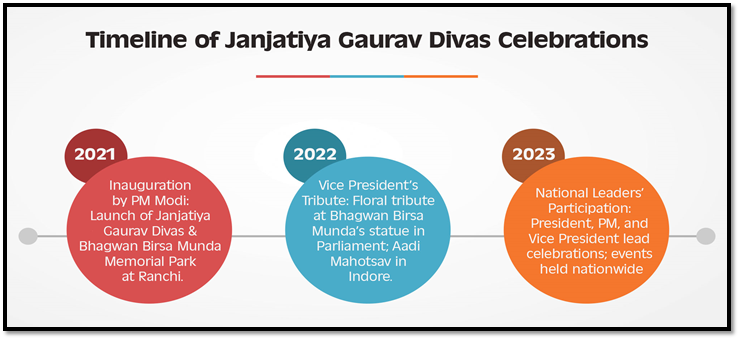
First celebrated: 2021
Declared during: Azadi Ka Amrit Mahotsav (75 years of India’s Independence).
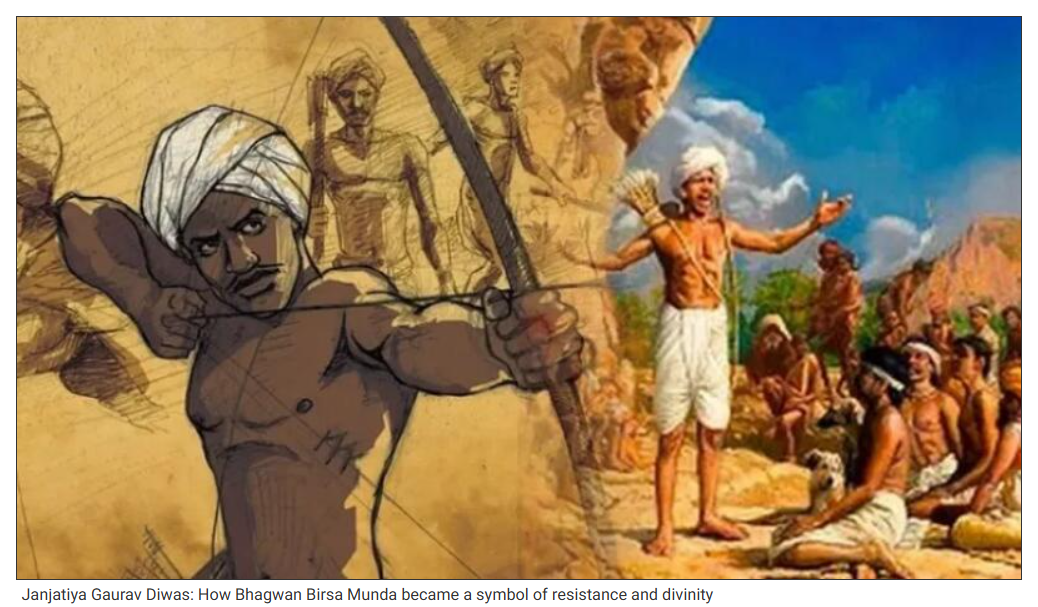
Marks the birth anniversary of tribal freedom fighter Birsa Munda.
2025 marks the end of the 150th birth anniversary year of Birsa Munda (born in 1875).
Government Directions
Union Tribal Affairs Ministry has directed States and Union Territories to organize commemorative events between November 1–15, 2025.
Events to be held at State and District levels.
Activities
Launch/benefit disbursal of tribal-focused schemes, especially:
PM-JANMAN
Dharti Aba Janjatiya Gram Utkarsh Abhiyan
Adi Karmayogi Abhiyan
Inauguration of tribal welfare projects and capacity-building programmes.
Tribal Village Vision 2030 document display under Adi Karmayogi Scheme.
Painting exhibitions by Eklavya Model Residential School students.
Adi Haats for tribal artisans, SHGs, and Van Dhan Vikas Kendras.
Health awareness campaigns through Mobile Medical Units.
School & college contests to celebrate tribal heritage.
Saturation campaigns for delivery of individual entitlements.
About Birsa Munda
Tribal freedom fighter from Chotanagpur Plateau region (Jharkhand).
Led the Ulgulan (Great Tumult) Movement against British exploitation.
Revered as “Dharti Aba” (Father of the Earth) among tribal communities.
Munda Rebellion (Ulgulan), 1899–1900
Overview
Leader: Birsa Munda
Duration: 1899–1900
Region: Chotanagpur plateau (present-day Jharkhand)
Nature: Tribal uprising against British colonial rule and local exploiters (zamindars, moneylenders, missionaries).
Meaning of “Ulgulan” - “Great Tumult” or “Revolution”.
Aim: Establishment of “Munda Raj” — self-rule and revival of Munda socio-cultural identity.
Causes of Rebellion
Land Alienation:
British replaced the Khuntkatti system (community ownership of land) with the Zamindari system.
Non-tribal landlords and moneylenders dispossessed tribals of land.
Economic Exploitation:
Heavy taxes, bonded labour (Beth Begari), and forced eviction.
Deprivation of forest rights and resources.
Cultural & Religious Factors:
Missionary influence and external interference in tribal traditions.
Birsa preached revival of traditional faith (Birsait movement) rejecting both British and missionary domination.
Political Aspirations:
Desire to overthrow foreign rule and establish a sovereign tribal kingdom (Munda Raj).
Course of the Rebellion
Armed tribal uprising: attacks on police stations, landlords, missionaries, and British establishments.
Use of traditional weapons – bows, arrows, axes, etc.
Spread across Ranchi, Singhbhum, and Hazaribagh districts.
British eventually suppressed the movement; Birsa Munda was captured and died in jail (1900) under suspicious circumstances.
Outcomes and Legacy
Although suppressed, it exposed the exploitation of tribal communities.
Led to reforms like the Chotanagpur Tenancy Act (1908) — protected tribal land rights from transfer to non-tribals.
Birsa Munda became a symbol of tribal resistance and a folk hero.
His birth anniversary (November 15) is celebrated as Janjatiya Gaurav Diwas.
Major Tribal Freedom Movements in India
Movement / Rebellion | Period | Region (Present-day) | Leader(s) | Significance / Nature of Revolt |
Santhal Rebellion | 1855–56 | Jharkhand, West Bengal (Rajmahal Hills) | Sidhu & Kanhu Murmu | Revolt against British land policies, moneylenders, and zamindars exploiting Santhal tribes. One of the largest tribal uprisings before 1857. |
Kol Uprising | 1831–32 | Chotanagpur Plateau (Jharkhand) | Budhu Bhagat | Protest against British interference in traditional land systems and exploitation by outsiders. |
Bhil Revolt | 1818–31 | Western India (Rajasthan, Gujarat, Madhya Pradesh, Maharashtra) | Govind Guru, Tantya Bhil | Revolt against British oppression and feudal landlords; demanded restoration of land and dignity. |
Khasi Rebellion | 1829–33 | Meghalaya (Khasi Hills) | Tirot Singh | Revolt against British attempt to control Khasi territory and build a road through their hills. |
Tamar Revolt | 1789–1832 (peak in early 1800s) | Tamar region, Jharkhand | Ganga Narayan Singh / Thakur Vishwanath Shahdeo / Tikait Umrao Singh (local tribal leaders) | Revolt against British revenue settlements and exploitation of Munda and Oraon farmers. Often seen as precursor to later tribal uprisings. |
Mizo Resistance | 1890s | Mizoram | Laldenga’s ancestors / Mizo chiefs | Resistance against British annexation and attempts to control Mizo Hills. |
Ulgulan (Munda Rebellion) | 1899–1900 | Chotanagpur (Jharkhand) | Birsa Munda | Revolt to establish Munda Raj, resist British rule, missionary influence, and reclaim tribal land rights (Khuntkatti system). |
Prelims Practice MCQ
Q. Consider the following statements regarding Janjatiya Gaurav Divas:
It was first celebrated in 2019 to commemorate the 150th birth anniversary of Birsa Munda.
It was declared during the Azadi Ka Amrit Mahotsav in 2021.
The day honors tribal freedom fighters and celebrates the heritage of India’s tribal communities.
Which of the statements given above is/are correct?
(a) 1 and 2 only
(b) 2 and 3 only ✅
(c) 1 and 3 only
(d) 3 only
Q. Consider the following pairs:
Tribal Revolt | Leader |
1. Santhal Rebellion | Sidhu & Kanhu Murmu |
2. Kol Uprising | Budhu Bhagat |
3. Bhil Revolt | Tantya Bhil |
4. Khasi Rebellion | Tirot Singh |
5. Ulgulan | Birsa Munda |
6. Tamar Revolt | Tikait Umrao Singh |
How many of the pairs given above are correctly matched?
(a) Three
(b) Four
(c) Five
(d) All six
✅ All six pairs are correctly matched.
Answer: (d) All six
Q. Which one of the following correctly matches the celebration with its purpose?
Day | Purpose |
(a) Janjatiya Gaurav Divas | To honor tribal freedom fighters |
(b) Parakram Diwas | To celebrate India’s Constitution Day |
(c) Ekta Diwas | To commemorate the Quit India Movement |
(d) Veer Bal Diwas | To celebrate the birth of Mahatma Gandhi |
✅ Correct Answer: (a) Janjatiya Gaurav Divas – To honor tribal freedom fighters
Explanation:
Day / Celebration | Date | Purpose / Significance |
(a) Janjatiya Gaurav Divas | 15th November | Celebrates the birth anniversary of Bhagwan Birsa Munda and honors the contribution of tribal freedom fighters across India. Declared in 2021 as part of Azadi Ka Amrit Mahotsav. ✅ |
(b) Parakram Diwas | 23rd January | Marks the birth anniversary of Netaji Subhas Chandra Bose to honor his courage and leadership. ❌ |
(c) Ekta Diwas | 31st October | Commemorates Sardar Vallabhbhai Patel’s birth anniversary, symbolizing national unity and integrity. ❌ |
(d) Veer Bal Diwas | 26th December | Observed to honor the martyrdom of Guru Gobind Singh Ji’s four sons (Sahibzadas). ❌ |