
Kavach anti-collision system on Indian Railways
Context
Union Railway Minister informed the Lok Sabha that the indigenous anti-collision Kavach safety system had been fully commissioned on over 2,000 km of the rail network.
Progress achieved so far
Infrastructure created
Optical Fibre Cable (OFC) laid: 7,129 km
Telecom towers installed: 860
Stations connected to data centres: 767
Track-side equipment deployed: 3,413 km
Locomotives equipped with Kavach: 4,154
Human resource
Around 40,000 technicians and operators trained
Training required due to:
High system complexity
Integration with signalling, telecom, and rolling stock
What is Kavach?
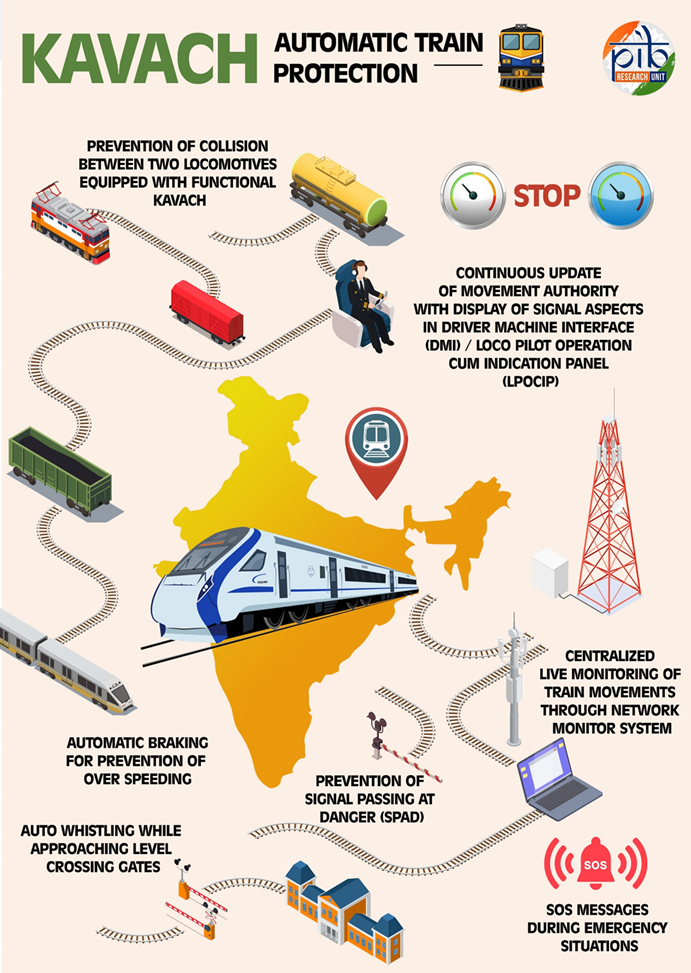
Kavach is an indigenously developed Automatic Train Protection (ATP) system designed to prevent train collisions and enhance operational safety on Indian Railways.
Kavach was developed by the Research Designs and Standards Organisation (RDSO) of Indian Railways,
in collaboration with Indian industry partners.RDSO functions under the Ministry of Railways
Kavach was earlier known as Train Collision Avoidance System (TCAS)
It aligns with Atmanirbhar Bharat by reducing dependence on imported ATP systems.

Objectives of Kavach
Prevent:
Train-to-train collisions
Overspeeding
Signal Passing at Danger (SPAD)
Enhance:
Passenger safety
Operational reliability
Real-time decision-making
Key features of Kavach
1. Collision prevention
Automatically applies emergency brakes if:
Two trains are on the same track
A train crosses a red signal
Speed exceeds permissible limits
2. Overspeed protection
Monitors train speed continuously
Enforces speed restrictions automatically
3. Signal compliance
Interacts with signalling system
Prevents human error in signal interpretation
4. Driver assistance
Provides audio-visual alerts in the cab
Enhances situational awareness
Major components of Kavach (ATP architecture)
Kavach is a system-of-systems, comprising five major components:
On-board equipment
Installed on locomotives
Computes braking curves
Communicates with track and station systems
Track-side equipment
- Radio Frequency Identification (RFID) tags for every 1 KM
Balises and radio units along tracks
Station equipment
Interfaces with signalling systems
Controls movement authority
Telecom network
Dedicated telecom towers
Continuous wireless communication
Optical Fibre Cable (OFC) backbone
Enables real-time data exchange
Connects stations to data centres
Why Kavach is complex
Requires:
Continuous OFC laying along tracks
Integration with legacy signalling systems
Installation across locomotives, stations, and tracks
Must function in:
High-density traffic conditions
Mixed rolling stock environment
Entirely fail-safe, with redundancy
Kavach vs global ATP systems
Component | Kavach | ETCS (Europe) |
Origin | Indigenous (India) | European |
Cost | Lower | High |
Adaptation | Indian conditions | European rail systems |
Status | Rapid deployment | Mature system |
Prelims Practice MCQs
Q. With reference to Kavach, consider the following statements:
Kavach is an indigenously developed Automatic Train Protection system.
It can automatically apply brakes to prevent collisions and overspeeding.
It functions without integration with signalling systems.
Which of the statements given above are correct?
(a) 1 and 2 only
(b) 1 and 3 only
(c) 2 and 3 only
(d) 1, 2 and 3
Answer: (a)
Q. With reference to Kavach, consider the following statements:
Kavach is an indigenously developed Automatic Train Protection (ATP) system.
It has been designed by the Research Designs and Standards Organisation (RDSO) under Indian Railways.
It was developed with participation of domestic manufacturers.
Kavach replaces the existing railway signalling system in India.
Which of the statements given above are correct?
(a) 1, 2 and 3 only
(b) 1 and 2 only
(c) 2 and 4 only
(d) 1, 2, 3 and 4
Answer: (a)
Explanation:
Statements 1, 2 and 3 are correct. Kavach is an indigenous ATP system designed by RDSO with industry participation.
Statement 4 is incorrect because Kavach works alongside existing signalling systems; it does not replace them.