
Kaziranga National Park & Tiger Reserve – Beyond the Rhino
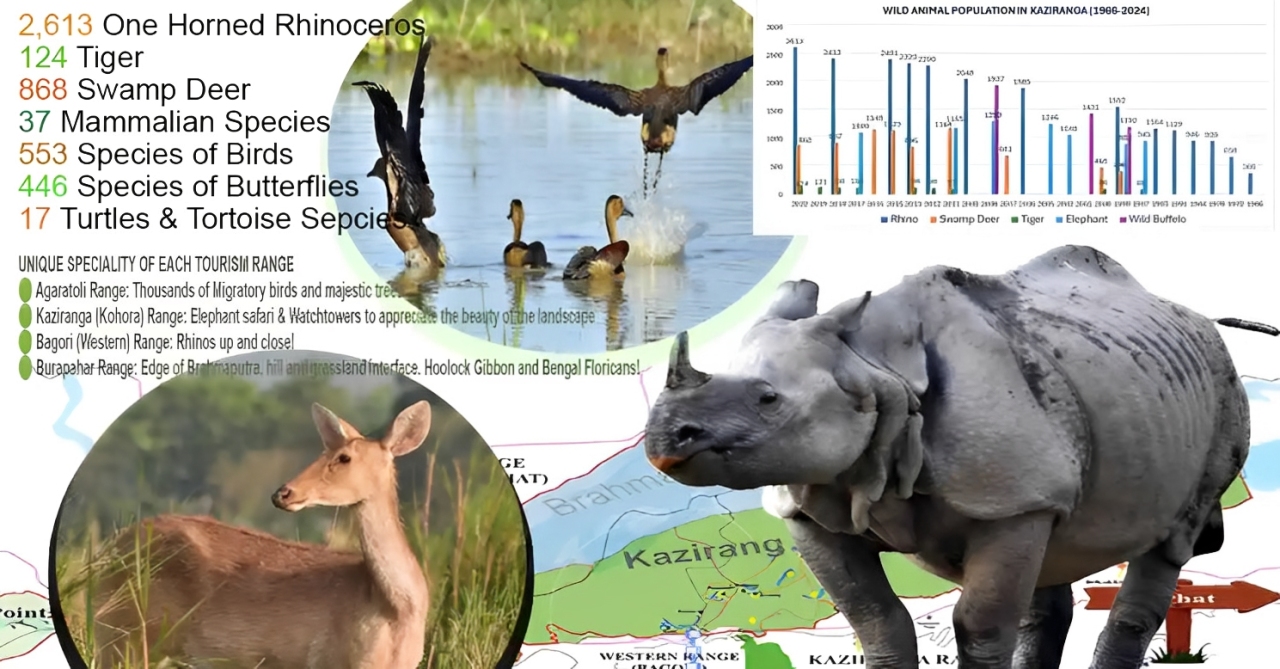
Context:
A 2024 rapid survey by the Corbett Foundation and Kaziranga’s forest staff has documented overlooked biodiversity in Kaziranga.
Key Findings:
Total species: 283
Insects: 254 species
Spiders: 29 species
Breakdown of insects:
Butterflies & moths – 85 species (30%)
Ants, bees & wasps – 40 species (14%)
Beetles – 35 species (12%)
Ecological Importance:
Insects & spiders support ecosystem by:
Pollination, seed dispersal
Soil aeration, plant regeneration
Natural pest control
Base of food chain for megafauna
Conservation Concerns:
Nearly 40% of global insect species are declining due to habitat loss, deforestation, climate change.
Kaziranga’s resilience depends not only on megafauna (Big Five) but also on microfauna.
Kaziranga Overview:
Location: Assam
Area: 1,307.49 sq. km
UNESCO World Heritage Site (1985)
Big Five: Indian rhinoceros, Bengal tiger, Asian elephant, wild water buffalo, eastern swamp deer.
Rhino population: 2,613 (largest in the world).
Tiger density: 18.65 per 100 sq. km (3rd highest in India, 2024).
Declared as tiger reserve in 2006

UPSC Prelims Practice Question
Q. With reference to Kaziranga National Park and Tiger Reserve, consider the following statements:
A 2024 survey recorded over 250 insect species and nearly 30 spider species in the park.
Butterflies and moths constitute the largest share of insect diversity recorded in the survey.
Kaziranga has the world’s largest population of one-horned rhinoceroses.
It has the highest tiger density in India as per 2024 estimates.
Which of the statements given above are correct?
A. 1, 2 and 3 only
B. 1 and 3 only
C. 1, 2, 3 and 4
D. 2 and 4 only
Answer: A
(1) Correct – 254 insects + 29 spiders = 283 total.
(2) Correct – Butterflies & moths (85 species, 30%) are largest group.
(3) Correct – Kaziranga has 2,613 rhinos, the world’s largest population.
(4) Incorrect – It has the third-highest tiger density, not the highest.