
Keezhadi / Keeladi Civilisation
Context (Why in news?)
A new scientific study suggests that parts of the ancient settlement at Keezhadi were buried by a high-energy flood event about 1,155 years before present, possibly leading to abandonment or relocation.
About the site
Located on the floodplain of the Vaigai River in southern Tamil Nadu.
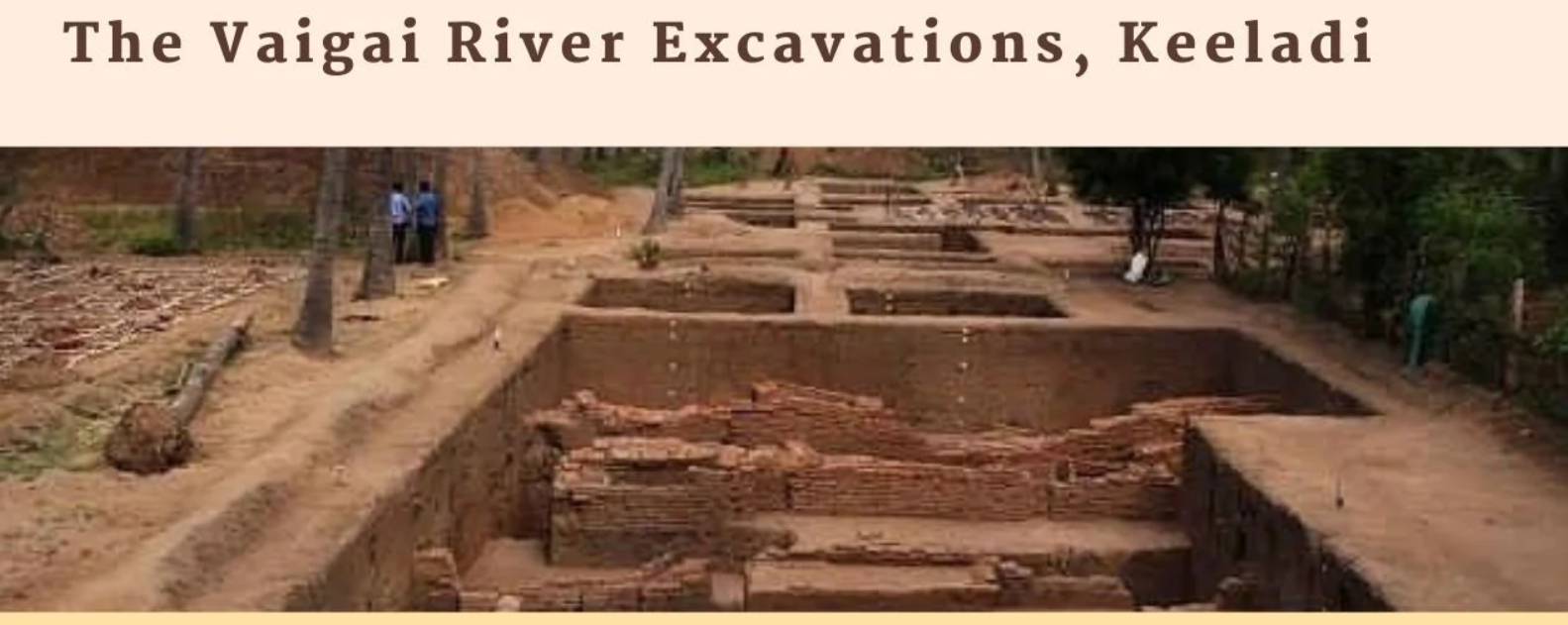
Excavations have revealed:
Planned brick structures
Channels resembling drains/canals
Fine clay floors
Pottery and roof-tile fragments
Supports Sangam-period literary descriptions of urban life and trade.

Key scientific method used
Optically Stimulated Luminescence (OSL) dating
Dates the last exposure of sediment grains (quartz) to sunlight.
Useful for determining when sediments buried archaeological remains, not when structures were built.
What made Keeladi findings significant?
Excavations at Keezhadi have provided strong material evidence of an early urban civilisation in South India, aligning closely with descriptions found in ancient Tamil texts.

Key aspects of significance
1. Evidence of a secular civilisation
Archaeologists found no religious symbols, idols, or ritual structures.
This suggests:
A secular, civic-oriented society
Public life not dominated by organised religion
This challenges assumptions that early Indian urban centres were primarily temple-centric.
2. Proof of urbanisation in South India
Findings point to a vibrant and sophisticated urban society, comparable to early historic urban centres elsewhere in India.
Features include:
Well-built brick structures
Planned habitation areas
Drain-like channels and water management systems
3. Planned urban layout
Structural remains are oriented along cardinal directions.
Indicates:
Knowledge of geometry and spatial planning
Systematic town planning rather than organic growth
4. High levels of literacy
Potsherds with Tamil Brahmi inscriptions were discovered.
Significance:
Confirms widespread literacy, not limited to elites or priests
Pushes back the antiquity of written Tamil usage
5. Astronomical awareness
Graffiti depicting the sun and moon found on artefacts.
Indicates:
Astronomical observation
Symbolic or calendrical understanding of celestial bodies
6. Social stratification
Discovery of an ivory dice suggests:
Presence of leisure activities
Existence of an elite or affluent section of society
Use of ivory points to access to luxury materials and trade networks.
7. Corroboration of Sangam literature
The civilisation uncovered at Keezhadi closely matches descriptions in Sangam Literature.
Sangam texts were composed during the Tamil Sangam period (c. 4th century BCE – 2nd century BCE), with Madurai as a major centre.
Keezhadi provides archaeological validation to what was earlier known mainly through literary sources.
Prelims Practice MCQ
Q. Keezhadi (Keeladi), often seen in the news, is located on the floodplain of which river?
(a) Cauvery
(b) Vaigai
(c) Tamiraparani
(d) Periyar
Correct answer: (b)
Explanation:
Keezhadi is situated on the Vaigai River floodplain in southern Tamil Nadu, which influenced settlement, agriculture, and trade.