
Kimberley Process
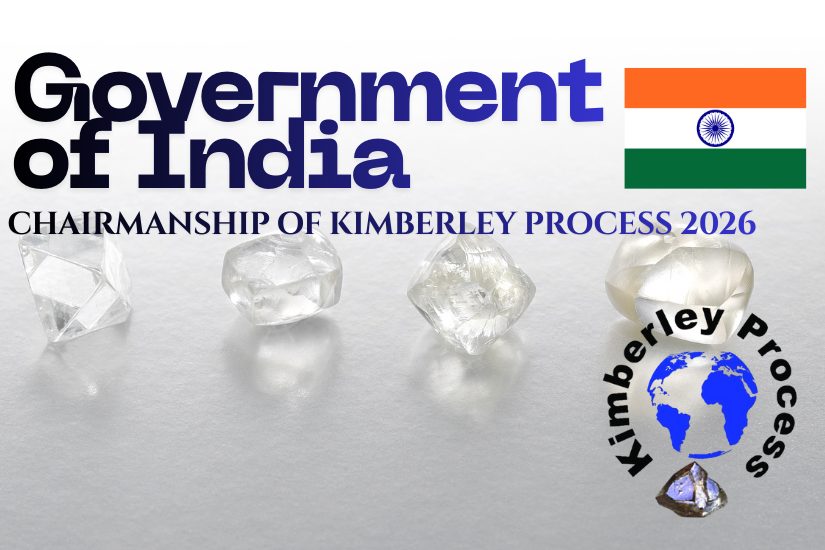
What is the Kimberley Process
A multilateral certification mechanism to regulate trade in conflict diamonds (rough diamonds used by rebel groups to fund conflicts against legitimate governments).
The KP, a tripartite setup of governments, industry organisations and civil society,Initiated in May 2000 by southern African countries.
Led to the Kimberley Process Certification Scheme (KPCS) in 2003.
Participants: 60 (representing 86 countries).
Coverage: ~99.8% of global rough diamond production.
Current working of KPCS
Each consignment of rough diamonds must carry a KP certificate issued by a participant country.
Trade allowed only between KP-compliant members.
Mandatory sharing of production and trade statistics.
Enforcement is decentralised (each country enforces domestically).
India’s strategic importance
Not a producer, but:
Imports ~40% of global rough diamonds (by value and quantity).
World’s largest cutting and polishing hub (Surat, Mumbai).
Re-exports polished diamonds to the U.S., UAE, China, Hong Kong, Israel.
This centrality in the value chain gives India significant leverage to push reforms.
Key producer countries
Angola, Botswana, Canada, Congo, Namibia, Russia
Together account for over 85% of rough diamond production.
Russia is the world's largest diamond-producing country by volume, consistently generating over 30% of global output, with major operations in Siberia and the Far East. Following Russia, Botswana is the second-largest producer by volume and leads in the value of stones produced. | ||
Structural problems in the Kimberley Process
1. Narrow definition of “conflict diamonds”
Focuses only on rebel groups vs governments.
Excludes:
State-sponsored violence
Human rights abuses
Human trafficking
Environmental damage
Abuses in artisanal and small-scale mining
Illicit trade networks
2. Consensus-based decision-making
Any country can block decisions through veto.
Raises doubts on:
How conflict diamonds are identified
What action follows identification
3. Ineffective embargoes
Example: Central African Republic
Banned in 2013, readmitted in 2024.
Embargo increased smuggling and violence instead of reducing conflict.
Shows that punitive bans without support mechanisms fail.
Reform agenda India can push as KP Chair (2026)
1. Gradual expansion of scope
Avoid immediate political confrontation.
Create a technical working group on:
Human rights risks
Violence beyond rebel insurgencies
Build evidence-based consensus before redefining conflict diamonds.
2. Technological modernisation
Promote digital, tamper-proof KP certificates.
Use blockchain-based certification:
Unique, immutable, time-stamped records
Linked to shipment details
Reduces fraud, increases transparency
Harmonised customs data exchange among members.
3. Capacity-building over punishment
Establish regional KP technical hubs in Africa:
Training
IT and certification support
Forensic and traceability capacity
Makes compliance collaborative rather than coercive.
4. Institutional transparency
Pilot independent or third-party audits.
Push for public release of granular KP statistics.
Strengthen civil society participation, preserving KP’s tripartite nature.
Focus on Africa and development
Recognise diamonds as a livelihood source for African communities.
Align KP objectives with Sustainable Development Goals:
Decent work
Poverty reduction
Responsible consumption and production
Ensure diamond revenues are channelled into:
Health
Education
Local infrastructure
Shift narrative from “blocking bad diamonds” to “enabling responsible diamond trade”.
Conclusion
India’s 2026 chairmanship is a strategic opportunity to reform the Kimberley Process.
By combining technology, inclusivity, capacity-building and transparency, India can help transform the KP into a:
More inclusive
Progressive
Sustainable
Rule-based multilateral institution
This aligns with India’s role as a leader of the Global South.
Prelims practice MCQs
Q. The Kimberley Process is primarily aimed at regulating the trade of which of the following?
A. Polished diamonds used in luxury markets
B. Synthetic diamonds used in industry
C. Rough diamonds used to finance rebel conflicts
D. Precious stones mined in protected areas
Correct answer: C
Explanation:
The Kimberley Process focuses specifically on rough (unpolished) diamonds that are used by rebel or insurgent groups to fund conflicts against legitimate governments. It does not cover polished diamonds or synthetic diamonds.
Q. With reference to the Kimberley Process Certification Scheme (KPCS), consider the following statements:
Each consignment of rough diamonds must be accompanied by a Kimberley Process certificate.
Trade in rough diamonds is permitted only between Kimberley Process participants.
Enforcement of the scheme is carried out by a central international authority.
Which of the statements given above are correct?
A. 1 and 2 only
B. 2 and 3 only
C. 1 and 3 only
D. 1, 2 and 3
Correct answer: A
Explanation:
Statements 1 and 2 are correct. Enforcement is decentralised and carried out individually by participant countries, not by a central authority, making statement 3 incorrect.