
Labour Codes notified
Context
Parliament passed four Labour Codes between 2019–2020, consolidating 29 existing labour laws.
The Union Government notified their implementation for provisions that do not require fresh rule-making.
Draft rules (published earlier) will be revised and placed in public domain for 45 days for consultation before full implementation.
States can now notify rules in their domain.
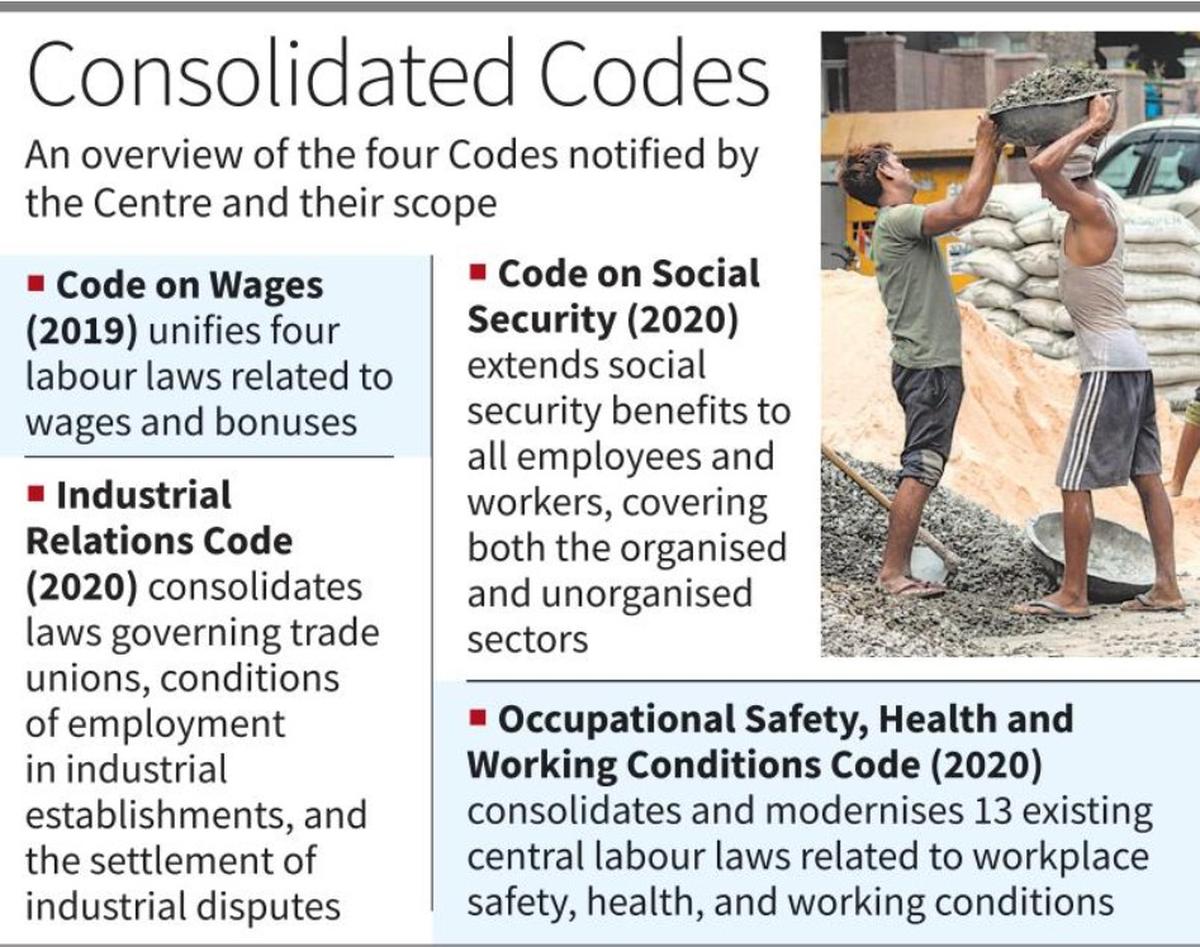
Four Labour Codes
Code on Wages, 2019
Industrial Relations Code, 2020
Code on Social Security, 2020
Occupational Safety, Health and Working Conditions Code, 2020
Key Changes Introduced
Appointment and formalisation
Mandatory appointment letters for all workers → drives formalisation.
Earlier no statutory requirement.
Social Security coverage
Coverage extended to all workers, including
Gig workers
Platform workers
Fixed-term employees
Aggregators must contribute 1–2 per cent of annual turnover, capped at 5 per cent of payments to gig/platform workers.
Minimum wages
Statutory minimum wage applicable to all employments, not only scheduled industries.
Health and safety
Mandatory free annual health check-ups for workers above 40.
Women allowed to work at night and in all job categories with adequate safeguards.
Wage and employment conditions
Timely payment of wages mandatory.
Equal benefits for fixed-term employees as permanent employees.
Gratuity eligibility for fixed-term employees reduced to 1 year (earlier 5 years continuous service).
ESIC and social protection
ESIC coverage extended pan-India, including previously uncovered regions.
Compliance reforms
Reduction of compliance burden:
Single registration
Single licence
Single return
Replaces multiple registrations and licences under 29 laws.

Implications
For workers
Greater protection, social security, universal minimum wages.
Enhanced safety, formalisation, and transparency.
Special benefits for gig/platform workers and fixed-term employees.
For employers
Simplified compliance regime.
Need to restructure wage components due to new definitions.
Higher financial obligations (contributions for gig/platform workers).
For economy
Moves towards a unified labour market, supporting investment and ease of doing business.
Push toward formalisation could increase workforce documentation and productivity.
Prelims Practice MCQs
Q. Which of the following provisions is explicitly introduced under the new Labour Codes?
Mandatory appointment letters for all workers
Mandatory free annual health check-up for all workers
Gratuity for fixed-term employees after one year
Statutory minimum wages across all employments
Select the correct answer:
a) 1, 3 and 4 only
b) 1, 2 and 4 only
c) 1, 2, 3 and 4
d) 2 and 3 only
Answer: c)
Explanation: All four are directly provided under the Codes: appointment letters, health check-up for 40+ workers, gratuity after one year for fixed-term workers, and universal minimum wages.
Q. Under the Code on Social Security, aggregators must contribute to the social security fund for gig and platform workers. This contribution is:
a) 1–5 per cent of annual turnover
b) 1–2 per cent of annual turnover, capped at 5 per cent of payments to workers
c) 2–3 per cent of annual turnover
d) 5 per cent of total workforce compensation
Answer: b)
Explanation: Contribution range: 1–2 per cent of annual turnover, but cannot exceed 5 per cent of the amount payable to gig/platform workers.