
László Krasznahorkai wins the 2025 Nobel Prize in Literature
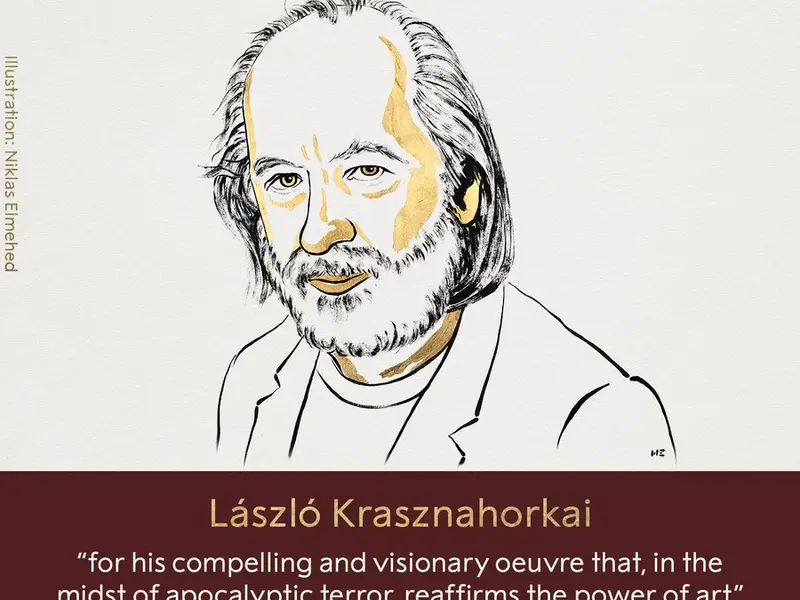
Key Details
Recipient: László Krasznahorkai
Country: Hungary
Award: Nobel Prize in Literature 2025
Citation: For his “compelling and visionary oeuvre that, in the midst of apocalyptic terror, reaffirms the power of art.”
Announced by: The Swedish Academy (Stockholm)
About the Writer
Born: Gyula, southeastern Hungary (near Romania border)
Age: 71 years (as of 2025)
Education: Studied law at universities in Szeged and Budapest; later shifted to literature.
Style:
Known for philosophical, dense, and bleakly humorous prose.
Frequently writes single-sentence novels with complex, meandering structures.
Represents the Central European literary tradition — following Franz Kafka and Thomas Bernhard.
Themes: Absurdism, grotesque excess, moral decay, and the endurance of art amid chaos.
Major Works
Work | Type / Adaptation | Notes |
Satantango | Novel | Debut work; adapted into a film by Béla Tarr |
The Melancholy of Resistance | Novel | Adapted by Béla Tarr (Werckmeister Harmonies) |
Baron Wenckheim’s Homecoming | Novel | Won National Book Award for Translated Literature (U.S., 2019) |
Political Views
A vocal critic of Hungarian Prime Minister Viktor Orbán, particularly over:
Autocratic governance
Nationalism in Hungary
Lack of support for Ukraine post-Russia’s invasion
In his interview with Svenska Dagbladet, he remarked:
“There is no hope left in Hungary today... The problem is not only political, but also social.”
Significance
Represents the Central European existential and absurdist tradition, bridging art, philosophy, and politics.
His Nobel recognition reflects the global attention to writers confronting authoritarianism and despair through art.
Symbolises the resilience of creative freedom amid restrictive political climates.