
LCA Tejas Mk1A
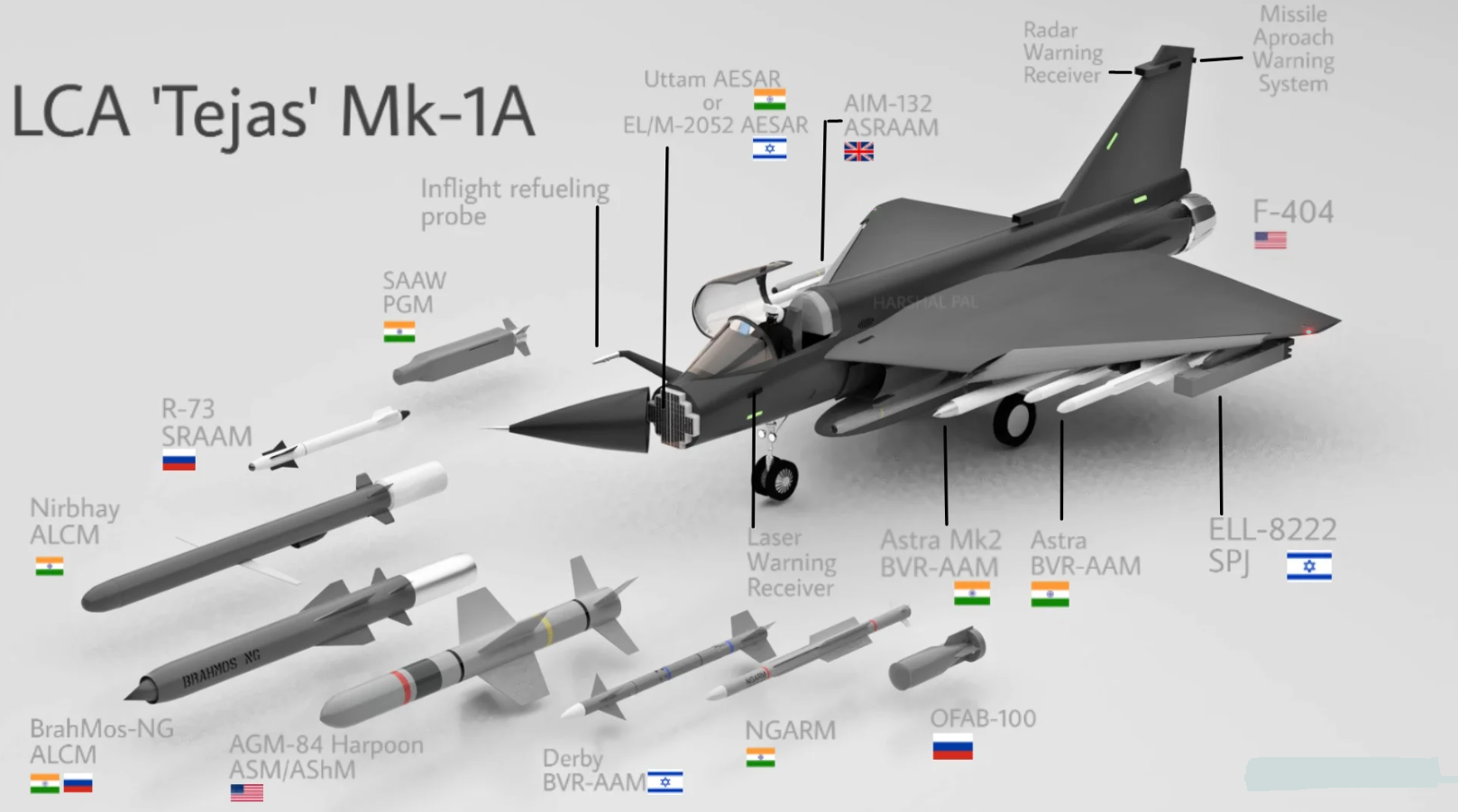
Context: The IAF’s fighter strength has dropped to 29 squadrons against the sanctioned 42 after the phasing out of MiG-21 aircraft.
The LCA Mk1A, an improved version of Tejas Mk1, is central to IAF’s modernisation plan.
HAL is contracted to deliver 83 aircraft worth ₹48,000 crore, with 97 Mk1A jets ordered in Sept for over ₹62,000 crore.
Light Combat Aircraft (LCA) Tejas
LCA Tejas is an indigenous 4.5-generation, all-weather, multi-role, supersonic fighter aircraft.
Developed by: Aeronautical Development Agency (ADA) under DRDO.
Manufactured by: Hindustan Aeronautics Limited (HAL).
Objective: To replace India’s MiG-21 fighter fleet.
Development Timeline
Year | Milestone |
1984 | LCA Programme initiated by Government of India |
2001 | First flight of Tejas prototype |
2003 | Officially named “Tejas” (means Radiance in Sanskrit) |
2015 | Inducted into Indian Air Force (IAF) |
2016 | First squadron “Flying Daggers” became operational at Sulur, Tamil Nadu |
2020 | Mk1A variant approved for production |
2025 | Delivery delays; HAL pushes Mk1A rollout to 2026 |
Design & Characteristics
Type: Single-engine, tailless, delta-wing, supersonic fighter jet.
Generation: 4.5.
Role: Air superiority, ground attack, interception, and maritime operations.
Flight control: Digital Fly-by-Wire system for stability.
Materials: Extensive use of composite materials → reduced weight & radar cross-section.
Performance Specifications
Maximum speed: Mach 1.8
Range: ~3,000 km
Payload capacity: 4,000 kg (missiles, bombs, fuel tanks)
Ceiling altitude: ~52,000 feet
Engine: GE F404-IN20 (imported from U.S.), indigenous engines under development.
Variants
Variant | Description |
Tejas Mk1 | Base version inducted into IAF. Indigenous content ~60%. |
Tejas Mk1A | Upgraded variant with enhanced avionics, radar, and EW systems. |
Tejas Trainer | Twin-seater aircraft for pilot training. |
Tejas Navy (Mk1 / Mk2) | Carrier-capable variant for Indian Navy. |
Tejas Mk2 (Medium Weight Fighter) | Under development — more powerful engine, greater payload & range. |
Tejas Mk1A - The Upgraded Variant
MK1A being considered 4.5 generation.
Fifth-generation fighters are a separate category defined by characteristics like stealth technology and advanced avionics, which the Tejas does not have. India is developing a separate fifth-generation fighter called the Advanced Medium Combat Aircraft (AMCA)
The Advanced Medium Combat Aircraft (AMCA) is a planned Indian single-seat, twin-engine, all-weather fifth-generation stealth, multirole combat aircraft being developed for the Indian Air Force and the Indian Navy. The aircraft is being designed by the Aeronautical Development Agency, an autonomous aircraft design body under the Ministry of Defence.
Purpose
To enhance combat capability, survivability, and maintainability over Mk1.
Central to IAF’s modernisation and indigenisation plan.
Key Upgrades
Feature | Mk1A Improvement |
Radar | AESA (Active Electronically Scanned Array) Radar – better target detection and tracking |
Electronic Warfare (EW) Suite | Radar Warning Receiver (RWR), Self-Protection Jamming |
Flight Control | Upgraded Digital Flight Control Computer (DFCC Mk1A) for better agility |
Avionics | Smart Multi-function Displays (SMFD), Digital Map Generator (DMG), Combined Interrogator and Transponder (CIT) |
Communication | Software Defined Radio (SDR), Operating Data Link (ODL) |
Weapons Compatibility | Integration of BVR missiles, ASRAAM, and precision-guided munitions |
Maintenance | Modular design for easier servicing and lower downtime |
Production & Orders
HAL Contract (2021):
83 Tejas Mk1A aircraft worth ₹48,000 crore.
Additional order (2025): 97 Mk1A worth ₹62,000 crore.
Total Tejas planned: ~324 aircraft (18 squadrons).
Certification Agency: Centre for Military Airworthiness and Certification (CEMILAC).
Challenges
Delays in delivery due to certification and testing issues.
Dependence on imported engines (GE F404/F414).
Slow production rate at HAL facilities.
Integration issues with advanced avionics and systems.
Significance
Represents India’s indigenous aerospace capability.
Reduces dependence on foreign defense imports.
Aligns with Atmanirbhar Bharat and Make in India initiatives.
Boosts IAF’s modernization and force readiness.
Prelims Practice MCQ
Q. Consider the following statements regarding the LCA Tejas:
It is India’s first indigenously developed jet-powered combat aircraft.
It is a 4.5-generation, single-engine, tailless, delta-wing, multi-role fighter aircraft.
The LCA Tejas is designed and developed by Hindustan Aeronautics Limited (HAL) alone.
Which of the statements given above is/are correct?
(a) 1 only
(b) 2 only
(c) 1 and 2 only
(d) 1, 2 and 3
✅ Answer: (c)
Explanation:
Tejas is India’s second indigenous combat aircraft after the HF-24 Marut (so 1 is incorrect).
It is indeed a 4.5-generation, tailless, single-engine, delta-wing multirole fighter (2 correct).
It was developed by ADA (DRDO) and manufactured by HAL (3 incorrect).
Q. With reference to the LCA Tejas Mk1A, consider the following statements:
It is equipped with an Active Electronically Scanned Array (AESA) radar and an advanced Electronic Warfare Suite.
It is powered by an indigenous Kaveri engine developed by GTRE.
It has compatibility with Beyond Visual Range (BVR) missiles.
Which of the statements given above is/are correct?
(a) 1 and 2 only
(b) 2 only
(c) 1 and 3 only
(d) 1, 2 and 3
✅ Answer: (c)
Explanation:
Tejas Mk1A has AESA radar and EW suite (1 correct).
It uses GE F404-IN20 (imported) engine, not Kaveri (2 incorrect).
It supports BVR missiles (3 correct).
The Kaveri engine is primarily used for India's indigenous fighter aircraft programs, originally intended for the Tejas Light Combat Aircraft (LCA).
Due to initial challenges, the project has been refocused on developing derivative engines for other aircraft, including unmanned aerial vehicles (UAVs) like the Ghatak stealth drone
Q. Which of the following statements about LCA Tejas Programme are correct?
It was launched to replace India’s ageing MiG-21 aircraft.
The programme is managed by the Aeronautical Development Agency (ADA).
The first flight of Tejas took place in 2015.
(a) 1 only
(b) 1 and 2 only
(c) 1 and 3 only
(d) 2 and 3 only
✅ Answer: (b)
Explanation:
Programme launched to replace MiG-21 fleet (1 correct).
Managed by ADA under DRDO (2 correct).
First flight occurred in 2001, not 2015 (3 incorrect).