
Lessons from India’s Vaccination Drive
Scale and Impact
India runs the world’s largest immunisation programme (UIP).
Every year: 2.6 crore infants and 2.9 crore pregnant women are vaccinated free of cost.
Helped reduce under-5 mortality (from 45 in 2014 to 31 in 2021 per 1,000 live births).
Expansion of Coverage
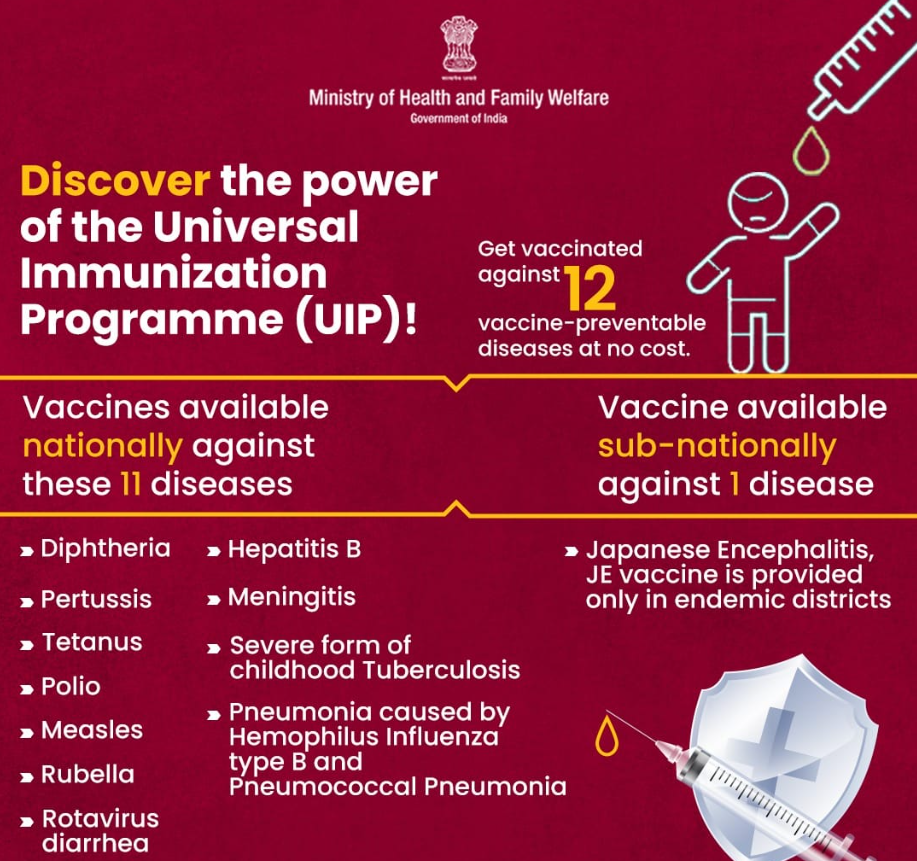
UIP now covers 12 diseases (11 vaccines nationwide + 1 in endemic areas).
New vaccines added in the past decade:
Tetanus & Adult Diphtheria,
Inactivated Poliovirus,
Measles-Rubella,
Rotavirus,
Pneumococcal Conjugate,
Japanese Encephalitis.
World Immunisation Week (WIW) is a global healthcare event, typically celebrated every year in the last week of April between 24th and 30th.
Mission Indradhanush (MI)
Launched in 2014 to raise full coverage from 62% → 90%.
Intensified MI (IMI) in 2017 targeted low-coverage & missed populations.
By 2023 → 12 phases completed; vaccinated 5.46 crore children & 1.32 crore pregnant women.
Integrated into Gram Swaraj Abhiyan to widen reach.
Key Achievements
Polio-free since 2011.
Maternal & neonatal tetanus eliminated (2015).
Yaws eliminated (2016).
Measles-Rubella campaign (2017–19) vaccinated 34.8 crore children.
COVID-19 vaccination: over 220 crore doses by Jan 2023; covered 97% (1 dose) and 90% (2 doses).
Supported global south via Vaccine Maitri.
Challenges
Difficult to reach:
Remote & migratory populations,
Clusters with low awareness or hesitancy.
COVID-19 disrupted routine immunisation → measles outbreaks (2022–24).
Innovations and Technology
Digital tracking through U-WIN platform (based on Co-WIN) for end-to-end vaccination records.
Electronic Vaccine Intelligence Network (eVIN) → stock monitoring.
Cold Chain MIS → real-time cold storage tracking.
SAFE-VAC → vaccine safety reporting.
Zero-dose outreach to identify unvaccinated children.
Global Leadership
India = world’s largest vaccine producer.
Showcased self-reliance (domestic COVID-19 vaccine development).
Gained recognition (e.g., Measles & Rubella Champion Award, 2024).
Way Forward
Strengthen surveillance + immunisation linkage.
Counter anti-vaccine narratives.
Adopt One Health approach (human-animal-environment joint surveillance).
Continue improving cold chain, awareness, and last-mile delivery.
Universal Immunisation Programme (UIP) – India
1. Introduction
Launched: 1985 by the Government of India.
Became part of Child Survival and Safe Motherhood Programme (1992).
Since 2005, a key component of the National Health Mission (NHM).
Coverage: All residents of India, including foreign residents.
Cost of vaccines: Fully borne by the Government of India .
2. Diseases Covered (12 in total)
Original set (1985 onwards):
Tuberculosis (BCG)
Diphtheria
Pertussis (Whooping Cough)
Tetanus
Poliomyelitis
Measles
Later additions:
Hepatitis B (2007)
Haemophilus influenzae type B (Hib) → pneumonia, meningitis
Japanese Encephalitis (JE)
Rotaviral gastroenteritis (RVV)
Rubella (as Measles-Rubella vaccine)
Pneumococcal diseases (pneumonia, meningitis) (2017)
3. New Vaccines Introduced (phased additions)
Injectable Polio Vaccine (IPV) – supplement to oral polio drops.
Adult JE vaccine – for vulnerable populations in endemic areas.
Pneumococcal Conjugate Vaccine (PCV) – against pneumonia & meningitis.
Measles-Rubella vaccine (MR) – replaced single measles shot.