
Loggerhead sea turtle and climate change threats
Context
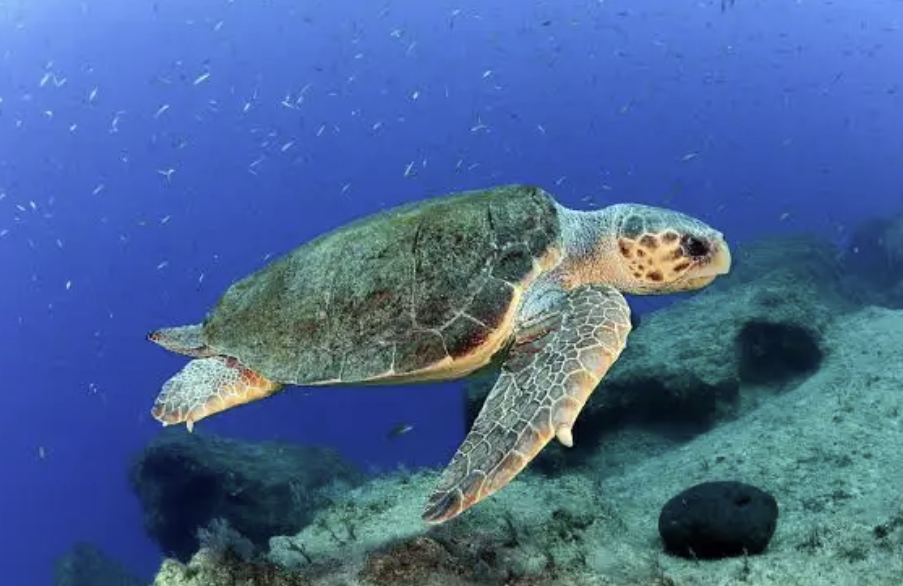
The strong-jawed loggerhead sea turtle, one of the most widely distributed marine turtles, is now facing multi-dimensional threats from climate change, according to a 17-year study conducted in Cabo Verde and published in the journal Animals.
Four major climate impacts identified
1. Earlier nesting (phenological shift)
Warmer ocean temperatures are triggering earlier nesting in the year.
This indicates short-term adaptive flexibility.
However, long-term ecological consequences remain uncertain.
2. Reduced reproductive frequency
Earlier: females bred once in two years.
Now: breeding gap has increased to four years.
Indicates stress due to declining food availability.
3. Declining clutch size
Fewer eggs per nesting attempt.
Linked to reduced maternal body size and energy reserves.
4. Shrinking body size
Scientists observed a trend toward smaller females.
Smaller body size → smaller clutch size → reduced reproductive output.
This combination directly affects population replacement rate.
Why is this happening?
Ocean productivity decline
Satellite-based chlorophyll estimates show declining marine productivity.
Key feeding grounds in the Atlantic are becoming less productive.
Loggerheads depend on abundant marine invertebrates (crabs, molluscs, jellyfish).
“Capital breeders”
Loggerheads are described as capital breeders:
They accumulate energy reserves over years while foraging.
Reproduction depends on stored energy.
If food availability declines → energy reserves fall → reproduction suffers.
This makes them especially vulnerable to long-term oceanic changes.
Additional climate-related threats
Beyond reproduction, climate change also affects turtles through:
1. Sea level rise
Erosion and inundation of nesting beaches.
Reduced availability of suitable nesting sites.
2. Sand temperature rise
Sea turtles exhibit temperature-dependent sex determination (TSD).
Warmer sand → more female hatchlings.
Extreme warming could create skewed sex ratios.
3. Increased storm frequency
Nest destruction.
Hatchling mortality.
Why this is concerning
Even if nesting numbers appear stable:
Reduced clutch size
Longer breeding intervals
Smaller adult size
→ Can silently erode long-term population viability.
This reflects a broader pattern seen in marine biodiversity under climate stress.
Loggerhead sea turtle
1. Classification
Family: Cheloniidae (hard-shelled sea turtles)
IUCN Status: Vulnerable
CITES: Appendix I (trade prohibited)
2. Distribution
Atlantic, Pacific, Indian Oceans
Mediterranean Sea
Marine and estuarine habitats; females nest on beaches
3. Key Features
Large head with powerful jaws
Avg length: ~90 cm
Avg weight: ~135 kg
Omnivorous; feeds mainly on benthic invertebrates
4. Life History
Sexual maturity: 17–33 years
Lifespan: 47–67 years
Low reproductive rate (breeds every 2–3 years)
Temperature-dependent sex determination
Prelims Practice MCQs
Q. With reference to the Loggerhead Sea Turtle, consider the following statements:
It is a capital breeder that relies on long-term stored energy reserves for reproduction.
Rising ocean productivity has increased its clutch size in recent years.
It exhibits temperature-dependent sex determination.
Which of the statements given above is/are correct?
(a) 1 and 3 only
(b) 2 only
(c) 1 only
(d) 1, 2 and 3
Answer: (a) 1 and 3 only
Explanation:
Statement 1 is correct: Loggerhead turtles are capital breeders, meaning they accumulate energy over time before reproducing.
Statement 2 is incorrect: Ocean productivity is declining, reducing reproductive output.
Statement 3 is correct: Like other sea turtles, they exhibit temperature-dependent sex determination (TSD), where warmer sand produces more females.
Q. Which of the following is/are direct consequences of declining marine productivity for Loggerhead turtles?
Increased breeding frequency
Reduced clutch size
Shrinking adult body size
Select the correct answer using the code below:
(a) 1 only
(b) 2 and 3 only
(c) 1 and 2 only
(d) 1, 2 and 3
Answer: (b) 2 and 3 only
Explanation:
Statement 1 is incorrect: Breeding frequency has reduced (from ~2 years to ~4 years gap).
Statements 2 and 3 are correct: Reduced food availability leads to smaller females and smaller clutch sizes.
Q. The term “capital breeder” refers to species that:
(a) Breed continuously throughout the year irrespective of food supply
(b) Depend exclusively on terrestrial food sources
(c) Rely on stored energy reserves accumulated prior to reproduction
(d) Produce large numbers of offspring with minimal parental investment
Answer: (c) Rely on stored energy reserves accumulated prior to reproduction
Explanation:
Capital breeders accumulate energy over time and use stored reserves for reproduction. Loggerhead turtles depend on long-term foraging success before nesting.