
Members of Parliament Local Area Development Scheme (MPLADS)
Why in news
Allegations by Bharatiya Janata Party
Accused three Congress MPs from Rajasthan of misusing MPLADS funds by allocating money to Kaithal district, Haryana, instead of their constituencies.
MPs involved:
Brijendra Singh Ola (Jhunjhunu): ₹25 lakh
Rahul Kaswan (Churu): ₹50 lakh
Sanjana Jatav (Bharatpur): ₹45 lakh
BJP argued:
Violates core objective of MPLADS
Inappropriate inter-State allocation
Politically motivated (Kaithal is linked to Aditya Surjewala)
Response by Indian National Congress
Allocations were as per MPLADS Guidelines 2023
Rules permit:
MPs to recommend works outside constituency/State up to ₹50 lakh per financial year
In case of calamity of severe nature: up to ₹1 crore anywhere in India
Congress counter-alleged that BJP MPs had also used funds questionably in the past.
Members of Parliament Local Area Development Scheme (MPLADS)
Basic Overview
Launched: 23 December 1993
Nature: Central Sector Scheme
Objective: Creation of durable community assets based on locally felt needs
Eligible works: Public infrastructure of lasting value
Role of MPs: Recommend works (no execution power)
Administrative Structure
Ministries
1993–1994: Ministry of Rural Development
Since October 1994: Ministry of Statistics and Programme Implementation (MoSPI)
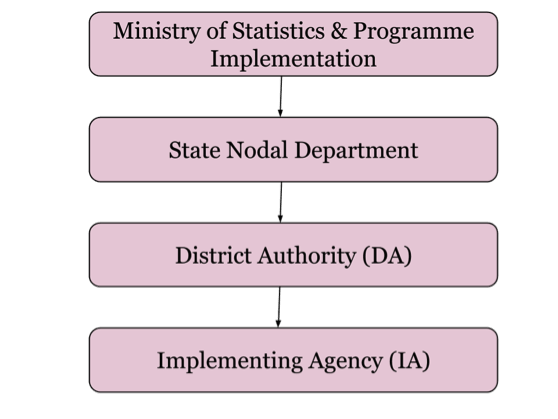
Implementation Machinery
State level: Nodal Department (coordination & monitoring)
District level: District Authority (DA)
Functions of District Authority
Sanction works recommended by MPs
Identify implementing & user agencies
Supervise execution
Inspect at least 10% of works annually
Transfer completed assets to user agencies
Report progress to MoSPI
Involve MPs in inspections (where feasible)
Eligibility of MPs
Lok Sabha MPs: Works in own constituency
Rajya Sabha MPs: Works in any district of the State represented
Nominated MPs (LS/RS): Works anywhere in India
Financial Provisions
Annual Allocation
₹5 crore per MP per year (since 2011–12)
₹5 lakh (1993–94)
₹2 crore (1998–99)
Release Pattern
Released by MoSPI to District Authorities, not to MPs
Two instalments of ₹2.5 crore each
Non-lapsable funds (carry forward allowed)
Geographic Flexibility
Outside constituency/State:
Up to ₹25 lakh per year (general purpose, national unity)
Natural Calamity
Within State: up to ₹25 lakh
Calamity of Severe Nature (e.g., tsunami, major cyclone, earthquake):
Up to ₹1 crore anywhere in India
Social Justice Mandate
Minimum earmarking by MPs:
15% for Scheduled Castes (SCs) areas
7.5% for Scheduled Tribes (STs) areas
Convergence with Other Schemes
Mahatma Gandhi National Rural Employment Guarantee Scheme (MGNREGS) – for durable assets
Khelo India – sports infrastructure
Works on Land of Societies / Trusts
Allowed if:
Registered society/trust
Engaged in social welfare
Minimum 3 years of existence
Financial Limits
Annual ceiling for MPs reduced to Rs. 50 lakh for all Trusts/Societies combined, with a Rs. 1 crore cap per Trust/Society during an MP’s term. Unexpended portions of the MPLADS funds ceiling for Trusts/ Societies can be carried forward to subsequent years; works sanctioned before 1.4.2023 to continue under old guidelines.
Prohibitions
Not allowed if MP or MP’s family is an office bearer
Performance of States
Top Performing States (FY23): Gujarat (145.11%), Jharkhand (128.45%), Karnataka (127.76%), and Kerala (122.33%).
Highest Volume: While Gujarat had the highest ratio, Uttar Pradesh received the maximum funds (₹427.5 crore) and utilized 99% of them by March 2023.
Top Performing UTs: Lakshadweep (111.68%), Andaman & Nicobar Islands (105.68%), and Delhi (104.1%).
Permissible Works
Priority Sectors
Drinking water
Education
Health & sanitation
Electricity & non-conventional energy
Irrigation
Roads, bridges, railways
Sports
Agriculture & allied activities
SHGs & urban development
Other Permitted Works
Railway halt stations
CCTV in strategic locations
Bio-digesters (schools, hospitals, stations)
Rainwater harvesting systems
Weighing machines for farmers
Skill development shelters
Works Not Permitted
Office/residential buildings for agencies
Land acquisition or compensation
Naming assets after individuals
Grants/loans to relief funds
Assets for individual benefit
Works on religious land
Works in unauthorised colonies
Transparency & Accountability Measures
Permanent plaque at project site (MP name, year, cost)
Display of works at:
District Authority office
MPLADS website
RTI applicable
Mandatory audits by:
Chartered accountants
Local fund auditors / statutory auditors
Regular:
MoSPI review meetings
District-level quarterly/monthly reviews
Issues & Criticism
Allegations of misuse & corruption
2006 sting operation exposed bribery
Seven-member committee constituted for probe
Recurrent demand to scrap the scheme
New Guidelines for MPLADS (Issued by Ministry of Statistics and Programme Implementation)
1. Fund Release Pattern
Government agencies:
75% of project cost released as first instalment
Non-governmental agencies:
60% of project cost released as first instalment
Small projects (< ₹2 lakh):
100% amount released in one instalment
2. Minimum Project Cost Norm
General rule:
No project costing less than ₹1 lakh shall be sanctioned
Exceptions (essential works):
Installation of hand pumps
Purchase of computers and accessories
Solar electric lamps
Chaupals
Essential equipment
3. Expansion of Permissible Works
The basket of works under MPLADS has been widened to include:
Purchase of books for libraries
Ambulances and hearse vans, provided:
Owned and controlled by District Authorities
4. Promotion of Digital Literacy
Purchase of Microsoft Office software permitted
Includes training of two teachers per school
Objective: Promote computer literacy
5. Transparency and Accountability Measures
(a) Public Disclosure
Permanent plaque at worksite mentioning:
Name of MP
Year of sanction
Cost of project
Display of:
Completed and ongoing works
At District Authority office
On MPLADS website
(b) Citizen Oversight
Citizens can seek information through RTI on:
Status of funds
Progress of works
(c) Audit Provisions
Mandatory audit of utilised funds by:
Chartered Accountants
Local Fund Auditors
Statutory auditors as per State/UT procedures
(d) Review Mechanism
MoSPI review meetings at:
State level
Central level
District Authorities to:
Review implementation with executing agencies
Monthly, or at least once every quarter
Prelims Practice MCQs
Q. With reference to the Members of Parliament Local Area Development Scheme (MPLADS), consider the following statements:
MPLADS is a Central Sector Scheme fully funded by the Government of India.
MPs have the authority to sanction and execute projects under MPLADS.
MPLADS focuses on the creation of durable community assets.
Which of the statements given above is/are correct?
A. 1 and 2 only
B. 1 and 3 only
C. 2 and 3 only
D. 1, 2 and 3
Correct answer: B
Explanation:
Statement 1 is correct: MPLADS is a Central Sector Scheme.
Statement 2 is incorrect: MPs can only recommend, not sanction or execute works.
Statement 3 is correct: Emphasis is on durable community assets.
Q. Which of the following ministries is currently responsible for administering MPLADS?
A. Ministry of Rural Development
B. Ministry of Panchayati Raj
C. Ministry of Statistics and Programme Implementation
D. Ministry of Home Affairs
Correct answer: C
Explanation:
Since October 1994, MPLADS has been administered by the Ministry of Statistics and Programme Implementation.
Initially, it was under the Ministry of Rural Development.