
Misuse of Defamation Law & Debate on Decriminalisation
Background
Defamation: Injury to a person’s reputation through words, signs, or visible representations.
In India, it exists in two forms:
Civil defamation (damages/compensation under law of torts).
Criminal defamation (Sections 499 & 500 IPC: imprisonment up to 2 years, fine, or both).
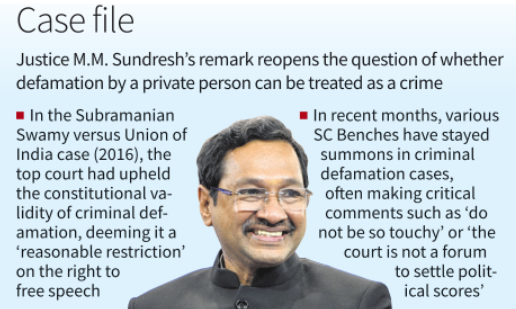
Supreme Court in Subramanian Swamy vs Union of India (2016)
Upheld criminal defamation as constitutionally valid.
Held that:
Reputation is a facet of Right to Life (Article 21).
Thus, restrictions on free speech (Article 19(1)(a)) are reasonable.
Current Developments
Justice M.M. Sundresh (2025): remarked, “Time has come to decriminalise this”.
Increasing misuse by:
Political parties to silence criticism.
Private individuals to harass journalists, critics, and opponents.
High-Profile Cases
Rahul Gandhi: Faced multiple criminal defamation complaints (remarks on Amit Shah, China-India clash, Savarkar, etc.). SC stayed proceedings.
Shashi Tharoor: Relief in ‘scorpion on Shivling’ case.
The Wire journalists: Summons stayed in case filed by former JNU professor.
Key Legal Principle (Imran Pratapgarhi Case, 2025)
Defamatory words/acts must be judged from the perspective of reasonable, firm-minded people, not those who are weak or overly sensitive.
Stakes for India
Freedom of Speech vs Protection of Reputation:
Criminalisation chills free expression, especially political dissent and investigative journalism.
Civil remedies (damages, injunctions) may be sufficient and less prone to misuse.
Global Trend: Many democracies have decriminalised defamation, retaining only civil liability.