
Monoclonal Antibodies (mAbs)
Definition
-
Laboratory-produced proteins that mimic natural antibodies.
-
Bind specifically to target antigens (usually on cells or pathogens).
-
Used in diagnosis, treatment, and research.
Key Characteristics
-
Specificity
-
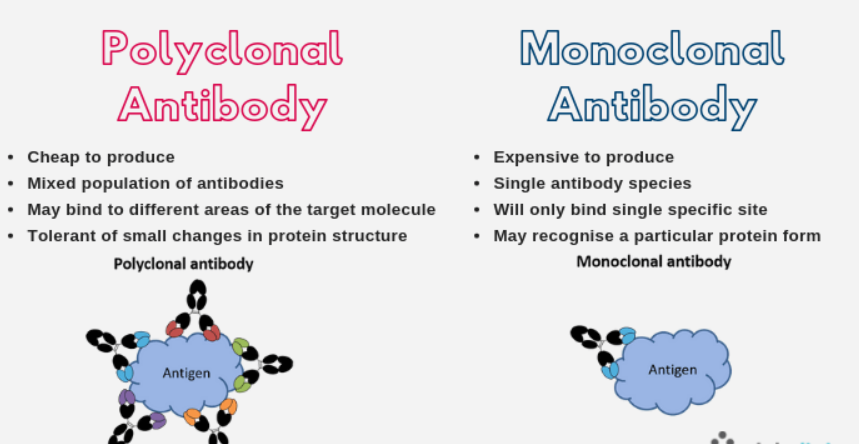
Bind to a single epitope on an antigen.
-
Unlike polyclonal antibodies (which bind to multiple epitopes).
An epitope is the specific molecular region on the surface of an antigen that is recognized by the immune system, specifically by antibodies, B cells, or T cells. It is the precise site where an antibody binds, and it is capable of eliciting an immune response.
-
-
Monoclonality
-
All antibodies are identical and derived from one B-cell clone.
-
-
Laboratory Production
-
Produced via hybridoma technology.
-
Fusion of a B-lymphocyte with a myeloma (tumor) cell forms a hybridoma that secretes the desired antibody indefinitely.
-
Production Process
-
Immunization of a mouse → B cells collected
-
B cells fused with myeloma cells → Hybridomas
-
Screening of hybridomas → Only desired antibody-producing clone selected
-
Clone expanded → Mass production of monoclonal antibodies

Applications
1. Disease Diagnosis
-
Immunoassays (e.g., ELISA, lateral flow tests)
-
Pregnancy and ovulation test kits
-
Tissue and blood typing in organ transplantation
2. Disease Treatment
-
Cancer: Target tumor cells (e.g., CD markers)
-
Autoimmune diseases: Suppress inflammatory molecules (e.g., TNF-alpha)
-
Infectious diseases: Block virus entry or promote viral clearance
3. Research
-
Cell and molecular identification
-
Development of new therapeutic targets
-
Protein tagging and molecular interaction studies
Mechanism of Action
-
Bind to specific antigen on a cell/pathogen surface
-
Trigger immune responses:
-
Antibody-Dependent Cellular Cytotoxicity (ADCC)
-
Complement activation
-
Block receptors or neutralize molecules
-
Examples of mAbs in Therapy
| Disease | Monoclonal Antibody | Target |
|---|---|---|
| Cancer (Lymphoma) | Rituximab | CD20 on B cells |
| Leukemia | Blinatumomab | CD19 (leukemia) + CD3 (T cells) |
| Rheumatoid Arthritis | Adalimumab, Infliximab | TNF-α (inflammatory mediator) |
| COVID-19 | Casirivimab, Imdevimab (Regeneron) | SARS-CoV-2 Spike Protein |
-
High specificity → fewer side effects
-
Can be tailored to specific diseases
-
Used in personalized medicine
Challenges
-
High cost of production
-
Risk of immune reactions (e.g., cytokine release syndrome)
-
Not orally active – usually given via injection

Monoclonal antibodies represent a revolution in targeted therapy, enabling precision medicine in oncology, immunology, and infectious disease management. Their continued development and affordability are central to future healthcare strategies.