
Nauru's “climate resilience citizenship” programme
×
![]()
Context: The Pacific island nation of Nauru has launched a “climate resilience citizenship” programme to raise funds for climate action by selling passports at $105,000 each.
The scheme, which began in February 2025, aims to earn over $5 million in its first year (targeting 66 passports) and could eventually generate $43 million, about 20% of government revenue. The Nauru passport offers visa-free access to over 80 countries.
About Nauru:
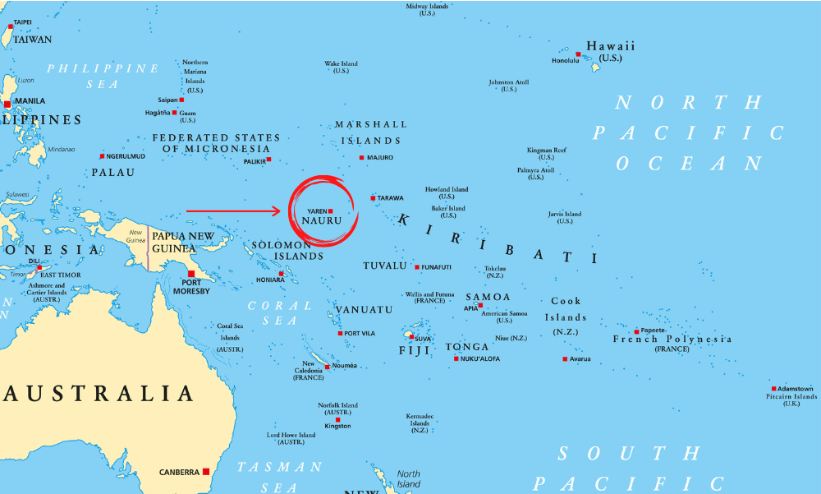
Nauru, officially the Republic of Nauru and formerly called Pleasant Island, is a small island country in the South Pacific’s Micronesia region.
Its closest neighbour is Banaba in Kiribati, about 300 km to the east. With an area of 21 sq. km, it is the world’s third-smallest country (after Vatican City and Monaco) and the smallest republic, island nation, and Commonwealth member state by area. It has a population of around 10,800, making it the third least-populated country (excluding colonies/territories).
Nauru is a member of the UN, the Commonwealth of Nations, and the Organisation of African, Caribbean and Pacific States.
Nauru’s Geography and Resources:
The island’s highest point, Command Ridge, is just 71 m (233 ft) above sea level. Nauru is a raised coral atoll, once rich in phosphate rock. This natural mineral, found just beneath the surface, was heavily mined during the 20th century, and by the 1990s most deposits were depleted. As a result, about 90% of the island’s land is now barren and unsuitable for farming.
The national flag features the chemical symbol for phosphorus, and the country’s motto is God’s Will First. Historically, phosphate and guano (seabird excrement) were extracted extensively. After the decline of phosphate mining, Nauru began deep-sea manganese mining in 2018 to contribute to the global shift towards renewable energy.