
Nepal officially joined International Big Cat Alliance (IBCA)
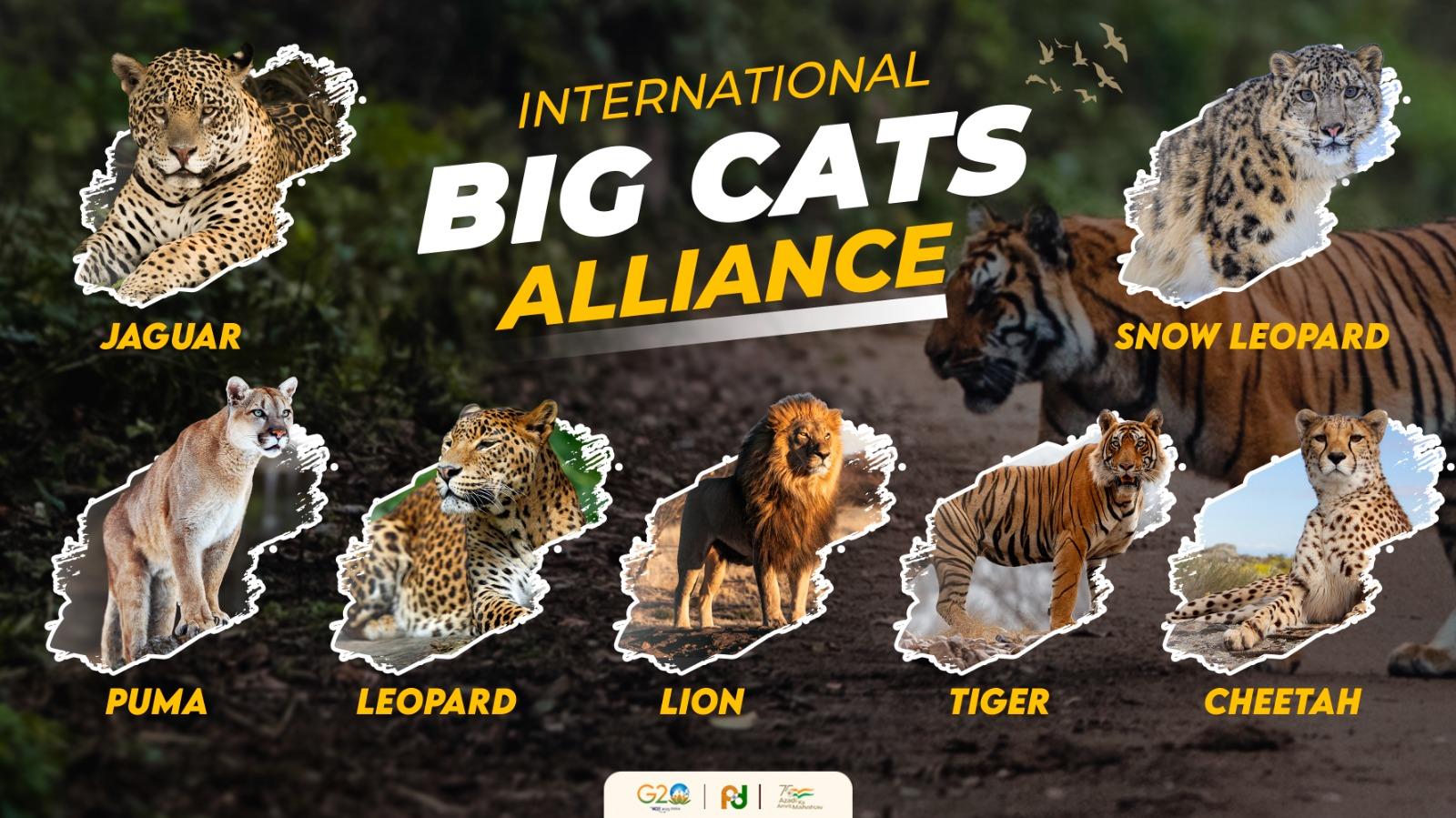
Big cats in Nepal: Tiger, Snow Leopard, Common Leopard.
International Big Cat Alliance (IBCA)
Launch & Establishment:
Announced by PM Narendra Modi on 9 April 2023 during 50 years of Project Tiger in Mysuru, Karnataka.
Union Cabinet approval: 29 Feb 2024.
Established: 12 March 2024, through National Tiger Conservation Authority (NTCA), MoEFCC.
HQ: India.
Initial Govt. Support: One time support ₹150 crore for 5 years (2023–24 to 2027–28).
Patterned on the International Solar Alliance (ISA) model.
Members & Scope:
- 95 Range countries hosting the 7 big cats.
- Non-range countries willing to support conservation.
Seven species covered:
Tiger
Lion
Leopard
Snow Leopard
Cheetah
Jaguar
Puma
Found in India: (5) Tiger, Lion, Leopard, Snow Leopard, Cheetah.
Objectives:
Global collaboration for big cat conservation.
Halt and reverse decline in big cat populations.
Share & replicate India’s conservation best practices.
Integrate biodiversity policies with UN SDGs (climate change, poverty reduction, food security).
Serve as a central repository for conservation know-how & funds.
Approach & Functions:
Knowledge sharing, capacity building, networking, research, advocacy.
Corpus fund with contributions from bilateral/multilateral agencies, corporates, financial institutions.
Strengthen species-specific platforms & transnational conservation efforts.
Promote habitat restoration and ecosystem-based climate adaptation.
Engage youth, local communities & brand ambassadors for awareness.
Helps tackle challenges like:
-
Poaching & illegal wildlife trade
-
Habitat loss & fragmentation
-
Human-wildlife conflict
-
Climate change effects on fragile ecosystems
-
India’s Role
-
Pioneer in Project Tiger (1973) & Asiatic Lion Conservation in Gir.
-
Snow Leopard conservation under SECURE Himalaya Project.
-
Recent success in Cheetah reintroduction (Kuno National Park, 2022).
Governance:
IBCA governance consists of Assembly of Members, Standing Committee and a Secretariat with its Head Quarter in India.
Assembly of Members (apex body).
Standing Committee.
Secretariat in India.
International Steering Committee to finalise framework & agreements.
First Assembly (16 June 2025, New Delhi) — attended by 9 countries, endorsed:
Bhupender Yadav as President.
S.P. Yadav as Director General.
Ratified HQ Agreement, workplan, rules of procedure, staff & finance manual.
| Species | Scientific Name | IUCN Red List | CITES | Indian Wildlife (Protection) Act, 1972 |
|---|---|---|---|---|
| Tigers | Panthera tigris | Endangered | Appendix-I | Schedule-I |
| Lions | Panthera leo | Vulnerable | Appendix-I | Schedule-I |
| Leopards | Panthera pardus | Vulnerable | Appendix-I | Schedule-I |
| Snow Leopards | Panthera uncia | Vulnerable | Appendix-I | Schedule-I |
| Pumas | Puma concolor | Least Concerned | Appendix II (P.c. costaricensis & cougar: Appendix-I) | NA |
| Jaguars | Panthera onca | Near Threatened | Appendix-I | NA |
| Cheetahs | Acinonyx jubatus | Vulnerable | Appendix-I | Schedule-I |