
New-generation PFAS compounds in human blood
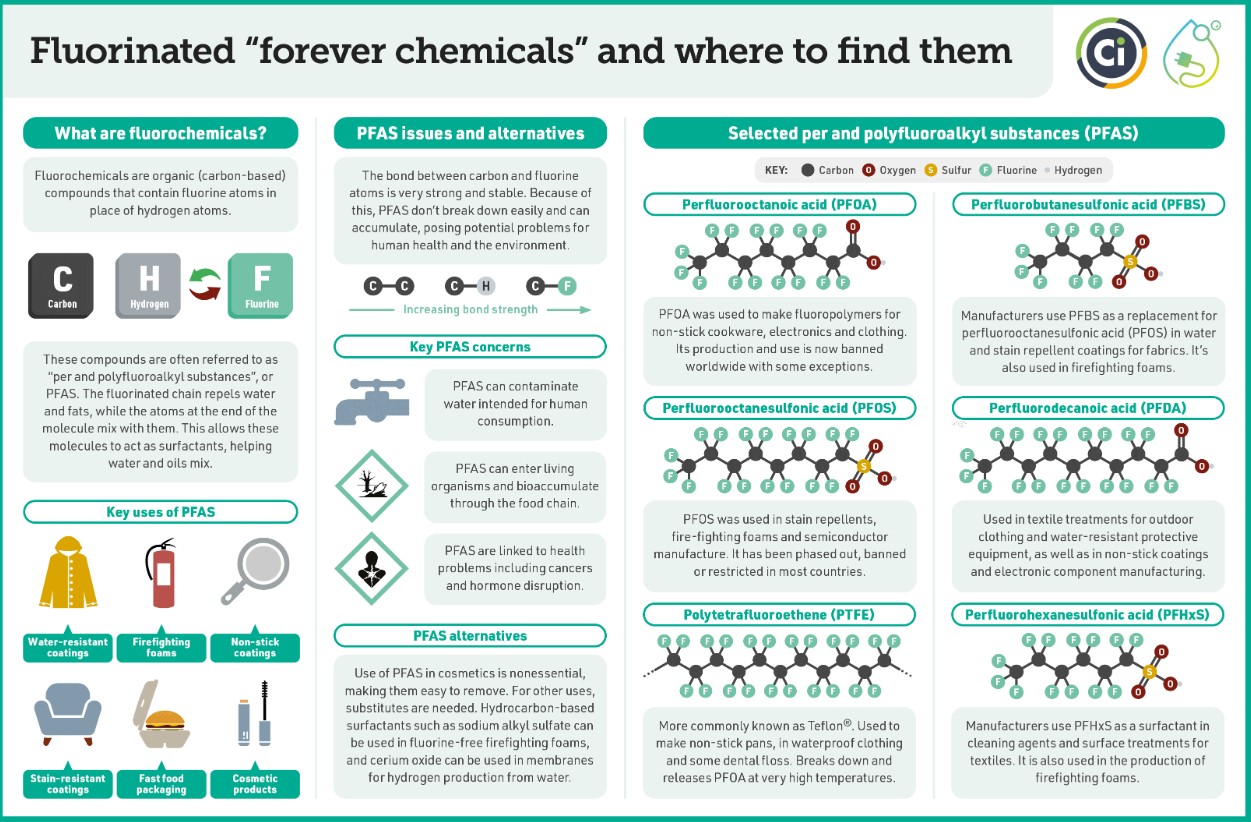
Background: PFAS (“Forever chemicals”)
PFAS (Per- and Polyfluoroalkyl Substances) are a large group of synthetic chemicals.
Nicknamed “forever chemicals” due to:
Extremely strong carbon–fluorine bonds.
High persistence in environment and human body.
Used in:
Non-stick cookware, firefighting foams, waterproof fabrics, food packaging.
Key findings from blood sample analysis (2003–2021)
Older PFAS levels declined by ~86% in human blood samples.
Primary reason: Manufacturers phased out production after regulatory pressure and health concerns.
However, decline does not indicate elimination of PFAS exposure.
Emergence of replacement chemicals
Scientists detected 9Cl-PF3ONS:
Found in 68% of people tested.
Used as a replacement PFAS compound.
Identified Cl-PFNPA:
Detected in human blood for the first time.
Previously unreported in biomonitoring studies.
Health implications
Study did not establish a direct link between these new compounds and autoimmune diseases.
However:
Toxicological profiles of new PFAS variants remain poorly understood.
Past experience shows health effects often emerge years after widespread exposure.
Prelims Practice MCQs
Q. With reference to PFAS, also known as “forever chemicals”, consider the following statements:
They are termed “forever chemicals” due to their resistance to natural degradation.
Declining levels of older PFAS in human blood indicate complete elimination of PFAS exposure.
New PFAS compounds are increasingly being detected as replacements for regulated ones.
Which of the statements given above are correct?
(a) 1 and 3 only
(b) 1 and 2 only
(c) 2 and 3 only
(d) 1, 2 and 3
Correct answer: (a)
Explanation:
Statement 1 is correct: PFAS persist due to strong chemical bonds.
Statement 2 is incorrect: Exposure continues through replacement compounds.
Statement 3 is correct: New PFAS like 9Cl-PF3ONS are replacing older variants.