
NITI Aayog Workshop on Coal Gasification Technology
Context
-
Organized by NITI Aayog.
-
Participants: Ministry of Coal, IIT Delhi, Fraunhofer IKTS (Germany), BHEL, IIT Roorkee, GAIL, CIMFR, IOCL, CIL, TFL, NLCIL, EIL, L&T, JSPL, DVC, CCL, PDIL, CSIR-IMMT, Dastur Energy.
-
Aligned with:
-
National Coal Gasification Mission
-
Make in India
-
Atmanirbhar Bharat
-
India’s Coal Profile
-
4th largest coal reserves in the world: 378 billion tonnes (199 billion tonnes proven).
-
Indian coal = high ash content (25–45%) vs low ash in global coals.
-
Challenge: earlier perception that Indian coal is “non-gasifiable” due to ash.
-
Recent trials prove feasibility through indigenous technology.
Key Workshop Highlights
-
Technology Discussions
-
Focus on fluidized bed, circulating bed, entrained flow systems.
-
Global insights from Fraunhofer IKTS, Germany.
-
Indian pilots: IIT Delhi, Thermax, BHEL, CIMFR.
-
-
Recommendations
-
Circulating fluidized bed gasification most suited for India’s high-ash coal.
-
Other technologies (entrained flow, fixed bed) unsuitable due to Indian coal ash chemistry.
-
Scale up pilot → commercial projects.
-
Integrate Carbon Capture, Utilization & Storage (CCUS).
-
Strong industry involvement in core technology development.
-
Expected Outcomes
-
Acceleration of large-scale coal gasification projects.
-
Development of indigenous technology ecosystems.
-
Contribution to energy security, reduced import dependence, cleaner coal utilization.
-
Roadmap for commercial adoption with policy & financial support.
Chemicals from Coal Gasification

Process
-
Gasification vs Combustion:
-
Combustion → burns coal directly for heat & power.
-
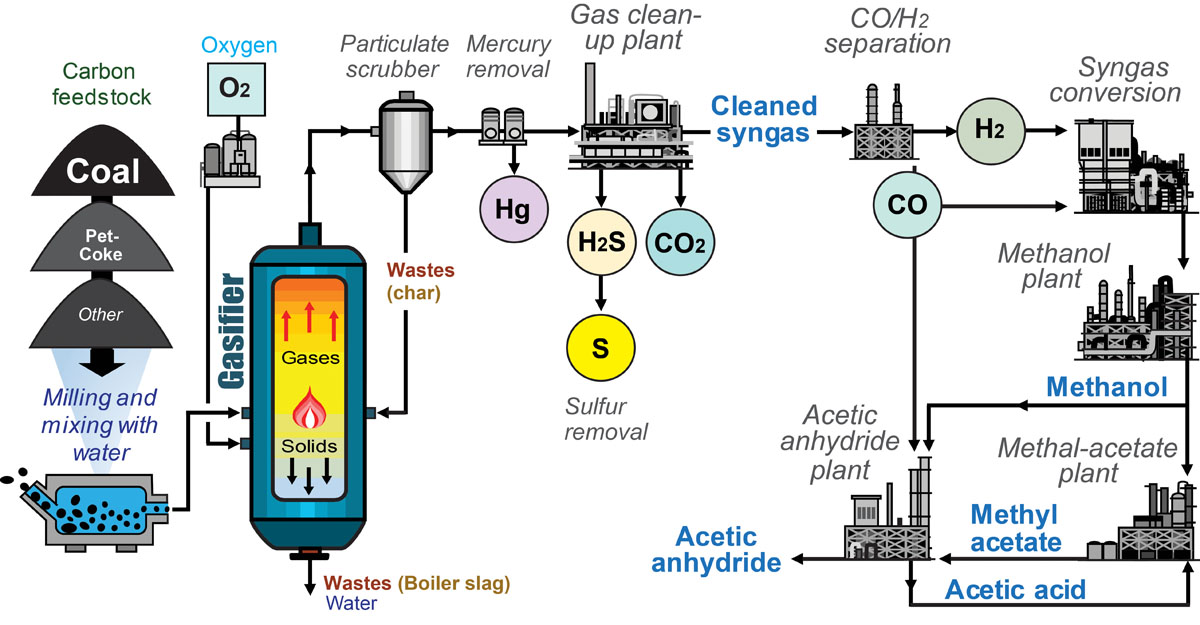
Gasification → coal + water (slurry) + oxygen → thermal-chemical breakdown → produces syngas.
-
-
Syngas Composition:
-
Mainly Carbon Monoxide (CO), Hydrogen (H₂), Water Vapor (H₂O) + minor gases.
-
Acts as a building block for fuels, electricity, and chemical products.
-
Industrial Example
-
Feedstock: Coal or coal + pet-coke mix.
-
Steps:
-
Particulates removed.
-
Purification: Removal of Hg, H₂S, CO₂.
-
Sulfur recovered as elemental sulfur (S).
-
-
Syngas separation → CO + H₂ (feedstocks).
-
Conversion to Methanol (CH₃OH).
-
Derivatives:
-
Methyl acetate → Acetic acid & Acetic anhydride.
-
Acetic anhydride: Used in photographic film, textiles, plastics, pharmaceuticals.
-
-
Key Products from Coal Gasification
-
Methanol – precursor for formaldehyde, olefins, fuels.
-
Ammonia (NH₃) – fertilizers, explosives.
-
Urea – nitrogen fertilizers.
-
Hydrogen (H₂) – refining, steel, green fuel.
-
Carbon Monoxide (CO) – acetic acid, plastics, resins.
-
Synthetic Natural Gas (SNG) – substitute for natural gas.
-
Acetic Anhydride – textiles, film, industrial solvents.