
Nobel Prize in Physics 2025 — Quantum Tunnelling and Superconducting Circuits
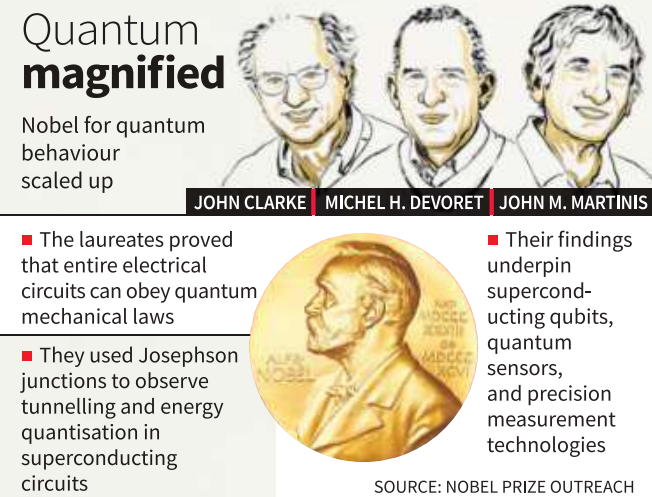
Awardees
Laureates:
John Clarke (University of California, Berkeley, USA)
Michel Devoret (École Normale Supérieure, France / UC Berkeley)
John Martinis (University of California, Santa Barbara, USA)
Announced by the Royal Swedish Academy of Sciences (2025)
For Discovery of macroscopic quantum tunnelling and energy quantisation in electrical circuits.
Core Contribution
The trio organised and manipulated single quantum particles to exhibit quantum tunnelling — a phenomenon usually confined to subatomic scales.
They demonstrated that quantum effects can be observed and controlled in engineered electrical circuits, bridging the micro (quantum) and macro (classical) worlds.
Quantum Tunnelling
Definition: The ability of a particle to pass through an energy barrier it classically should not cross.
Example : A cricket ball hitting the ground would normally bounce back, but in quantum tunnelling, a few “cricket-ball particles” pass through the ground instead.
Significance:
Core principle in quantum physics.
Explains phenomena like alpha decay, electron transport in semiconductors, and scanning tunnelling microscopy.
Experiment
The scientists designed an electrical circuit with two superconductors, separated by a thin insulating layer known as a Josephson junction.
Superconductors: Materials that conduct electricity without resistance.
Josephson junction: A structure where electron pairs (Cooper pairs) can quantum mechanically tunnel through an insulator.
Allows electrons to tunnel quantum mechanically through the insulator.
This tunnelling current is highly sensitive to magnetic fields and quantum states.
These circuits form the basis of quantum bits (qubits) used in quantum computers.
Observations:
At temperatures near absolute zero, electric current could escape from a zero-voltage state by tunnelling through the barrier — a purely quantum phenomenon.
The system exhibited discrete energy levels, not continuous ones — evidence of energy quantisation at a macroscopic scale.
The superconducting phase difference — representing the collective motion of trillions of electrons — behaved as a single quantum variable.
To ensure accuracy, the experiment was isolated from microwave radiation and thermal noise.
Technological Impact
Josephson Junctions now form the basis for:
Superconducting Qubits → used in quantum computers (IBM, Google, etc.)
Quantum voltage standards
Ultrasensitive magnetometers (SQUIDs – Superconducting Quantum Interference Devices)
Single-photon detectors in astronomy and biomedical imaging
Their discoveries laid the foundation for modern quantum technologies such as:
Quantum computation
Quantum communication
Quantum sensing