
NUCLEAR ENERGY MISSION
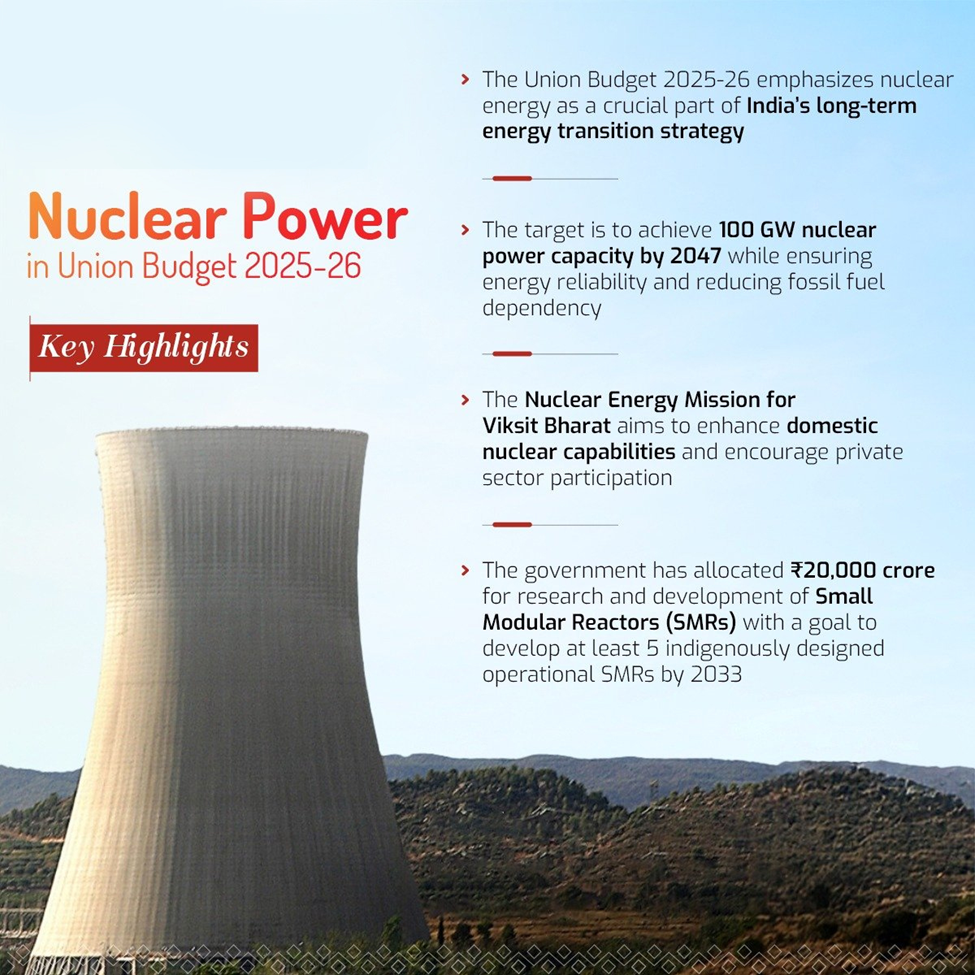
Vision: 100 GW Nuclear Power Capacity by 2047 for Viksit Bharat and Net Zero by 2070
Mission Objectives
-
Augment nuclear power capacity to 100 GW by 2047.
-
Support base load power requirement with low-carbon energy.
-
Accelerate India’s path toward Net Zero emissions by 2070.
-
Reduce dependence on fossil fuels for power, industry, and transport.
Scope and Deployment Strategy
-
Mix of large and small nuclear power plants:
-
In greenfield (new) and brownfield (existing) sites.
-
Captive plants for industries.
-
Off-grid installations in remote locations.
-
-
Support for:
-
Repurposing retiring thermal power plants.
-
Decarbonising industrial and transport sectors.
-
-
Active private sector participation.
-
Emphasis on R&D for advanced technologies and Small Modular Reactors (SMRs).
Indigenous Development of SMRs by BARC
| Type | Output | Application |
|---|---|---|
| BSMR (Bharat Small Modular Reactor) | 200 MWe | Base load, captive |
| Small Modular Reactor | 55 MWe | Decentralized grids |
| High Temp Gas-Cooled Reactor | 5 MWth | Hydrogen production via thermochemical process |
-
Construction timeframe: 60–72 months post-administrative sanction.
-
Lead units to be installed at DAE sites with NPCIL collaboration.
Current Nuclear Power Status (as of Aug 2025)
| Category | Capacity |
|---|---|
| Installed capacity | 24 reactors → 8,780 MW |
| Under construction | 18 reactors → 13,600 MW (includes PFBR 500 MW) |
| Targeted mid-term capacity | 22,380 MW |
Resource Base: Uranium in India
-
Total U₃O₈ (Uranium oxide) resource: 4,33,800 tonnes (in-situ).
-
Located in 47 deposits across:
-
AP, Telangana, Jharkhand, Meghalaya, Rajasthan, Karnataka, Chhattisgarh, UP, Uttarakhand, HP, Maharashtra
-
-
New find (2025):
-
26,437 tonnes in Jaduguda North-Baglasai Mechua, Jharkhand (NW extension of Jaduguda deposit).
-
Safety Architecture
-
Regulatory oversight:
-
Independent monitoring by Atomic Energy Regulatory Board (AERB).
-
Continuous reviews and strict procedural compliance.
-
Applications Beyond Power
-
Hydrogen Production:
-
High-temperature gas-cooled reactors for green hydrogen.
-
-
Transport & Industry:
-
Nuclear-generated hydrogen and captive power for decarbonizing sectors.
-
Significance of the Mission
-
Strategic:
-
Enhances energy security and reduces import dependence.
-
-
Economic:
-
Enables clean base-load power for industrial growth.
-
-
Environmental:
-
Aids in carbon neutrality, especially where solar/wind are insufficient for base load.
-
Challenges to Address
-
High capital costs and long gestation.
-
Public perception and safety concerns.
-
Waste disposal and uranium supply security.
-
Need for skilled human resources and technological breakthroughs (e.g., thorium reactors in future).
Way Forward
-
Fast-track construction of approved projects.
-
Strengthen international cooperation (e.g., with France, Russia, US).
-
Accelerate indigenous SMR development and deployment.
-
Integrate nuclear energy into Just Energy Transition plans.