
Nuclear Power in Space – U.S. Lunar Fission Reactor & Global Governance Challenges
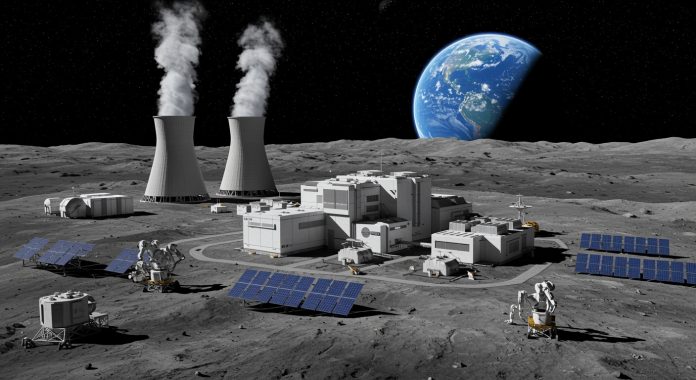
U.S. Lunar Fission Surface Power Project
The U.S. has announced plans to deploy a small nuclear fission reactor on the Moon by early 2030s.
This would be the first permanent nuclear power source beyond Earth orbit, marking a new era in space exploration.
Why nuclear power?
Solar energy on the Moon is limited due to:
Two-week-long lunar nights
Low sunlight at poles
Sustained human presence on the Moon and Mars requires reliable, continuous, high-density energy, which nuclear reactors can provide.
Promise of Nuclear Power in Space
1. Radioisotope Thermoelectric Generators (RTGs)
Have powered missions like Voyager.
Convert heat from plutonium-238 decay into electricity.
Resistant to dust/darkness but produce only hundreds of watts → inadequate for habitats or industry.
2. Compact fission reactors
Size: similar to a shipping container.
Power output: tens to hundreds of kilowatts.
Applications:
Life support systems
Laboratories
Manufacturing units
3. Future demands: industrial-scale ISRU
In-situ resource utilisation (ISRU) on Mars:
Converting water ice → rocket fuel + oxygen.
Requires 1 MW+ continuous power.
Solar energy insufficient for such demands.
4. Reactor deployment in extraterrestrial environments
On Mars: reactors can be buried under regolith:
Natural shielding from cosmic radiation
High energy output
On the Moon: reactors can support:
Warm habitats
Water/ice processing
Fuel production
Recharging vehicles
Advances in Nuclear Space Technology
Nuclear thermal propulsion
Propellant heated by nuclear decay and expelled through nozzles.
U.S. DRACO programme to test it in lunar orbit by 2026.
Could shorten Mars travel time → reduced exposure to cosmic rays.
Nuclear electric propulsion
Reactor-generated electricity ionises propellant.
Enables years of efficient thrust for deep-space probes and cargo missions.
Legal and Governance Challenges ("Legal Vacuum")
Existing framework: UN Principles (1992)
UNGA Resolution 47/68: Guidelines on nuclear power sources in space.
Apply only to RTGs and electricity-generation reactors.
Key obligations:
Principle 3: prevent radioactive release in normal/emergency conditions
Principle 4: pre-launch safety analysis
Principle 7: emergency notification for malfunctions or reentry
Limitations:
Non-binding (GA resolution) → no enforcement mechanism.
No coverage of:
Nuclear thermal propulsion
Nuclear electric propulsion
No binding technical standards for:
Reactor design
Operational limits
End-of-life disposal
Gaps in broader space law
Outer Space Treaty: bans WMDs in orbit, silent on peaceful nuclear propulsion.
Liability Convention: unclear about accidents in cislunar/deep space involving reactors.
NPT: only partial relevance.
Environmental concerns
No binding protocols to prevent:
Radioactive contamination of celestial bodies
Unsafe disposal of reactors
Risk: irreversible alteration of pristine extraterrestrial environments.
Issue of “safety zones”
Needed around reactors for protection.
But cannot become a pretext for territorial appropriation, which violates the Outer Space Treaty.
Highlighted by ESA advisor Kai-Uwe Schrogl.
Need for Updated Global Governance
Why reform is urgent
Nuclear accidents in space can have cross-border, long-lasting consequences.
Growing number of actors (state + private) increases risk.
Without regulations, the “nuclear dawn” in space could become a new Cold War.
What reforms are needed
Update 1992 UN Principles:
Include propulsion reactors
Define safety benchmarks
Establish disposal standards
Develop binding environmental protocols under UNCOPUOS.
Create multilateral oversight mechanism (similar to IAEA) to:
Certify reactor designs
Verify compliance
Improve transparency
India’s Role
Strategic opportunity
Collaboration between ISRO + Department of Atomic Energy can:
Develop a domestic space reactor
Power operations in lunar shadowed regions
Enable continuous Mars ISRU
Showcase India’s deep-space technological leadership
Norm-making leadership
India can champion:
Safe nuclear practices in space
Balanced approach between ambition and restraint
Multilateral governance for a multipolar space era
Similar to its past leadership in non-aligned diplomacy.
Prelims Practice MCQs
Q. Which of the following is a major limitation of RTGs for future human space settlements?
A. They are too large for spacecraft
B. They produce insufficient electrical power for habitats and industry
C. They require continuous sunlight
D. They cannot operate beyond Earth’s orbit
Correct answer: B
Explanation: RTGs produce only a few hundred watts, inadequate for life support and ISRU.
Q. The DRACO programme relates to:
A. Nuclear-powered lunar habitation modules
B. Nuclear thermal propulsion technology
C. Solar electric propulsion for Mars missions
D. Mining helium-3 on the Moon
Correct answer: B
Q. The 1992 UN Principles Relevant to Nuclear Power Sources in Outer Space are limited because:
They are non-binding
They do not cover nuclear thermal propulsion
They lack mandatory safety design standards
A. 1 and 2 only
B. 1 and 3 only
C. 1, 2 and 3
D. 2 and 3 only
Correct answer: C
Explanation: All three limitations are explicitly noted.
Q. Which of the following international treaties prohibits the placement of WMDs in Earth orbit?
A. Liability Convention
B. Outer Space Treaty
C. Moon Agreement
D. Nuclear Non-Proliferation Treaty
Correct answer: B