
Nucleic Acid Test (NAT) And Safe Blood Transfusion
Context
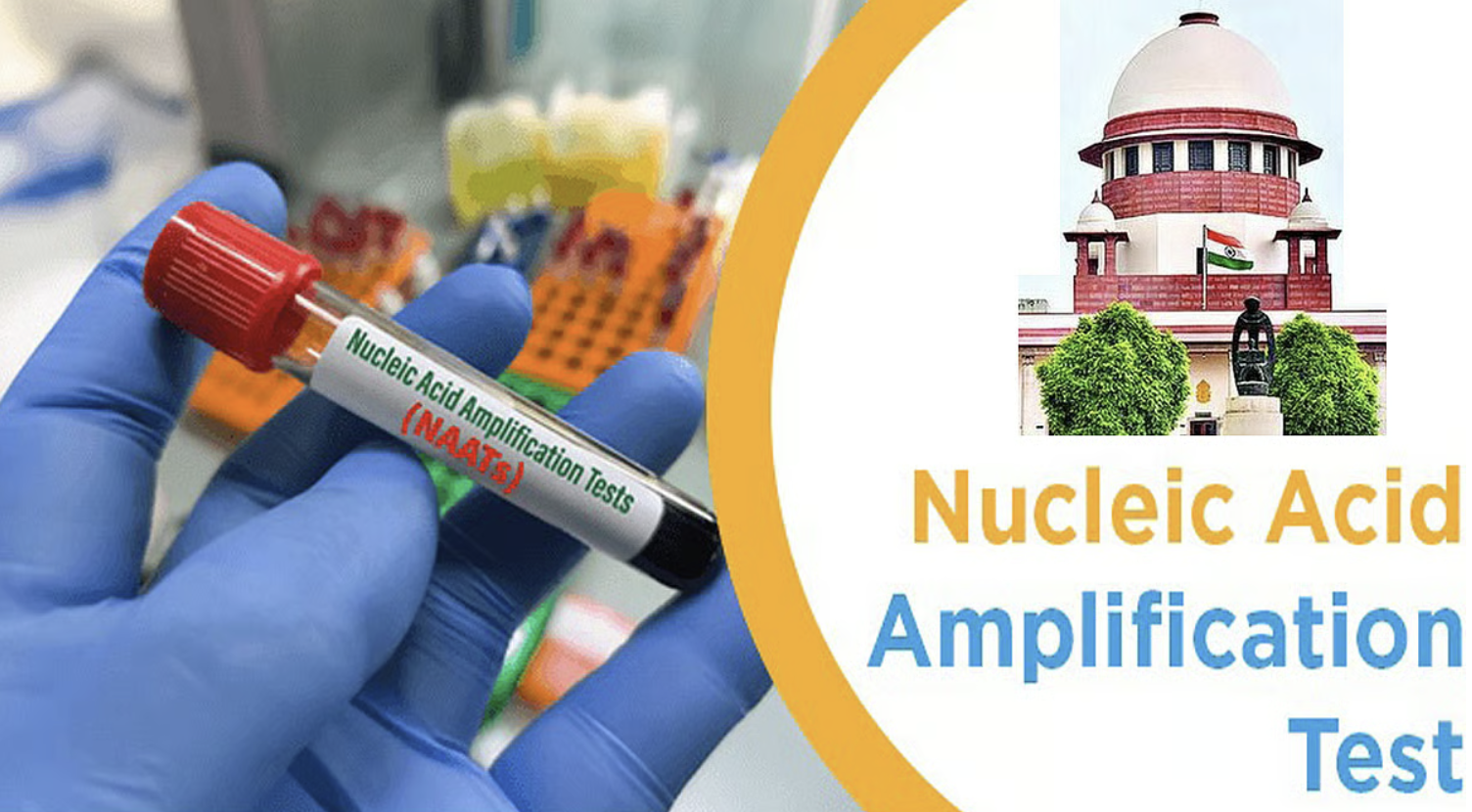
The Supreme Court of India is examining whether Nucleic Acid Testing (NAT) should be made compulsory in blood banks across India to prevent transfusion-transmitted infections (TTIs). The petition argues that safe blood transfusion is part of the Right to Life under Article 21 of the Constitution.
What Is Nucleic Acid Test (NAT)?
NAT is an advanced molecular diagnostic technique that detects the genetic material (RNA or DNA) of viruses in donated blood.
Unlike conventional antibody-based tests, NAT identifies infection at a much earlier stage because it detects the virus itself rather than the immune response.
Viruses commonly screened:
HIV (Human Immunodeficiency Virus)
Hepatitis B Virus (HBV)
Hepatitis C Virus (HCV)
NAT is considered highly sensitive and reduces the “window period” — the time between infection and detectability.
NAT vs ELISA – Technical Comparison
The current standard screening method in many blood banks is ELISA (Enzyme-Linked Immunosorbent Assay).
Scientific Difference
ELISA detects:
Antibodies or antigens produced in response to infection.
NAT detects:
Viral genetic material directly.
Feature | NAT | ELISA |
Type | Molecular test | Antibody-based test |
Detects | Viral genetic material | Antibodies/antigens |
Window period detection | Yes (shorter) | Limited |
Sensitivity | Higher | Lower |
Cost | Higher | Relatively cheaper |
Implication
Because antibodies take time to develop, ELISA may fail to detect infections during early stages. NAT significantly reduces this detection gap.
Window Period – Why NAT Matters
Window period is the duration between:
Entry of virus into bloodstream
Development of detectable antibodies
During this time:
ELISA may return negative result
Blood may still be infectious
NAT shortens this window considerably, reducing transfusion-related infections.
Public Health Context – Thalassemia
Thalassemia is:
An inherited genetic blood disorder
Characterised by insufficient haemoglobin production
Requires regular blood transfusions
India has one of the highest thalassemia burdens globally.
Frequent transfusion patients face higher risk of:
HIV
Hepatitis B
Hepatitis C
The petition describes infected transfusions as “preventable tragedies.”
Constitutional Dimension
Under Article 21, the Supreme Court has expanded the Right to Life to include:
Right to health
Right to medical care
Right to dignified life
The petitioner argues:
Safe blood transfusion is integral to the right to health and life.
This case builds upon the privacy and health jurisprudence developed post Puttaswamy judgment.
Issues Before The Court
The Court is examining:
Whether NAT should be mandatory nationwide.
Whether States can financially sustain NAT.
Cost-effectiveness compared to ELISA.
Current status of NAT adoption in State hospitals.
The Bench has asked for an affidavit detailing:
States using NAT
Number of hospitals implementing NAT
Economic And Administrative Concerns
A. Cost Factor
NAT requires specialised equipment.
Higher operational cost than ELISA.
May strain weaker State health budgets.
B. Federal Dimension
Health is a State subject (List II, Seventh Schedule).
Mandating NAT nationally may require:
Central funding
Policy harmonisation
C. Infrastructure Gaps
Not all blood banks have molecular testing facilities.
Skilled manpower requirements.
Prelims Practice MCQs
Q. With reference to Nucleic Acid Testing (NAT), consider the following statements:
NAT detects antibodies produced in response to viral infection.
NAT can reduce the window period for detecting infections in donated blood.
NAT is primarily used for detecting bacterial contamination in blood.
Which of the statements given above are correct?
(a) 2 only
(b) 1 and 3 only
(c) 2 and 3 only
(d) 1, 2 and 3
Answer: (a)
Explanation:
Statement 1 is incorrect — NAT detects viral genetic material (RNA/DNA), not antibodies.
Statement 2 is correct — NAT reduces the window period significantly.
Statement 3 is incorrect — NAT is mainly used for viral detection (HIV, HBV, HCV), not bacterial contamination.
Q. The term “window period” in blood screening refers to:
(a) The time taken to complete laboratory testing
(b) The period between infection and detectability of antibodies
(c) The time during which blood is stored before transfusion
(d) The incubation period of genetic disorders
Answer: (b)
Explanation:
Window period is the time between viral infection and the point when antibodies become detectable. During this period, ELISA may fail but NAT can detect infection.
Q. Enzyme-Linked Immunosorbent Assay (ELISA) differs from NAT because ELISA:
(a) Detects viral RNA directly
(b) Is a molecular amplification technique
(c) Detects antibodies or antigens
(d) Requires gene sequencing
Answer: (c)
Explanation:
ELISA detects antibodies or antigens.
NAT detects viral nucleic acids through molecular amplification techniques.