
Odisha Speaker rejects Congress notice for no-confidence motion

Context:
Odisha Assembly Speaker Surama Padhi on Monday rejected the notice for no-confidence motion submitted by the Congress, challenging the performance of the Mohan Majhi government.
The Speaker ruled that the motion could not be moved as the Congress failed to place it on the day following the filing of the notice. The Congress, however, alleged that the House was not in order and accused the Speaker of deliberately rejecting its notice.
No-Confidence Motion – Meaning
It is a motion moved by the opposition to test whether the Council of Ministers still enjoys the confidence (majority support) of the House.
If passed, the government is obliged to resign.
Constitutional & Procedural Basis
Article 75(3) (Union) & Article 164(2) (States):
“Council of Ministers shall be collectively responsible to the House of the People/Legislative Assembly.”
No-confidence is not in the Constitution directly but is governed by Rules of Procedure of the House.
Procedure in Lok Sabha (similar in State Assemblies)
Notice:
Any member (Lok Sabha MP)can give a written notice to the Speaker.
The notice must be supported by at least 50 members (in Lok Sabha; number differs in State Assemblies depending on rules).
Provided under Rule 198 of the Lok Sabha (Rules of Procedure).
Can be moved only in Lok Sabha (not Rajya Sabha).
No need to state the reason.
Can be adopted without prior justification.
- A member has to give a written notice of the motion before 10 am, which is then read out by the Speaker of the House.
The Constitution of India does not mention the words 'No-Confidence Motion'.
Admissibility:
The Speaker examines the notice.
If admitted, the Speaker announces it in the House.
Allotment of Time:
The motion must be taken up within 10 days of being admitted.
A date is fixed for discussion and voting.
Debate & Voting:
The motion is debated.
At the end, a vote is held.
If a majority of the total members present and voting support the motion, the government falls.
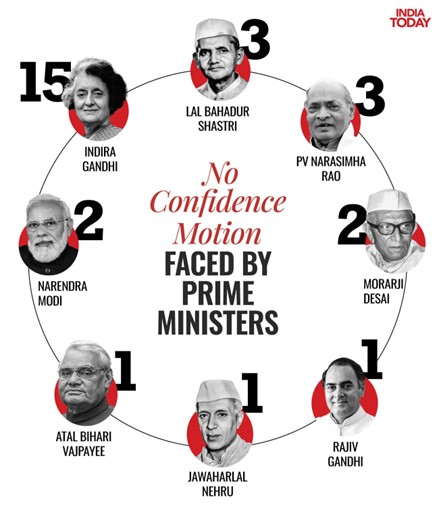
First ever no confidence motion was moved in 1963 against the Nehru government after the India-China war.
.
In State Legislative Assemblies
The same principle applies.
The Speaker decides on admissibility and timing.
If procedure is not strictly followed (for example, as in the Odisha case — not moving it on the very next day), the Speaker can reject it.