
Pamir–Karakoram anomaly.
Context
There is rapid global glacier retreat around the world due to climate change.
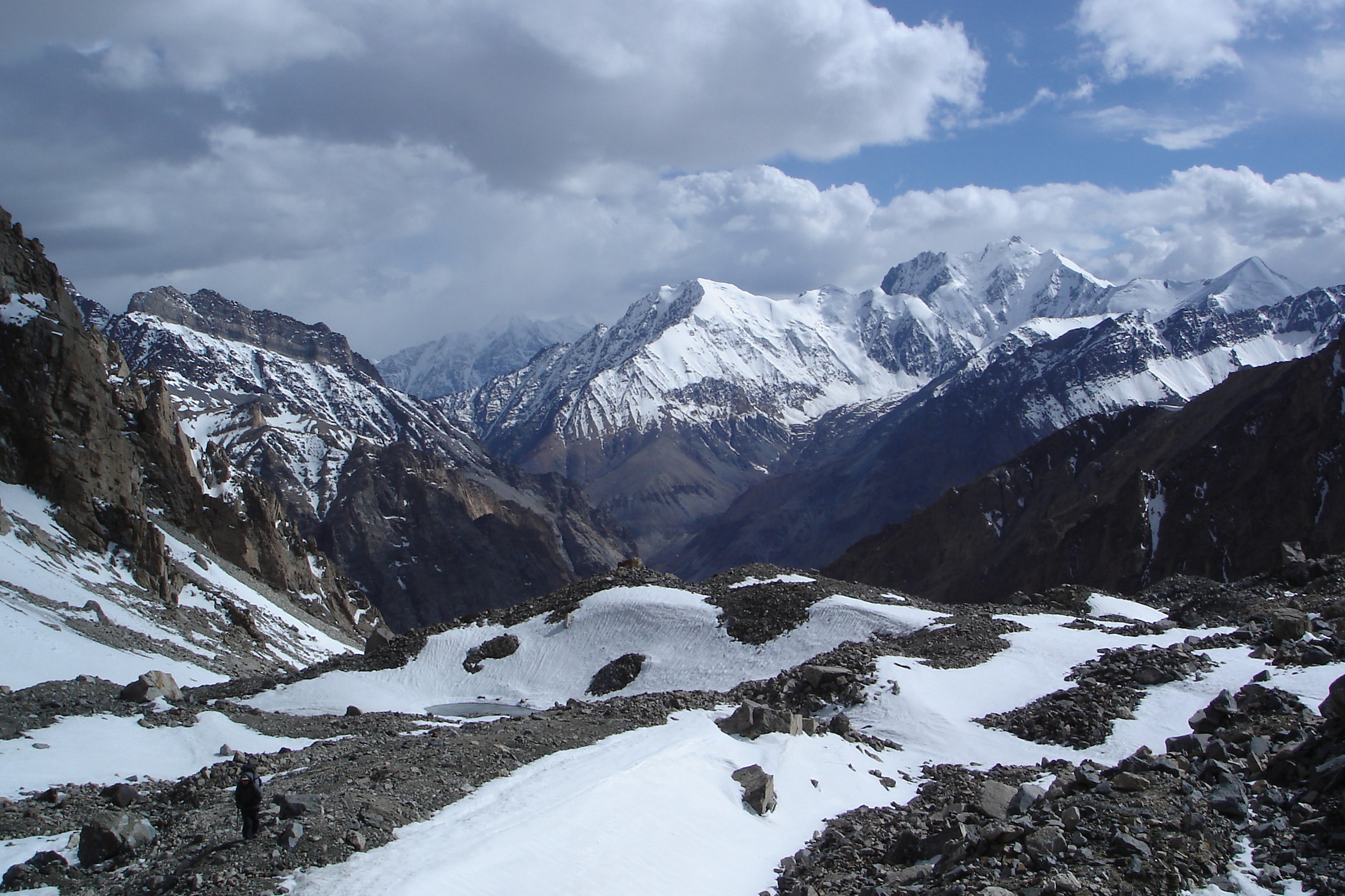
Exception: Pamir–Karakoram region (Tajikistan–Central Asia) where glaciers have remained stable or slightly grown.
This unusual behaviour is called the Pamir–Karakoram anomaly.
Earlier this year, scientists braved harsh conditions to a site at an altitude of 5,810 m on the Kon-Chukurbashi ice cap in the Pamir Mountains.

Pamir–Karakoram anomaly
Meaning
A phenomenon where glaciers in the Pamir–Karakoram region:
Have not retreated significantly.
In some cases, have increased in volume, unlike most global glaciers.
Reasons under consideration
Colder regional climatic conditions.
Increased precipitation over the last century.
Possible impact of agricultural irrigation in Pakistan, increasing atmospheric moisture.
Ice cores provide the first direct physical evidence to test these hypotheses.

What ice cores reveal
Climatic indicators
Clear ice layers → Warm periods with melting and refreezing.
Low-density layers → Snow accumulation, indicator of precipitation.
Brittle/cracked ice → Snowfall over partially melted layers.
Volcanic sulphates → Time markers for dating layers.
Water isotopes → Past temperature reconstruction.
Time scale
Potentially records climate history up to 10,000 years.
However, significant melting occurred around 6,000 years ago during a warm phase.
Prelims practice MCQs
Q. The term “Pamir–Karakoram anomaly” refers to:
A. Accelerated glacier melting in Central Asia
B. Stable or slightly growing glaciers despite global warming
C. Volcanic activity beneath Pamir glaciers
D. Artificial glacier creation through irrigation
Answer: B
Explanation:
The anomaly denotes the unusual stability or growth of glaciers in the Pamir–Karakoram region, contrary to global trends.
Q. Ice cores are scientifically valuable because they:
Preserve long-term climatic records
Contain isotopic evidence of past temperatures
Indicate historical volcanic activity
Which of the above are correct?
A. 1 and 2 only
B. 2 and 3 only
C. 1, 2 and 3
D. 1 only
Answer: C
Explanation:
Ice cores store layered climatic information including snowfall, temperature (via isotopes), and volcanic markers like sulphates.
Q. Kon-Chukurbashi ice cap, mentioned in the news, is located in:
A. Andes Mountains
B. Alps
C. Pamir Mountains
D. Tien Shan Mountains
Answer: C
Explanation:
The Kon-Chukurbashi ice cap lies in the Pamir Mountains of Tajikistan