
Pandit Chhannulal Mishra (1936–2025): Legacy of Thumri
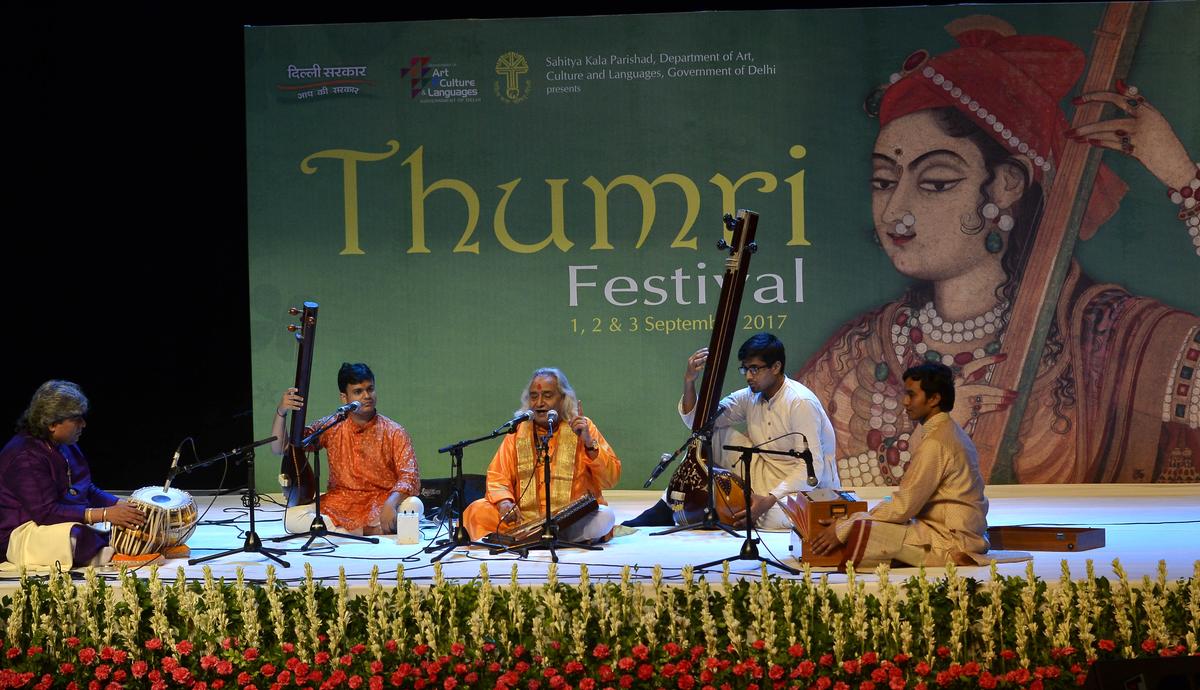
Context: Renowned classical singer and Padma Vibhushan awardee Pandit Channulal Mishra passed away
Early Life
Born: August 3, 1936, Hariharpur (Azamgarh, U.P.)
Musical family background; father Badri Prasad Mishra was his first teacher.
Trained under Ustad Abdul Ghani Khan (Kirana Gharana).
Influenced by Thakur Jaidev Singh (musicologist) – developed ability to transcend gharana boundaries.
He was an exponent of the Banaras gharana and the Purab Ang tradition of Thumri.
Musical Contributions
Genres: Thumri, Khayal, Chaiti, Hori, Ghazals, Devotional music.
Languages: Awadhi, Brijbhasha, Urdu, Sanskrit.
Style: Fusion of Kirana and Benaras Gharanas – combining rigour of Hindustani classical with lyrical nuances of semi-classical.
Known for spiritual and poetic sensitivity – every note aligned with meaning of text.
Instruments: Frequently accompanied by swarmandal, adding ethereal quality.
Cultural Significance
Symbol of syncretic culture of Varanasi, alongside Ustad Bismillah Khan.
Blended devotional mysticism (Tulsidas, Kabir) with popular appeal, elevating taste of lay audiences.
Expanded Thumri beyond elite chambers; made semi-classical accessible.
Saw stage as temple, transforming performance into spiritual communion.
Embodied Narada’s dictum: Music as devotion.
Recognition & Popular Appeal
He won Padma Vibhushan in 2020 and Padma Bhushan in 2010.
Appeared in cinema – sang Saans Albeli (Aarakshan, 2011), connecting with younger audiences.
Revered as “musician without reservations”, appealing across generations.
Socio-Political Role
In 2014, one of the four proposers for Narendra Modi’s Varanasi Lok Sabha nomination, becoming a symbol of cultural nationalism.
Legacy
Voice described as “sacred confluence of Shiva’s damru and Ganga’s serenity.”
Expanded Thumri’s boundaries, keeping semi-classical traditions alive in the modern era.
Leaves behind a repertoire spanning devotional, classical, semi-classical, and cinematic music.
Thumri: A Semi-Classical Vocal Genre
Meaning & Etymology
Derived from Bhojpuri word thumak (to walk gracefully with jingling anklets).
Associated with dance, dramatic gestures, mild eroticism, and evocative love poetry.
Origins & Evolution
Early traces linked to Bhakti saints: Jayadeva (Gita Govinda), Ramanuja, Ramanand.
Reached mass popularity in Chaitanya Mahaprabhu’s kirtans (16th c.) – blending devotion and love for Krishna.
Flourished under Vaishnavism and Sufism influences, celebrating divine love.
18th–19th century: Patronage at the court of Nawab Wajid Ali Shah of Awadh (Lucknow).
Bandish ki thumri (bol-baant) → linked with Kathak dance and courtesan culture.
Later 19th century in Varanasi: Bol-banav thumri evolved – slower, more introspective, devotional.
Key Characteristics
Themes:
Shringara rasa (love, union, separation).
Blend of romantic & devotional moods.
Language:
Awadhi, Brij Bhasha, Bhojpuri, Urdu.
Musical Aspects:
Limited set of ragas: Kafi, Khamaj, Bhairavi, Pilu, Pahadi, Jogiya.
Structure: Sthayi and Antara.
Popular talas: Deepchandi, Roopak, Addha, Punjabi (lighter, lilting).
Allows raga-mixing and expressive improvisation.
Performance Style:
Historically tied to Kathak dance.
Requires emotional, supple voice to express nuanced feelings.
Ends often with laggi (fast tabla improvisation).
Types of Thumri
Purab Ang (Banaras style) – lyrical, devotional, slow (bol-banav).
Lucknow style – more dance-oriented, associated with courtesans.
Comparison: Thumri vs Khayal
Khayal – elaborates raga deeply, emphasizes grandeur and structure.
Thumri – prioritizes emotion & poetry, lighter and more intimate.
Today, Thumri often concludes Khayal concerts, leaving a lingering emotional effect.
Noted Exponents
Purab Ang / Banaras Style: Rasoolan Bai, Siddheshwari Devi, Girija Devi, Mahadev Prasad Mishra, Pandit Chhannulal Mishra.
Other Icons: Gauhar Jan, Begum Akhtar, Shobha Gurtu, Naina Devi, Noor Jehan, Nirmala Devi.
Khayal singers who also performed Thumri: Bade Ghulam Ali Khan, Bhimsen Joshi, Rajan & Sajan Mishra, Prabha Atre.
Instruments Used
Vocal focus, supported by:
Tabla, Tanpura (drone), Harmonium, Sarangi, Swarmandal.
Cultural Significance
Represents synthesis of folk, devotional, and classical traditions.
Syncretic tradition: Hindu Bhakti & Islamic Sufi influences.
Elevated from courtesan culture to concert stage & devotional platform.
Deeply tied to Kathak dance and the cultural ethos of Awadh & Banaras.
Practice UPSC MCQ
Consider the following statements about Pandit Chhannulal Mishra:
He was a leading exponent of the Purab Ang style of Thumri.
He was awarded the Padma Vibhushan.
He trained under Ustad Abdul Ghani Khan of the Kirana Gharana.
Which of the statements given above are correct?
A) 1 and 2 only
B) 2 and 3 only
C) 1 and 3 only
D) 1, 2 and 3
Answer: D) 1, 2 and 3