
Pennaiyar river dispute: Supreme Court directs Centre to form tribunal
Why in news
The Supreme Court of India has directed the Union Government to constitute an inter-State river water disputes tribunal to adjudicate the long-pending dispute between Tamil Nadu and Karnataka over the sharing of Pennaiyar river waters.
Key directions of the Supreme Court
A Bench headed by Justice Vikram Nath ordered the Centre to notify the tribunal within one month.
The direction was issued under Section 5 of the Inter-State River Water Disputes Act, 1956.
The Court allowed Tamil Nadu’s complaint to be formally placed before the tribunal once it is constituted.
Background of the dispute
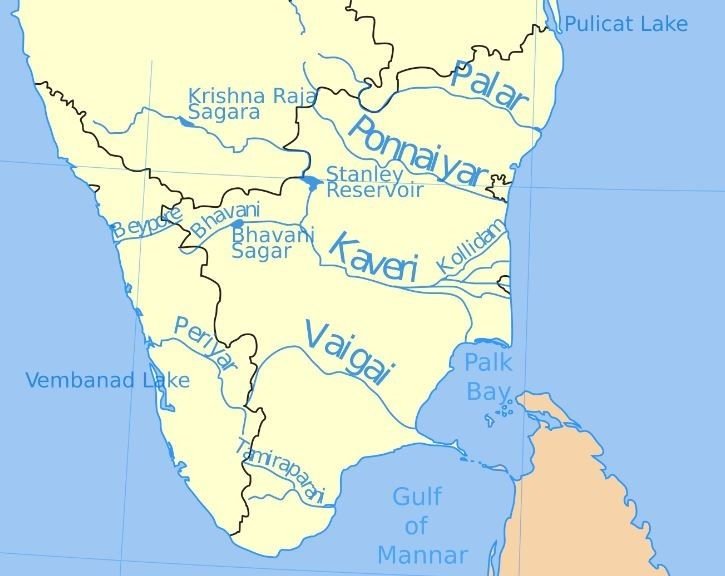
Pennaiyar River is an inter-State river, flowing from Karnataka to Tamil Nadu.
In 2018, Tamil Nadu approached the Supreme Court alleging that:
Karnataka was constructing dams and diversion structures on the river.
Such actions would prejudice downstream flows to Tamil Nadu.
Arguments by Tamil Nadu
No State has exclusive ownership over waters of an inter-State river.
Flowing water of an inter-State river is a national asset.
The 1892 agreement governing Pennaiyar river waters is valid and binding on both States.
Karnataka should be restrained from initiating new schemes in the Pennaiyar basin until adjudication by a tribunal.
Ponnaiyar river (South Pennar / Dakshina Pinakini / Thenpennai)
Basic information
Also known as:
Dakshina Pinakini (Kannada)
Thenpennai / Ponnaiyar / Pennaiyar (Tamil)
Type: Inter-State river
Country: India
States: Karnataka and Tamil Nadu
Empties into: Bay of Bengal
Source and course
Source: Nandi Hills, Chikkaballapura district, Karnataka
Mouth: Near Cuddalore, Tamil Nadu
Length: ~500 km (497 km in Tamil Nadu)
Status: Second longest river in Tamil Nadu after the Kaveri
Major cities and settlements along the river
Chikkaballapura
Bangalore
Hosur
Krishnagiri
Kaveripattinam
Tiruvannamalai
Cuddalore
Important for Prelims: The river flows through major industrial belts, especially around Bangalore and Hosur.
Tributaries
Left bank: Pambar River
Right bank: Vanniyar River
Basin and hydrology
Catchment area: ~3,690 sq km (spread across Karnataka and Tamil Nadu)
Nature: Mostly seasonal river
Water flow depends on:
South-West monsoon (upper catchment in Karnataka)
North-East monsoon (Tamil Nadu)
Plays a major role in:
Groundwater recharge
Feeding tanks and reservoirs in northern Tamil Nadu
Dams and infrastructure
Kelavarapalli Dam – near Hosur
Krishnagiri Dam – near Krishnagiri
Sathanur Dam – near Tiruvannamalai
Largest dam on the river
Gross capacity: ~7.3 Tmcft
Environmental concerns
Severe pollution due to:
Industrial effluents
Urban sewage, especially from Bangalore
Sewage inflow through:
Bellandur Lake
Varthur Lake
The old course of Dakshina Pinakini is stated to have disappeared.
Historical and cultural significance
References found in:
Sangam literature
Tevaram (Bhakti period) hymns
Historically described as a perennial river with rich vegetation
Important religious sites on its banks include:
Penneswaraar Temple
Veerateshwarar Temple
Kabilar Kundru
Shree Venkateshwara Swamy Temple (Dakshina Tirupati)
Prelims Practice MCQs
Q. With reference to the Ponnaiyar (South Pennar) River, consider the following statements:
It originates in the Nandi Hills of Karnataka.
It is the longest river entirely within Tamil Nadu.
It drains into the Bay of Bengal.
Which of the statements given above is/are correct?
(a) 1 and 3 only
(b) 2 only
(c) 1 and 2 only
(d) 1, 2 and 3
Correct answer: (a)
Explanation:
Statement 1 is correct: Origin is Nandi Hills, Karnataka.
Statement 2 is incorrect: It is the second longest river in Tamil Nadu, after the Kaveri.
Statement 3 is correct: It empties into the Bay of Bengal near Cuddalore.
Q. Which of the following rivers are tributaries of the Ponnaiyar River?
Pambar River
Vanniyar River
Bhavani River
Select the correct answer using the code below:
(a) 1 only
(b) 1 and 2 only
(c) 2 and 3 only
(d) 1, 2 and 3
Correct answer: (b)
Explanation:
Pambar is a left-bank tributary.
Vanniyar is a right-bank tributary.
Bhavani is a tributary of the Kaveri, not Ponnaiyar.