
PM E-DRIVE scheme and challenges
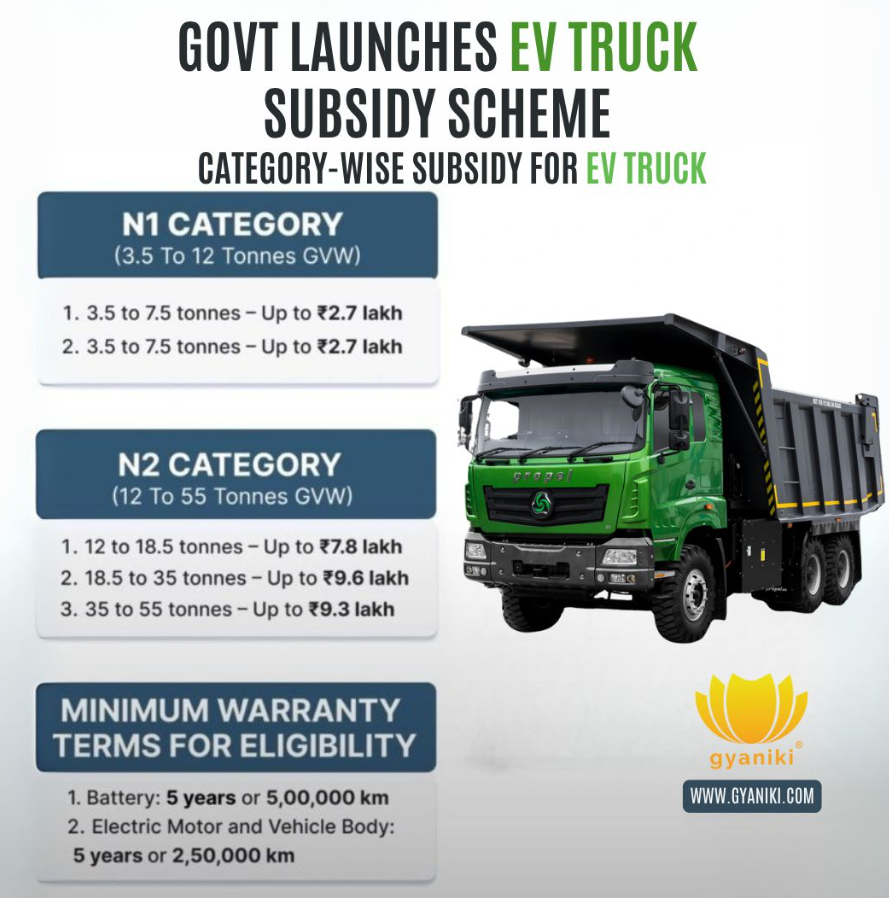
Context: The Society of Indian Automobile Manufacturers (Siam) has urged the Ministry of Heavy Industries (MHI) to bring N1 category commercial vehicles (CVs) — those that weigh less than 3.5 tonnes — under the PM E-Drive scheme for electric trucks.
-
PM E-Drive scheme (launched after FAME-II ended in March 2024):
-
Outlay: ₹500 crore (till March 2026).
-
Current coverage by weight : N2 (3.5–12 tonnes) and N3 (>12 tonnes) e-trucks.
-
Excludes N1 (<3.5 t) Commercial Vehicles (CV), which are vital for last-mile logistics.
-
Society of Indian Automobile Manufacturers (Siam) demand (April 2025 letter to MHI):
-
Urged inclusion of N1 Commercial Vehicles CVs (<3.5 tonnes) under PM E-DRIVE.
-
Argued these vehicles form 60% of Commercial Vehicles (CV) industry volumes and are crucial for urban deliveries.
-
SIAM’s Justifications for N1 Inclusion
-
Emission reduction: High daily use (60–200 km) → greater per-vehicle environmental benefits.
-
Energy security: Reduced reliance on imported fossil fuels.
-
Cost efficiency: Lower fuel + maintenance costs → helps operators’ margins.
-
Support for small players: Farmers, SMEs, and last-mile operators at “bottom of the pyramid” benefit most.
Historical Background
-
N1 EVs earlier supported under:
-
NITI Aayog’s Shoonya Campaign (zero-emission mobility for cities).
-
FAME-II scheme (covered N1 under e-4W umbrella, with subsidies).
-
-
With FAME-II’s expiry → policy gap created for N1 CVs.
Challenges in Current PM E-DRIVE Scheme
-
Exclusion of N1 vehicles → undermines last-mile electrification.
-
Scrappage certificate requirement: Almost none available (only 2 for N2, 0 for N3 by July 2025).
-
Price cap of ₹1.25 crore → excludes long-range trucks and tippers.
-
Low incentives:
-
₹2.7–3.6 lakh (N2), ₹7.8–9.3 lakh (N3).
-
Far lower than subsidies for e-buses (up to ₹35 lakh).
-
-
Localisation mandate: Traction motors → constrained by rare earth supply.
-
Unclear approval timelines for certification → adds uncertainty.
Implications
If Included
-
Boost last-mile electrification, aligning with urban climate goals.
-
Lower logistics costs → benefits e-commerce, SMEs, agriculture.
-
Stronger ecosystem for charging infra in cities.
If Excluded
-
Risk of policy gap → slow adoption in the most high-volume, high-usage CV category.
-
Small businesses and farmers miss out on subsidies.
-
India may struggle to meet urban emission targets and EV penetration goals.
The exclusion of N1 CVs (<3.5 t) from PM E-Drive is seen as a critical design flaw, given their dominance in last-mile delivery and high usage. SIAM’s push highlights that electrifying this segment could deliver maximum environmental, economic, and social gains compared to larger trucks.