
PM Electric Drive Revolution in Innovative Vehicle Enhancement (PM E-DRIVE)
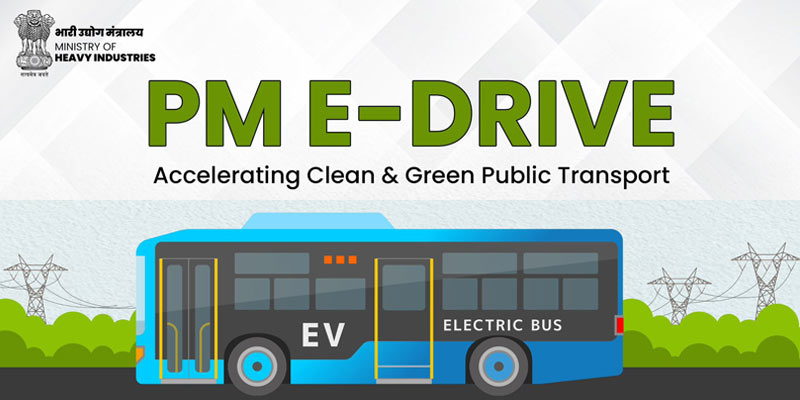
Context
Kerala is planning to develop a model electric truck (e-truck) freight corridor along National Highway-66, aimed at accelerating freight electrification under the PM Electric Drive Revolution in Innovative Vehicle Enhancement (PM E-DRIVE) scheme.
PM Electric Drive Revolution in Innovative Vehicle Enhancement (PM E-DRIVE)
What is PM E-DRIVE?
PM E-DRIVE is a flagship Centrally Sponsored Scheme of the Ministry of Heavy Industries (MHI) aimed at accelerating electric mobility, strengthening EV charging infrastructure, and building a domestic EV manufacturing ecosystem in line with Aatmanirbhar Bharat and Net-Zero 2070 goals.
Timeline and duration
Approved by Cabinet: September 2024
Original duration:
October 2024 – March 2026 (2 years)
Extended duration :
Up to 31 March 2028 (4 years total)
Important distinction:
e-2W, e-3W (L5), e-rickshaws & e-carts
→ Terminal date remains 31 March 2026e-trucks, e-buses, e-ambulances, testing agencies
→ Extended till 31 March 2028
Financial outlay
Total outlay: ₹10,900 crore
Fund-limited scheme
No enhancement in budget despite extension
Once funds are exhausted → scheme or sub-components will be closed
Disbursement model:
First-come, first-served
Milestone-linked grants (especially for e-buses)
Objectives
Accelerate EV adoption across vehicle categories
Develop robust public charging infrastructure
Promote Make in India through Phased Manufacturing Programme
Reduce:
Vehicular emissions
Oil import dependence
Support India’s Net-Zero emissions by 2070
Evolution and background
PM E-DRIVE builds upon earlier EV initiatives:
FAME-I (2015)
FAME-II (2019)
Electric Mobility Promotion Scheme (EMPS)
Unlike FAME-II (largely passenger-centric), PM E-DRIVE places strong emphasis on commercial and freight electrification.
Key components of PM E-DRIVE
1. Target beneficiaries
Eligible vehicle categories include:
Electric two-wheelers (e-2W)
Electric three-wheelers (e-3W, L5)
E-rickshaws and e-carts
E-ambulances
E-trucks (mandatory scrapping certificate)
Electric buses for public transport
2. Demand incentives
Incentive capped at:
15% of ex-factory price, or
Fixed per-vehicle limit (whichever is lower)
Price ceiling for vehicle eligibility
Incentives applicable only during scheme validity
3. Charging infrastructure development
Target: 72,300 public fast charging stations
Focus areas:
Major cities
Select national highways and freight corridors
Bharat Heavy Electricals Limited (BHEL):
Developing a national EV Super App
Functions:
Slot booking
Payments
Charger availability tracking
4. Testing agencies upgradation
₹780 crore allocation
Objective:
Upgrade testing agencies under MHI
Introduce advanced testing technologies
Ensure safety, quality, and performance standards
Extension justified due to:
Long procurement and commissioning cycles
Eligibility conditions
Only EVs with advanced batteries eligible
Government-procured EVs excluded
Prevents internal fund transfers
Vehicles must be:
Registered under Central Motor Vehicles Rules (CMVR), 1989
Manufactured and registered within scheme validity
E-trucks require scrapping certificate
Why extension till 2028 was necessary
1. E-trucks
Market still nascent
Full-scale commercial production needs time
2. E-buses
₹4,391 crore allocated for 14,028 electric buses
Post-selection process starts March 2026
Grants disbursed over 18 months, milestone-linked
3. Testing agencies
Time-intensive procurement and commissioning processes
Impact so far
Under EMPS + PM E-DRIVE:
e-2W sales ~5.7 lakh units in 2024-25
Freight and public transport electrification identified as high-impact segments
Prelims Practice MCQs
Q. With reference to the PM E-DRIVE Scheme, consider the following statements:
It is a Centrally Sponsored Scheme implemented by the Ministry of Heavy Industries.
Its total financial outlay was increased when the scheme was extended till 2028.
Electric trucks require scrapping certificates to be eligible for incentives.
Which of the statements given above are correct?
(a) 1 and 3 only
(b) 1 and 2 only
(c) 2 and 3 only
(d) 1, 2 and 3
Answer: (a)
Explanation:
The outlay remains ₹10,900 crore; only the duration was extended.