
Protect Forest Dwellers from Eviction - Forest Rights Act (FRA), 2006
Background:
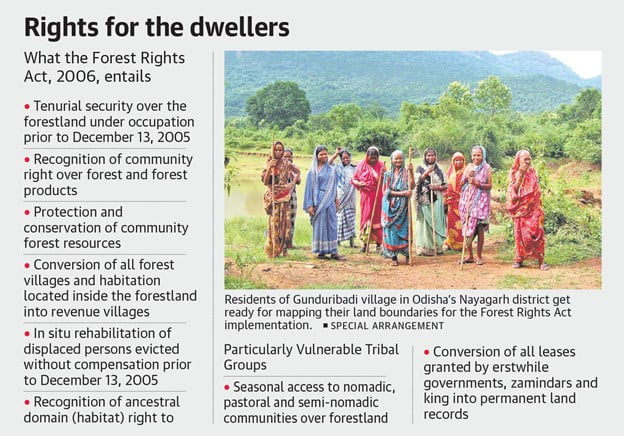
The Union Government has directed all States and Union Territories to ensure that no tribal or forest-dwelling community is forcibly evicted from wildlife sanctuaries or national parks until their Forest Rights are fully recognised and settled.
The directive follows the government’s defence of the Forest Rights Act (FRA), 2006 in the Supreme Court.
Key Provisions and Directives
Legal Basis
Based on the Scheduled Tribes and Other Traditional Forest Dwellers (Recognition of Forest Rights) Act, 2006 – commonly known as the Forest Rights Act (FRA).
The Ministry of Tribal Affairs (MoTA), led by Secretary Vibhu Nayar, issued the directive on October 22, 2025.
Key Instructions to States
No eviction of Scheduled Tribes (STs) or Other Traditional Forest Dwellers (OTFDs) until:
Recognition, and
Verification procedures are complete.
States must ensure:
Recognition of Individual Forest Rights (IFRs)
Habitat Rights for Particularly Vulnerable Tribal Groups (PVTGs)
Community Forest Rights (CFRs) and Community Forest Resource Rights (CFRRs)
Legal Reference
Section 42 of the FRA:
No member of the Scheduled Tribes or traditional forest dwellers shall be evicted until recognition and verification of their rights is completed.Section 12 of the FRA:
Decisions on claims must be based on physical verification, not just satellite or GIS data.
Administrative Measures
Update forest land records to prevent disputes between Forest and Revenue Departments.
Eviction or displacement can only occur after rights are settled and resettlement plans are ready.
Encourage State Level Monitoring Committees to:
Resolve disputes, and
Integrate forest rights into welfare and livelihood schemes.
Use of Technology
Ground-level verification is primary.
Satellite imagery/GIS mapping should be supplementary tools only.
Best Practices Highlighted
Tamil Nadu and Madhya Pradesh showcased as models for effective FRA implementation.
Encouraged:
District-level action plans for identifying Community Forest Resource (CFR) areas.
Preparation of FRA Atlas documents for better monitoring.
Focus on PVTGs
Emphasis on recognising and protecting Habitat Rights of Particularly Vulnerable Tribal Groups (PVTGs).
Such recognition is key to ensuring cultural preservation and sustainable livelihoods.
Forest Rights Act (FRA), 2006 – Important Sections
Section 2 – Key Definitions
Defines crucial terms used throughout the Act:
“Forest dwelling Scheduled Tribes (FDSTs)” – STs who primarily reside in and depend on forests.
“Other Traditional Forest Dwellers (OTFDs)” – Non-STs residing in forest land for at least 75 years prior to 13 Dec 2005.
“Forest land” – Includes reserved, protected and unclassified forests, as well as sanctuaries and national parks.
“Minor forest produce (MFP)” – Non-timber forest products like bamboo, tendu leaves, honey, etc.
“Gram Sabha” – Village assembly responsible for initiating and verifying rights claims.
Section 3 – Forest Rights Recognised
Recognises 13 categories of rights for forest dwellers:
Individual Forest Rights (IFRs) – Right to live in and cultivate forest land under individual or common occupation.
Community Rights (CFRs) – Rights over common property resources, grazing areas, water bodies, etc.
Habitat Rights – For Particularly Vulnerable Tribal Groups (PVTGs) and pre-agricultural communities.
Ownership & collection of Minor Forest Produce (MFP).
Right to protect, regenerate or conserve community forest resources (CFRRs).
Right to traditional seasonal resource access of nomadic or pastoralist communities.
Right to in-situ rehabilitation in case of illegal eviction.
Section 4 – Recognition & Vesting of Rights
Provides for vesting of forest rights in STs and OTFDs who were residing in forests prior to 13 December 2005.
Gram Sabha initiates the process of determining rights.
No eviction or removal until rights are formally recognised.
Empowers the government to notify rules for implementation.
Section 5 – Duties of Gram Sabha & Right-Holders
Gram Sabha and right-holders shall:
Protect wildlife, forest, and biodiversity.
Ensure sustainable use of forest resources.
Prevent destruction, over-exploitation, or ecological imbalance.
💡 This section turns forest dwellers into active custodians of forests.
Section 6 – Procedure for Recognition of Rights
Three-tier process:
Gram Sabha (GS): Receives, verifies, and consolidates individual and community claims.
Sub-Divisional Level Committee (SDLC): Examines records, ensures verification.
District Level Committee (DLC): Final authority to approve claims and issue titles.
Section 7 – Offences & Penalties
Imposes penalties for contravention of rights granted under the Act.
Protects forest dwellers from unlawful deprivation of recognised rights.
Section 8 – Power to Delegate
Central Government may delegate its powers (except to make rules) to State Governments or authorities.
Section 9 – Constitution of Committees
Provides for the constitution of committees for carrying out the purposes of the Act — mainly at state and district levels.
Section 10 – Power to Make Rules
Empowers Central Government to make rules by notification for implementation of the Act.
Forest Rights Rules, 2008 were framed under this section (amended in 2012 & 2022).
Section 11 – Protection of Rights
Ensures forest rights once recognised cannot be arbitrarily withdrawn.
Protects claimants from administrative misuse or re-appropriation of land.
Section 12 – Physical Verification of Claims
Mandates ground-level, physical verification for claim determination.
Technological inputs (e.g., satellite imagery, GIS) are only supplementary, not substitutes.
Ensures fair and evidence-based recognition of rights.
Section 13 – Act to be in Addition to Existing Laws
FRA operates in addition to and not in derogation of other laws (e.g., Wildlife Protection Act, 1972).
In case of conflict, FRA’s provisions ensuring rights take precedence.
Section 14 – Power of Central Government to Issue Directions
Central Government may issue directions to any State Government for effective implementation.
Ministry of Tribal Affairs (MoTA) is the nodal agency under this section.
Section 15 – Power to Remove Difficulties
Empowers the Central Government to remove difficulties in giving effect to the Act, via notification.
Section 42 – Safeguard Against Eviction
(Often cited in implementation guidelines)
No member of a Scheduled Tribe or traditional forest dweller shall be evicted or removed from forest land under occupation until recognition and verification of rights are complete.
Forms the legal basis of MoTA’s directives (e.g., Oct 2025 letter to states).
Prelims Practice MCQ
Q. With reference to the Forest Rights Act (FRA), 2006, consider the following statements:
The Act recognises individual, community, and habitat rights of forest-dwelling Scheduled Tribes and other traditional forest dwellers.
Satellite imagery and GIS mapping are the primary basis for verifying forest rights claims.
No member of a Scheduled Tribe or traditional forest dweller can be evicted from forest land until their rights are recognised and verified.
Which of the statements given above is/are correct?
(a) 1 and 2 only
(b) 2 and 3 only
(c) 1 and 3 only ✅
(d) 1, 2 and 3
✅ Correct Answer: (c) 1 and 3 only
Explanation:
Statement 1 – Correct: The Forest Rights Act, 2006 recognises three main types of rights
Individual Forest Rights (IFRs), Community Forest Rights (CFRs), and Habitat Rights for Particularly Vulnerable Tribal Groups (PVTGs).
These provide land tenure, community resource access, and cultural protection.Statement 2 – Incorrect: The ground-level evidence (physical verification) is the primary basis for claim assessment.
Satellite imagery and GIS mapping are to be used only as supplementary tools, not as the main method.Statement 3 – Correct: As per Section 42 of FRA, no member of Scheduled Tribes or traditional forest dwellers shall be evicted from forest land until recognition and verification of their rights is complete.
Hence, forced eviction before this process is illegal.