
Representation of Persons with Disabilities in Union Government Jobs
Legal Framework
-
Rights of Persons with Disabilities (RPwD) Act, 2016:
-
Raised reservation in government jobs from 3% to 4% for persons with benchmark disabilities (≥40%).
-
1% of quota earmarked for specific categories (e.g., blindness, hearing impairment, locomotor disability, autism, etc.).
-
Supreme Court Concern
-
Issue: Disabled persons recruited “on merit” often counted against reserved quota posts, instead of being shifted to general merit list.
-
Consequence: Denies reservation benefits to lower-scoring but eligible disabled candidates.
-
Court asked Centre to clarify: Are “merit” candidates being “pushed upward” to unreserved posts as mandated?
Data (DoPT reports)
-
Overall trend (2011–2022):
-
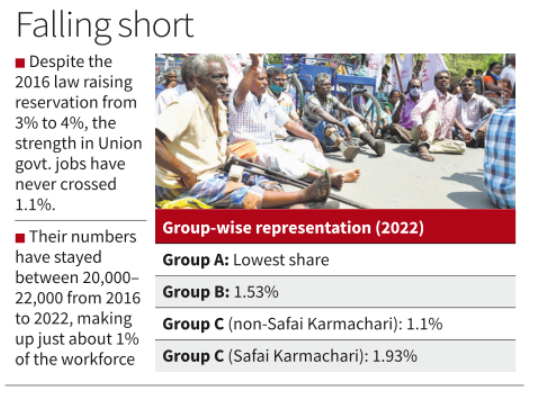
Representation never exceeded 1.1% of total Union govt. staff.
-
Absolute numbers fluctuated 13,000–22,000 employees with disabilities.
-
-
Recent DATA :
-
21,874 disabled employees (1.15% of workforce).
-
Distribution:
-
Group A: 1%
-
Group B: 1.53%
-
Group C (Safai Karmachari): 1.93% (highest)
-
Group C (non-Safai Karmachari): 1.1%
-
-
-
Earlier data:
-
2011: 15,747 (less than 1%).
-
2016: ~20,000 employees (0.67%).
-
2018: Crossed 1% for first time (1.13%).
-
-
Incomplete reporting post-2018:
-
Employee strength considered fell from 30 lakh (2016) to 20 lakh (2018) due to missing ministry data.
-
Issues Highlighted
-
Reservation under-implemented despite legal mandate.
-
Data gaps post-2018 undermine transparency and accountability.
-
Concentration in lower posts (Group C Safai Karmachari), very low in Group A/B positions.
-
Systemic exclusion: barriers in recruitment, workplace accessibility, and awareness of provisions.
Implications
-
Reflects implementation deficit in social justice measures.
-
Shows gap between law on paper (4% quota) and ground reality (1.15% actual representation).
-
Raises issues of inclusive governance, equality of opportunity, and judicial monitoring of welfare provisions.