
Researchers identify four species of sea butterflies new to India
Discovery
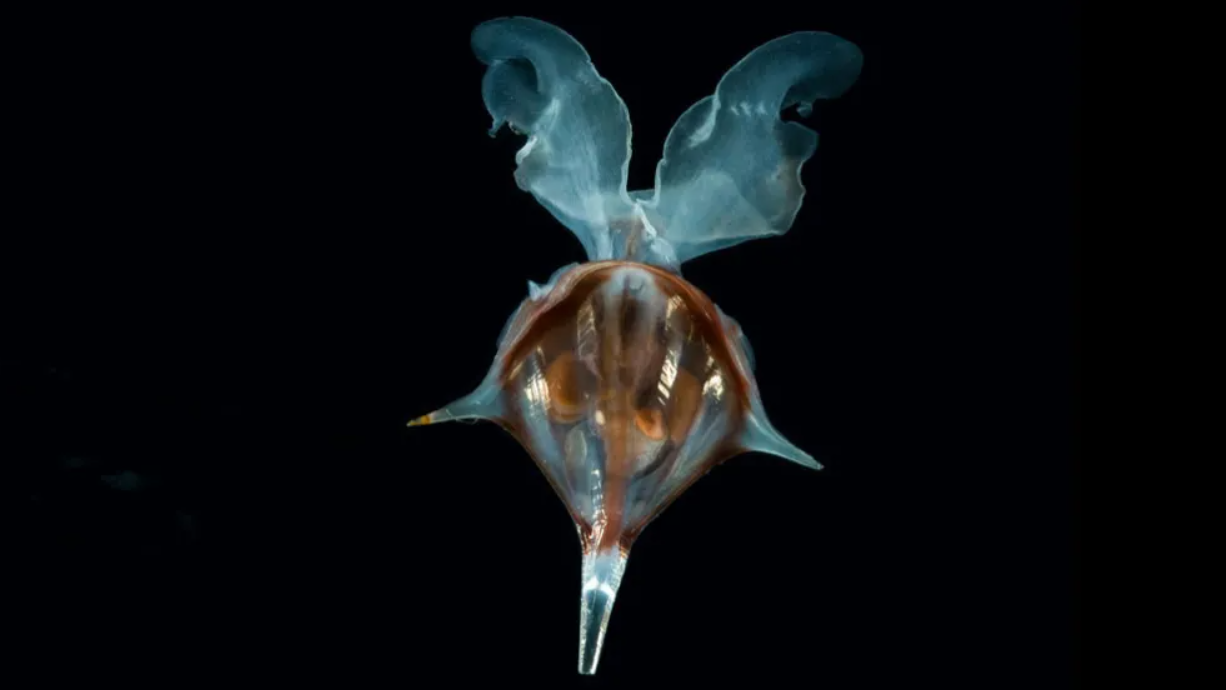
Four species of Diacavolinia sea butterflies (pteropods) have been recorded for the first time in India from sediments collected in 2011 around Nicobar Islands at 200 m depth by FORV Sagar Sampada.
Species discovered:
D. deshayesi, D. grayi, D. mcgowani, D. strangulata.India’s known pteropod species count increased from 22 to 26.
Biological context
Pteropods are molluscs (zooplankton) living in the water column.
Types:Sea angels – shell-less.
Sea butterflies – have aragonite shells.
They are visible to the naked eye but require microscopes for species-level identification.

Ecological significance
Food-web role
Serve as prey for baleen whales, fish, seabirds.
High lipid and calcium content; sea angels feed on sea butterflies.
Carbon cycling role
Perform vertical migration (up at night, down during day), aiding carbon transfer.
Aragonite shells (calcium carbonate) sink after death → carbon sequestration.
Indicators of ocean conditions
Aragonite shells dissolve easily → sensitive to ocean acidification.
Provide paleoenvironmental records through chemical signatures.
Climate change threat
Increasing CO₂ absorption → lower pH → shells rupture, thin, or do not form.
Pteropods cannot regenerate broken shells.
Populations declining globally; may be among the first plankton groups to face extinction if emissions rise.
Decline can cause:
Disruption of food chains.
Disruption of carbon cycle.
Overgrowth of phytoplankton → harmful algal blooms.
Research challenges
Samples were old, fossilised, fragile; preserved in formaldehyde → DNA analysis impossible.
Lack of consolidated taxonomic keys; limited expertise for identification.
Based on a single cruise → limited sampling.
Research significance
Fills taxonomic gaps for Indian Ocean pteropods.
Provides baseline for:
Ocean acidification studies.
Paleoclimate reconstruction.
Future ecological monitoring in Andaman and Nicobar Islands.
Region’s pteropods indicate healthy marine ecosystems, but development pressures pose threats.
Prelims Practice MCQs
Q.Which of the following best explains why pteropods are considered indicators of ocean acidification?
A. Their shells contain silica which dissolves quickly in acidic water.
B. Their aragonite shells are highly soluble and show rapid dissolution with slight pH changes.
C. They are top predators whose population declines indicate trophic disruption.
D. They perform vertical migration which is inhibited by acidified waters.
Correct answer: B
Explanation:
Pteropods have delicate aragonite (calcium carbonate) shells which dissolve rapidly as pH drops, making them highly sensitive indicators of acidification.
Q. Which of the following ecological functions of pteropods contributes directly to long-term carbon sequestration?
A. High reproductive rate
B. Production of aragonite shells that sink after death
C. Serving as prey to baleen whales
D. Feeding on phytoplankton during night migration
Correct answer: B
Explanation:
Aragonite shells (calcium carbonate) sink to the seabed after death, forming sediments that store carbon long-term.
Q.Consider the following statements:
Sea angels and sea butterflies are both molluscs.
Sea angels possess well-developed aragonite shells.
Sea butterflies contribute to the ocean carbon cycle through vertical migration.
Which of the above statements is/are correct?
A. 1 and 3 only
B. 1 and 2 only
C. 2 and 3 only
D. 1, 2 and 3
Correct answer: A
Explanation:
Both are molluscs → True.
Sea angels are shell-less → False.
Sea butterflies perform vertical migration → True.