
Retail Inflation at 2.75% Under New CPI (Base Year 2024)
Context:
Context:
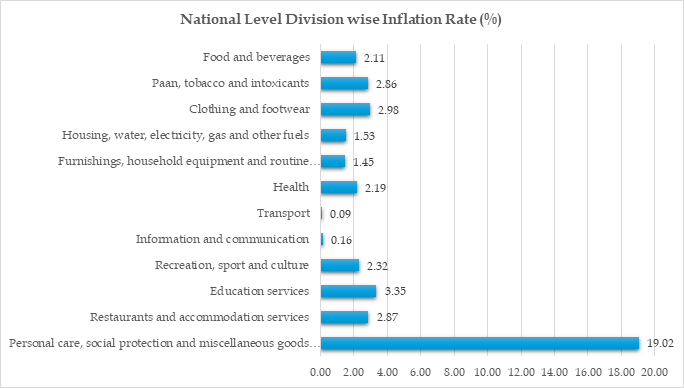
The Ministry of Statistics and Programme Implementation (MoSPI) has released the new series of the Consumer Price Index (CPI) with 2024 as the base year, placing retail inflation (January 2026) at 2.75%.
Since this is the first release under the new series, long-term historical comparison is not yet fully available. However, index values are provided from January 2025 onwards, and a linking factor has been issued to enable backward comparison up to 2013.
Why Was the CPI Base Year Revised?
The base year has been updated from 2012 to 2024 to reflect:
Changes in consumption patterns
Expansion of services sector
Digitalisation and rise of online marketplaces
Structural transformation of the economy
The revision is based on findings from the Household Consumption Expenditure Survey (HCES) 2023–24.
Major Changes in the New CPI Series
1. Expansion of Basket of Items
Total items increased from 299 to 358
Goods: 259 → 308
Services: 40 → 50
This reflects increasing diversification of consumption.
2. Wider Data Coverage
Rural markets: 1,181 → 1,465
Urban markets: 1,114 → 1,395
12 online marketplaces included (new addition)
This improves representativeness and captures digital consumption trends.
3. More Granular Classification
The new CPI divides items into 12 broad groups, compared to 6 earlier.
New/additional categories include:
Furnishings & household maintenance (4.47%)
Health (6.1%)
Transport (8.8%)
Information & communication (3.61%)
Recreation, sports & culture (1.52%)
Education services (3.33%)
Restaurants & accommodation (3.35%)
Personal care & social protection (5.04%)
This aligns India’s CPI classification closer to international standards.

Changes in Weights
Weights are based on HCES 2023–24 consumption patterns.
Category | Old Weight | New Weight | Trend |
Food & beverages | 45.86% | 36.75% | Decreased |
Housing (expanded category) | 10.07% | 17.67% | Increased |
Clothing & footwear | 6.53% | 2.38% | Decreased |
Paan, tobacco & intoxicants | 2.38% | 2.99% | Increased |
Key Implication:
Lower weight for food (a volatile category) may make headline inflation less volatile.
Higher weight for housing and utilities reflects urbanisation and rising service expenditure.
What are Index reference period, Weight reference period and Price reference period?
Ans:
Index reference period: It is the period for which index equals 100. For the current CPI, the index reference period is 2024=100.
Weight reference period: It is the period for on the basis of which weights are calculated. For CPI 2024, Household Consumption Expenditure Survey 2023-24 data is used for deriving the weights.
Price reference period: It is the period during which the base prices are collected. The price reference for the current CPI series is calendar year 2024.
Price Collection Methodology and Digitalisation
Introduction of CAPI
The CPI 2024 series introduces Computer Assisted Personal Interviewing (CAPI) for price data collection.
Features of CAPI
Electronic data collection using handheld devices
In-built validation checks
Standardised item specifications
Real-time monitoring
Improved timeliness and consistency
Significance
Reduces manual errors
Enhances data reliability
Enables faster compilation
Aligns with global best practices in official statistics
2. Continuation of Physical Market Collection
Physical market price collection remains the backbone of CPI compilation.
Ensures representativeness across rural and urban markets.
Maintains continuity with previous methodology.
3. Alternative Data Sources Introduced
To reflect changing consumption behaviour and digitalisation:
E-commerce Data
Prices from online marketplaces included
Collected in 12 large towns (population > 25 lakhs)
Online Service Sources
Airfares
OTT subscriptions
Administrative Data
Used for standardized services such as:
Rail fares
Postal charges
Fuel prices
Safeguards
Clear item specifications
Defined price collection protocols
Ensures comparability and consistency
4. Housing Index Compilation (Revised Structure)
The Housing Index is now a composite index based on three components:
Actual rental payments for housing
Maintenance, repair and security of dwelling
Water supply and other miscellaneous services relating to dwelling
Method
Weighted average of the three components
Year-on-year inflation computed based on composite Housing Index
Importance
Reflects broader cost of dwelling, not just rent
Better captures urbanisation and service-linked housing expenses
5. Compilation of Combined Index
Rural and Urban indices are compiled separately.
Combined Index is calculated using:
Weighted average of Rural and Urban indices
(using respective Rural and Urban weights)
Key Point
It is not a simple average.
6. Linking Factor and Back Series
To ensure continuity and time-series comparability:
Back Series Released
Linking factors between CPI 2012 and CPI 2024
All-India General Indices (Rural, Urban, Combined) from January 2013 – December 2024
Annual inflation rates from January 2014 – December 2024
7. Overlapping Period
Overlapping year: 2025
Both CPI 2012 and CPI 2024 series available
Used to compute linking factor
8. Formula for Linking Factor
Let:
Avg Iynew = Annual average (Geometric mean) CPI of new series (2024 base) in 2025
Avg Iyold = Annual average (Geometric mean) CPI of old series (2012 base) in 2025.

Prelims Practice MCQs
Q. With reference to the new Consumer Price Index (CPI) series with 2024 as the base year, consider the following statements:
The new CPI series is based on the Household Consumption Expenditure Survey (HCES) 2023–24.
The weight assigned to food and beverages has increased in the new series compared to the 2012 base year series.
Data under the new CPI series are collected from online marketplaces as well.
Which of the statements given above is/are correct?
(a) 1 and 2 only
(b) 1 and 3 only
(c) 2 and 3 only
(d) 1, 2 and 3
Answer: (b) 1 and 3 only
Explanation:
Statement 1 is correct: The weights in the new CPI are based on HCES 2023–24.
Statement 2 is incorrect: The weight of food and beverages has decreased from 45.86% to 36.75%.
Statement 3 is correct: Data are now collected from 12 online marketplaces, a new addition.
Q. Which of the following changes has/have been introduced in the new CPI series (Base Year 2024)?
Increase in the number of goods and services covered.
Reduction in the number of rural and urban markets surveyed.
Expansion of the housing category to include water, electricity, gas and other fuels.
Select the correct answer using the code below:
(a) 1 and 3 only
(b) 2 only
(c) 1, 2 and 3
(d) 3 only
Answer: (a) 1 and 3 only
Explanation:
Statement 1 is correct: Total items increased from 299 to 358.
Statement 2 is incorrect: The number of rural and urban markets has increased, not reduced.
Statement 3 is correct: Housing has been expanded to include utilities, raising its weight to 17.67%.
Q. Consider the following statements regarding the implications of the revised CPI weights:
Lower weight assigned to food may reduce volatility in headline inflation.
Higher weight to services reflects structural transformation of the Indian economy.
The revision has no impact on monetary policy formulation.
Which of the statements given above are correct?
(a) 1 and 2 only
(b) 2 and 3 only
(c) 1 only
(d) 1, 2 and 3
Answer: (a) 1 and 2 only
Explanation:
Statement 1 is correct: Food is a volatile component; reducing its weight may smooth headline inflation.
Statement 2 is correct: Increased weight to services reflects changing consumption patterns and economic transformation.
Statement 3 is incorrect: CPI is the key inflation measure used for monetary policy (inflation targeting), so revisions affect policy calibration.
Q. The Housing Index under CPI 2024 is compiled using which of the following components?
Actual rental payments for housing
Maintenance, repair and security of the dwelling
Water supply and other miscellaneous services relating to the dwelling
Capital value appreciation of property
Select the correct answer using the code below:
(a) 1 and 4 only
(b) 2 and 3 only
(c) 1, 2 and 3 only
(d) 1, 2, 3 and 4
Answer: (c) 1, 2 and 3 only
Explanation:
The Housing Index is a weighted average of:
Actual rentals
Maintenance, repair and security
Water supply and miscellaneous dwelling services
Capital appreciation of property is not included in CPI, as CPI measures consumption price changes, not asset price inflation.