
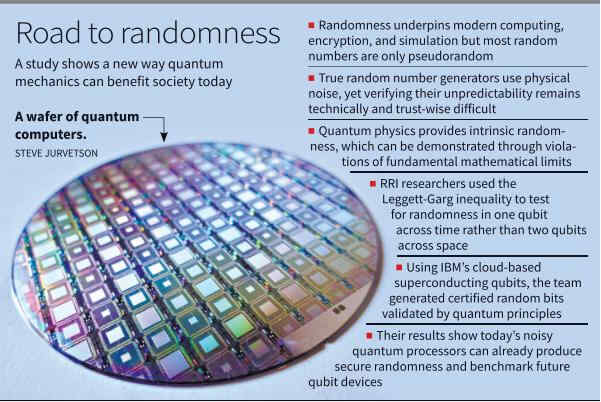
RRI technique yields certified randomness with one qubit
Background: Why Randomness Matters
Random numbers are crucial for things like:
Cryptography (secure communication)
Simulations (like biological or weather systems)
Scientific experiments
But most random numbers we use are not truly random - they are generated by computer algorithms called pseudorandom number generators (PRNGs).
If someone knows the algorithm and its starting seed, they can predict the numbers which is unsafe for encryption.
Problem with Classical Randomness
Some devices try to generate randomness using physical processes like:
Electronic noise
Radioactive decay
But these can wear out over time, and users must trust the manufacturer.
Also, it’s hard to prove that their numbers are genuinely random.
Why Quantum Physics Helps
Quantum physics is inherently random - for example, the spin of an electron or the state of a qubit can’t be predicted before measurement.
Physicists normally test quantum randomness by checking Bell inequalities - but these require two entangled qubits placed far apart, which is not practical on a single quantum computer.
The Leggett-Garg Inequality (LGI)
Instead of using space-separated qubits, scientists can test randomness using time-separated measurements on the same qubit.
This is based on the Leggett-Garg Inequality (LGI).
LGI checks whether measurements taken at different times on the same system behave as classical physics predicts.
If LGI is violated, it shows the system’s behavior is quantum and truly random.
They also check a condition called “no signalling in time”, meaning one measurement doesn’t influence the next — ensuring the randomness is independent.
Type | Description | Requirement |
Bell inequality | Tests quantum nonlocality — correlations between spatially separated entangled particles. | Needs two entangled qubits far apart. |
Leggett-Garg inequality (LGI) | Tests temporal correlations — measurements at different times on the same qubit. | Needs only one qubit and time-separated measurements. |
The Raman Research Institute (RRI) Experiment
Researchers from the Quantum Information and Computing (QuIC) Lab at Raman Research Institute (RRI), asked:
Can we generate certified quantum randomness using just one qubit on today’s quantum computers?
They used IBM’s superconducting quantum computers, available through the IBM Quantum Cloud.
How They Did It
They built simple quantum circuits using only one qubit.
The circuit applied a series of single-qubit gates (rotations around chosen axes).
Measurements were taken three times.
They checked:
If LGI was violated (sign of quantum behavior)
If “no signalling in time” was satisfied (ensuring independence)
Through many runs with changing parameters, they were able to certify that the randomness came purely from quantum mechanics.
Findings
The experiment successfully produced certified random numbers.
LGI violations were clearly observed, especially on IBM’s Brussels backend.
Some deviations from theory occurred due to noise (imperfections in current quantum hardware).
Why This Is Important
Secure Random Numbers:
Certified randomness means attackers cannot fake or predict it - vital for encryption and secure communication.Practical Feasibility:
Needs only one qubit and shallow circuits — accessible to anyone via cloud quantum computers.Device Independence:
The certification doesn’t rely on trusting the machine — it’s device-independent.Improving Quantum Hardware:
They used error-mitigation techniques like readout error correction, showing how to make quantum hardware more reliable.Validation of Quantum Theory:
Violating the Leggett-Garg inequality on a quantum computer further confirms quantum mechanics in a new context.Future Applications:
The method could be used to benchmark new qubits as they’re developed — a kind of quality test for future quantum devices.