
Salar de Pajonales: A Mars analogue in the Atacama Desert
Context
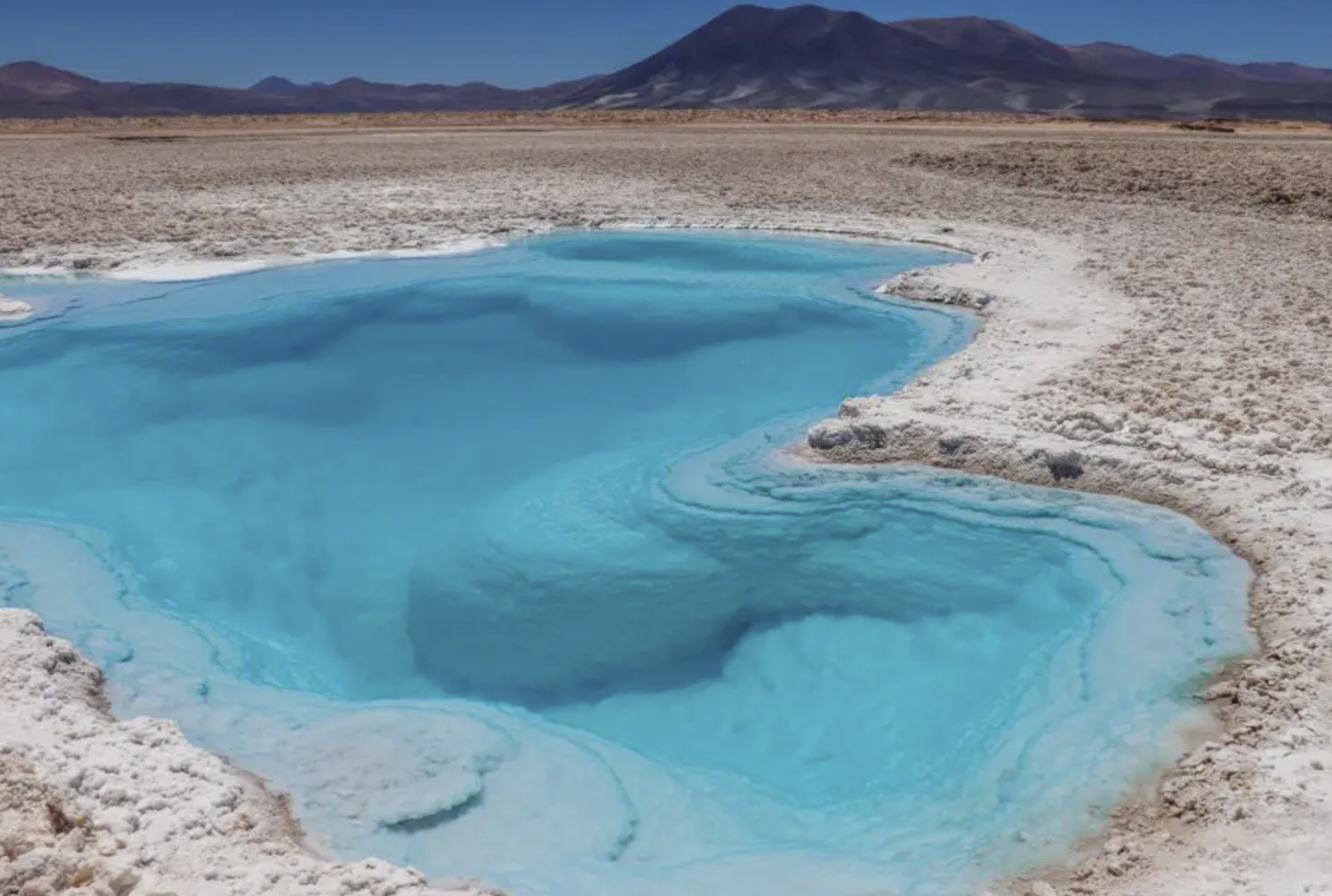
Salar de Pajonales is a playa, located in the Atacama Desert of Chile at an altitude of about 3.5 km, is considered one of the closest natural analogues to Mars-like conditions on Earth.It is the third-largest in that country, behind Salar de Punta Negra and Salar de Atacama
It combines:
Extreme aridity
Freezing temperatures
Intense ultraviolet (UV) radiation
High salinity
Thin atmosphere due to high altitude
These conditions closely resemble the Martian surface environment.
Why it is called a “Mars analogue”
Scientists use Earth-based “analogues” to simulate extraterrestrial environments. Salar de Pajonales is relevant because:
Mars is known to have large gypsum deposits.
The site contains gypsum (CaSO₄·2H₂O) — a mineral also detected on Mars.
It hosts stromatolites, layered rock structures formed by microbes.
Stromatolites are layered, sedimentary rock structures created over thousands of years by the trapping, binding, and cementation of sediments by microbial mats, primarily photosynthetic cyanobacteria. | ||

This makes it an ideal testing ground for strategies to search for past or present life on Mars.
Role of gypsum in sustaining life
The research revealed that gypsum acts as a natural shield and archive.
1. Protective shelter for living microbes
Microbes were found just millimetres below the gypsum surface.
Gypsum is translucent — it allows enough sunlight for photosynthesis.
It blocks harmful UV radiation.
It traps small amounts of moisture in an otherwise hyper-arid environment.
Thus, gypsum creates a micro-habitat suitable for survival.
2. Preservation of ancient life
Deeper within stromatolites, researchers found:
Fossils
Chemical biosignatures
After microbial death, gypsum sealed and preserved their remains, protecting them from degradation.
This suggests gypsum can function as a geological time capsule.
Relevance to Mars exploration
Mars missions have identified gypsum and other hydrated minerals on the Martian surface. If gypsum on Earth:
Protects microbial life
Preserves biosignatures
Then Martian gypsum deposits may contain:
Evidence of ancient life
Chemical traces of past microbial ecosystems
Future orbiters and rovers could prioritize gypsum-rich regions for exploration.
Prelims practice MCQs
Q. With reference to Salar de Pajonales, consider the following statements:
It is located in the Atacama Desert of Chile.
It is considered a Mars analogue due to its extreme dryness, high UV radiation, and high altitude.
It is located below sea level and experiences heavy annual rainfall.
Which of the statements given above is/are correct?
A. 1 and 2 only
B. 2 and 3 only
C. 1 only
D. 1, 2 and 3
Answer: A
Explanation:
Statements 1 and 2 are correct. Salar de Pajonales is located in the Atacama Desert in Chile and resembles Martian conditions due to extreme aridity, intense UV radiation, and high altitude (around 3.5 km above sea level).
Statement 3 is incorrect because the region is extremely dry and located at high altitude, not below sea level.
Q. Stromatolites are best described as:
A. Volcanic rock formations formed due to rapid lava cooling
B. Sedimentary structures formed purely by wind deposition
C. Layered rock structures built by microbial activity over time
D. Crystalline salt deposits formed in hyper-arid deserts
Answer: C
Explanation:
Stromatolites are layered sedimentary structures formed by microbial communities, especially cyanobacteria. They are among the oldest evidence of life on Earth and are important in the search for extraterrestrial biosignatures.
Q. Why is gypsum considered significant in the search for life on Mars?
It is translucent and allows sunlight penetration.
It can shield organisms from harmful ultraviolet radiation.
It can trap moisture and preserve chemical biosignatures.
Which of the statements given above are correct?
A. 1 and 2 only
B. 2 and 3 only
C. 1 and 3 only
D. 1, 2 and 3
Answer: D
Explanation:
All three statements are correct. Gypsum can allow limited sunlight to pass through, block harmful UV radiation, and trap moisture. It can also preserve fossils and chemical signatures of ancient life.