
Sangita Kalanidhi Award
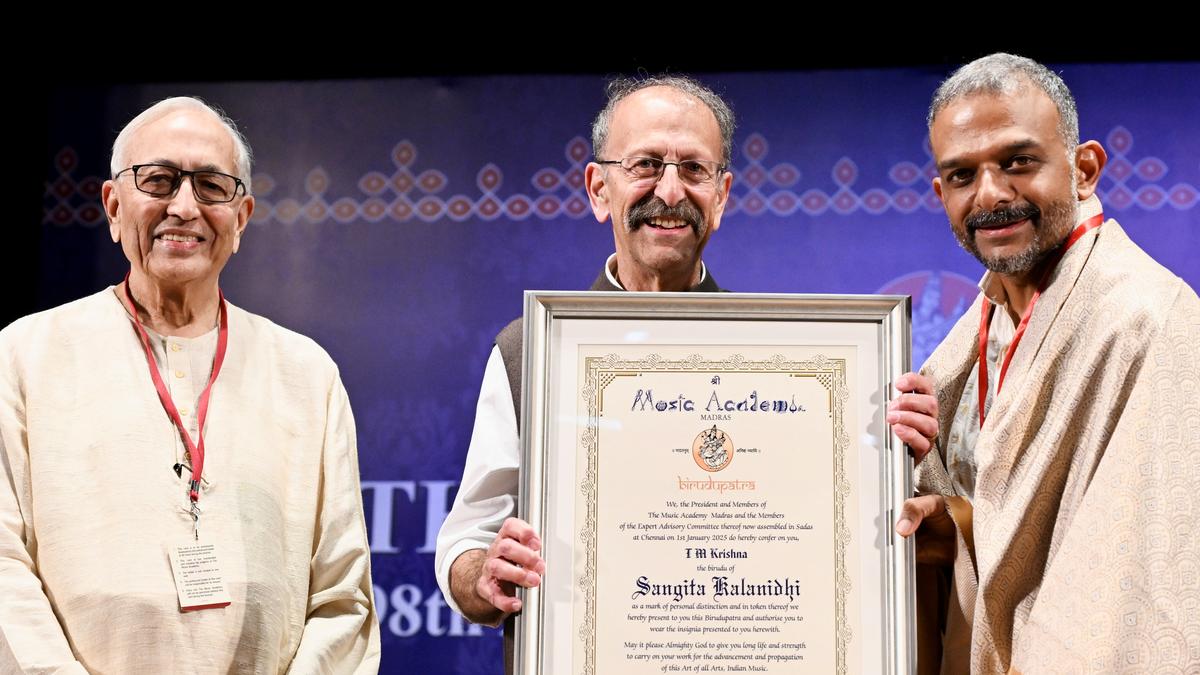
Context
Violinist R. K. Shriramkumar was recently honoured with the Sangita Kalanidhi Award by the Madras Music Academy, Chennai, recognising his outstanding contributions to Carnatic music.
About the award
Sangita Kalanidhi literally means “Treasure of Music and Art.”
It is considered the highest accolade in Carnatic music.
The award comprises a gold medal and a citation (birudu patra), and since 2005 often includes the M. S. Subbulakshmi Award (cash component).
Historical background of the institution
It emerged from the All India Congress Session held in Madras in December 1927, when a proposal to promote Carnatic music led to the idea of forming a dedicated academy.
The Academy was formally established on August 18, 1928, at the YMCA Auditorium in Esplanade, Chennai, with the aim of standardising, researching, teaching and promoting Carnatic music and the performing arts.
Evolution of the Sangita Kalanidhi title
The Academy began hosting annual music conferences from 1929, growing into the famed December Music Season.
In 1942, the title Sangita Kalanidhi was formally introduced to honour the musician invited to preside over the annual conference and festival — institutionalising the recognition of lifetime contributions to Carnatic music.
The first awards were retrospectively conferred on past presidents back to the inception of the annual conference.
Quick Prelims Pointers
Sangita Kalanidhi is an annual award conferred by the Madras Music Academy.
The Academy was formed in 1928, following discussions at the 1927 Indian National Congress session in Madras.
The award was formally instituted in 1942.
Prelims Practice MCQs
Q. With reference to the Sangita Kalanidhi award, consider the following statements:
It is considered the highest honour in Carnatic music.
It is awarded by the Union Ministry of Culture.
It has been awarded every year since 1929.
Which of the statements given above is/are correct?
(a) 1 only
(b) 1 and 2 only
(c) 1 and 3 only
(d) 1, 2 and 3
Answer: (a)
Explanation:
Statement 1 is correct.
Statement 2 is incorrect; it is awarded by the Madras Music Academy, not the Union Ministry.
Statement 3 is incorrect; the award was instituted only in 1942.