
Sariska Tiger Reserve
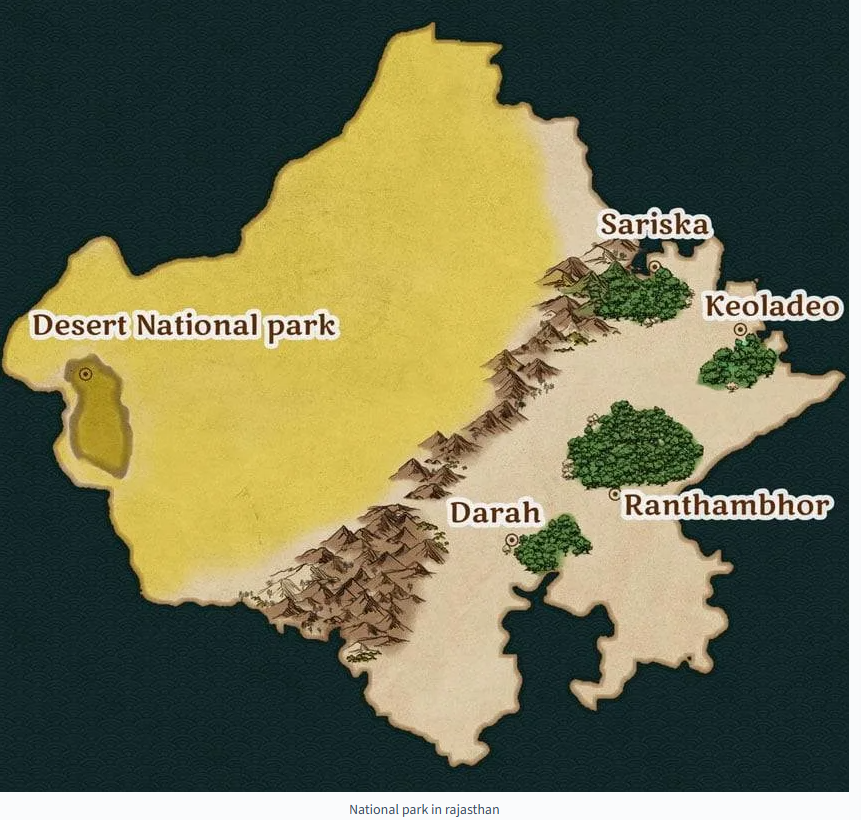
Context : Plan to redraw the boundaries of the Sariska Tiger Reserve in Rajasthan to revive over 50 mining operations
Sariska Tiger Reserve :
-
Location: Alwar district, Rajasthan, India
-
Total Area: 1203.34 km² (881 km² core + 322.23 km² buffer)
-
Forest Types: Tropical dry deciduous, tropical thorn, grasslands, scrub-thorn forests
-
Elevation: 300–722 m
-
Rainfall: ~700 mm annually
-
Part of: Aravalli Range, Khathiar-Gir dry deciduous ecoregion
-
Declared:
-
Wildlife Sanctuary in 1958
-
Tiger Reserve under Project Tiger in 1978
-
National Park in 1982 (area: 273.8 km²)
-
-
Ecological Importance: First reserve in the world with successfully relocated tigers; part of Northern Aravalli leopard and wildlife corridor
Flora
-
Forest Type:
-
Northern Tropical Dry Deciduous Forests
-
Northern Tropical Thorn Forests
-
Dominant Tree: Dhok (Anogeissus pendula) – covers 40% of forest area
-
Other Important Species:
-
Boswellia serrata (Indian frankincense or Salar)
-
Lannea coromandelica (Garjan or Indian ash tree)
-
Acacia catechu (Black cutch)
-
Bamboo, Ber, Arjun, Khair, etc.
-
Vegetation varies by terrain and soil type — rocky, plateau, and valley zones
Forest Type:
-
Northern Tropical Dry Deciduous Forests
-
Northern Tropical Thorn Forests
Dominant Tree: Dhok (Anogeissus pendula) – covers 40% of forest area
Other Important Species:
-
Boswellia serrata (Indian frankincense or Salar)
-
Lannea coromandelica (Garjan or Indian ash tree)
-
Acacia catechu (Black cutch)
-
Bamboo, Ber, Arjun, Khair, etc.
Vegetation varies by terrain and soil type — rocky, plateau, and valley zones
Fauna
Large Carnivores:
-
Bengal tiger (flagship species)
-
Indian leopard
-
Striped hyena
-
Caracal, Jungle cat, Ratel (honey badger)
Bengal tiger (flagship species)
Indian leopard
Striped hyena
Caracal, Jungle cat, Ratel (honey badger)
Large Herbivores:
-
Sambar deer, Spotted deer (Chital)
-
Nilgai (blue bull) – commonly seen near villages
-
Four-horned antelope, Wild boar
Sambar deer, Spotted deer (Chital)
Nilgai (blue bull) – commonly seen near villages
Four-horned antelope, Wild boar
Small Mammals:
-
Common langur, Rhesus macaque
-
Ruddy mongoose, Indian civet, Porcupine, Pangolin, Indian hare
Common langur, Rhesus macaque
Ruddy mongoose, Indian civet, Porcupine, Pangolin, Indian hare
Birds:
-
High peafowl density
-
Grey francolin, Aravalli red spurfowl, painted spurfowl
-
Great horned owl, white-rumped vulture, Indian cuckoo, sandgrouse, Indian pitta
-
Also home to winter migrant species
High peafowl density
Grey francolin, Aravalli red spurfowl, painted spurfowl
Great horned owl, white-rumped vulture, Indian cuckoo, sandgrouse, Indian pitta
Also home to winter migrant species
Ecological Threats
-
Rich in minerals (esp. copper and marble)
-
Despite a 1991 Supreme Court ban, illegal mining continues in and around the reserve
-
Tourism pressure from religious sites like Pandupol Hanuman Temple
-
Road diversion and human settlements inside the core zone remain unresolved
Rich in minerals (esp. copper and marble)
Despite a 1991 Supreme Court ban, illegal mining continues in and around the reserve
Tourism pressure from religious sites like Pandupol Hanuman Temple
Road diversion and human settlements inside the core zone remain unresolved
Notable Places
-
Kankwari Fort – 16th-century structure in reserve center
-
Sariska Palace – Former royal hunting lodge
-
Neelkanth Temple, Pandupol Hanuman Temple
-
Viratnagar – Ancient Buddhist monastery ruins (3rd century BCE)
Kankwari Fort – 16th-century structure in reserve center
Sariska Palace – Former royal hunting lodge
Neelkanth Temple, Pandupol Hanuman Temple
Viratnagar – Ancient Buddhist monastery ruins (3rd century BCE)