
Satellite Internet – How It Works & Its Strategic Significance
Why We Need Satellite Internet
-
Limitations of Ground Networks
-
Relies on cables & towers; uneconomical in sparsely populated areas.
-
Vulnerable to natural disasters (floods, earthquakes).
-
Poor for on-the-move connectivity in remote/temporary sites.
-
Advantages of Satellite Internet
-
Global coverage, independent of terrain/infrastructure.
-
Rapid deployment for sudden demand surges.
-
Connectivity for mobile platforms (aircraft, ships, remote rigs).
-
Supports digital economy, civil infrastructure, and military strategy.
Limitations of Ground Networks
-
Relies on cables & towers; uneconomical in sparsely populated areas.
-
Vulnerable to natural disasters (floods, earthquakes).
-
Poor for on-the-move connectivity in remote/temporary sites.
Advantages of Satellite Internet
-
Global coverage, independent of terrain/infrastructure.
-
Rapid deployment for sudden demand surges.
-
Connectivity for mobile platforms (aircraft, ships, remote rigs).
-
Supports digital economy, civil infrastructure, and military strategy.
Features of Satellite Internet
-
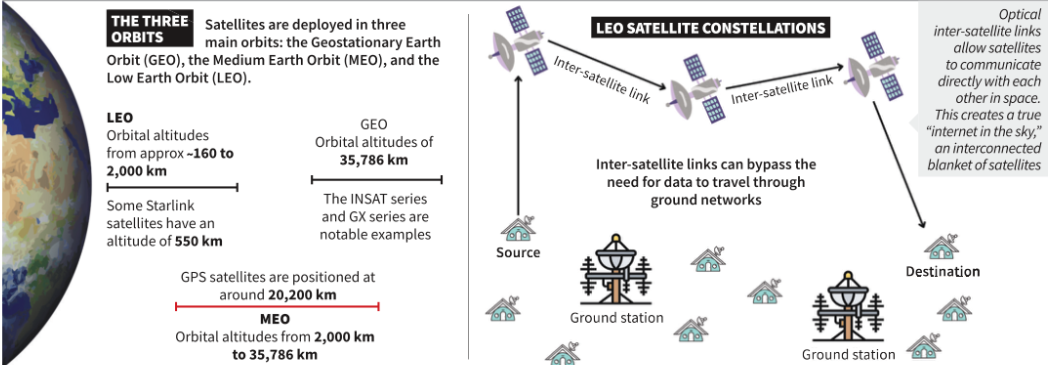
Mega-constellations (e.g., Starlink): hundreds/thousands of satellites in LEO (~few hundred km above Earth).
-
Applications: Military ops, disaster response, healthcare, agriculture, transport.
-
Dual-use nature: Civil & military; raises security concerns.
Mega-constellations (e.g., Starlink): hundreds/thousands of satellites in LEO (~few hundred km above Earth).
Applications: Military ops, disaster response, healthcare, agriculture, transport.
Dual-use nature: Civil & military; raises security concerns.
Case Studies:
-
Hurricane Harvey (2017) – Viasat enabled disaster coordination after 70% cell towers failed.
-
Russia–Ukraine war – Starlink used for troop coordination, medical evacuation, drones.
-
India (Siachen Glacier) – Indian Army uses for extreme remote connectivity.
-
Misuse Risks – Smuggled Starlink devices found with insurgent & drug groups in India.
How It Works
-
Components:
-
Space Segment – Satellites with communication payloads (lifespan: 5–20 years).
-
Ground Segment – Earth stations & user terminals.
-
Orbits:
Feature
GEO (Geostationary Earth Orbit)
MEO (Medium Earth Orbit)
LEO (Low Earth Orbit)
Altitude
~35,786 km above equator
2,000 km – 35,786 km
< 2,000 km
Coverage
~⅓ of Earth (except polar regions)
Larger than LEO, smaller than GEO
Small footprint (city-sized)
Orbit Period
24 hours (matches Earth’s rotation)
2–24 hours
90–120 minutes
Stationary Relative to Earth
Yes
No
No
Latency
High (due to long signal path)
Moderate
Very low
Satellite Size
Large
Large
Small (often table-sized)
Cost
Very high (per satellite)
High
Low per unit
Number Needed for Global Coverage
3
Dozens
Hundreds to thousands
Examples
Viasat Global Xpress (GX)
O3b (20 satellites)
Starlink (>7,000 in orbit, planned 42,000)
Advantages
Wide coverage with few satellites
Balance of coverage & latency
Low latency, cheaper launches
Disadvantages
High latency, unsuitable for real-time apps
Moderate latency, high cost
Requires mega-constellations for coverage
Components:
-
Space Segment – Satellites with communication payloads (lifespan: 5–20 years).
-
Ground Segment – Earth stations & user terminals.
Orbits:
| Feature | GEO (Geostationary Earth Orbit) | MEO (Medium Earth Orbit) | LEO (Low Earth Orbit) |
|---|---|---|---|
| Altitude | ~35,786 km above equator | 2,000 km – 35,786 km | < 2,000 km |
| Coverage | ~⅓ of Earth (except polar regions) | Larger than LEO, smaller than GEO | Small footprint (city-sized) |
| Orbit Period | 24 hours (matches Earth’s rotation) | 2–24 hours | 90–120 minutes |
| Stationary Relative to Earth | Yes | No | No |
| Latency | High (due to long signal path) | Moderate | Very low |
| Satellite Size | Large | Large | Small (often table-sized) |
| Cost | Very high (per satellite) | High | Low per unit |
| Number Needed for Global Coverage | 3 | Dozens | Hundreds to thousands |
| Examples | Viasat Global Xpress (GX) | O3b (20 satellites) | Starlink (>7,000 in orbit, planned 42,000) |
| Advantages | Wide coverage with few satellites | Balance of coverage & latency | Low latency, cheaper launches |
| Disadvantages | High latency, unsuitable for real-time apps | Moderate latency, high cost | Requires mega-constellations for coverage |
Mega-Constellations
-
Example: Starlink – 7,000+ satellites; plan for 42,000.
-
Features:
-
On-board processing → smaller/cheaper user terminals.
-
Optical inter-satellite links → true “internet in the sky” with minimal ground reliance.
-
Seamless “hand-off” between satellites via steerable antennas (moving spotlight analogy).
Satellites communicate directly in space (laser-based links).
-
Creates a “space-based internet” or internet in the sky.
-
Allows global data routing with minimal dependence on ground stations.
-
Reduces latency and increases network efficiency.
Connectivity Challenges
-
LEO satellites travel at ~27,000 km/h.
-
Visible to a user for only a few minutes before moving out of range
-
-
Applications
-
Civil:
-
Remote connectivity, IoE, navigation, smart cities.
-
Disaster management, telemedicine, precision agriculture.
-
Environmental monitoring, tourism, energy exploration.
-
-
Military & Security:
-
Battlefield communication, surveillance, drone ops.
-
Resilient comms in conflict zones.
-
Cost Factor
-
Current pricing: ~$500 for terminal, $50/month service.
-
More expensive than terrestrial broadband, but vital in remote/critical use cases.
-
Future: Direct-to-smartphone tech may remove need for terminals (e.g., AST SpaceMobile, Starlink tests).
Policy & Governance Needs
-
Integrate into national resilience plans.
-
Use to bridge digital divide & boost economic growth.
-
Shape international governance of mega-constellations to protect strategic interests.