
Satellites, Spectrum & the New Space Governance Challenge
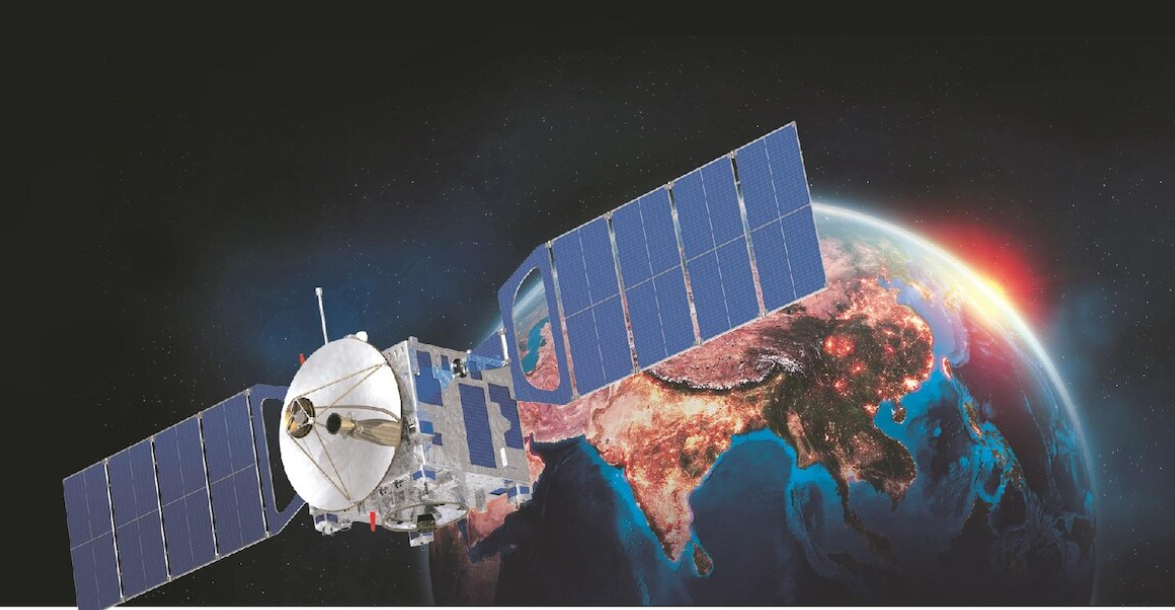
Why Spectrum Matters in Space
In satellite communication, spectrum = range of radio frequencies used for transmitting data between satellites and ground stations.
Radio frequencies are essential for all space-based communication — similar to “oxygen for space activities.”
Allocation of frequencies is done by the International Telecommunication Union (ITU).
Most sought-after bands:
Ku-band (12–18 GHz) – high-speed internet
Ka-band (26–40 GHz) – high data rate communication
L-band (1–2 GHz) – GPS and navigation
Spectrum alone isn’t enough: satellites also need orbital slots → physical positions enabling ground coverage without interference.

Megaconstellation Boom
Huge increase in satellites in Low-Earth Orbit (LEO):
Starlink: 8,000+ satellites (planned 42,000).
OneWeb: 648 satellites.
Project Kuiper (Amazon): 3,200 satellites.
China’s GuoWang: 13,000 planned.
Market Value Projection:
$4.27 billion (2024) → $27.31 billion (2032) (25.5% CAGR).
Strategic significance: developing nations see constellations as technological sovereignty instruments.
ITU Governance & Challenges
ITU Basics
UN specialised agency; 194 member states.
Coordinates global spectrum + orbital slots.
Principle: these are limited natural resources to be used “rationally, efficiently, economically.”
First-Come, First-Served Problem
Favors early filers → mostly Western and well-funded private companies.
Late entrants may find the most valuable spectrum already “claimed.”
Key ITU Reforms ( World Radiocommunication Conference -2023)
1. Resolution 8
Operators must notify deviations from planned orbits → prevents “orbital hoarding.”
2. Deployment Benchmarks
For megaconstellations:
10% deployed within 2 years
50% within 5 years
100% within 7 years
Prevents filing without real deployment.
Digital Divide & Megaconstellations
Connectivity Gap
For instance, on the Global Connectivity Index (a figure that combines the number of internet users, connected devices, natural-disaster vulnerability, and GDP), Switzerland leads with a score of 34.41 while India sits at 8.59, a nearly fourfold gap.
2.6 billion people still offline (2025).
Global Connectivity Index:
Switzerland: 34.41
India: 8.59
Why LEO Satellites Matter
Lower latency (20–40 ms) vs 600+ ms for geostationary satellites → enables telemedicine, online education.
But Affordability Issues
Starlink terminal: ~$600 + monthly fee → unaffordable for rural poor.
Cost of Closing Global Digital Divide
The ITU’s ‘Connecting Humanity Action Blueprint’ has also estimated that closing the digital divide by 2030 will require $2.6-2.8 trillion in investments, underscoring the scale of the challenge.
India’s Position
GSAT-N2: 48 Gbps throughput; covers Northeast & Andaman–Nicobar.
OneWeb: Bharti holds 39% → gives India strategic presence.
TRAI recommends administrative allocation (not auctions) for satellite spectrum →
Because NGSO (non-geostationary) spectrum can be shared with proper coordination.
Goal: promote affordable satellite broadband.
Risks: Congestion, Interference & Orbital Debris
By 2030: 50,000+ satellites expected.
Currently:
40,000 tracked objects in orbit.
27,000 pieces of debris > 10 cm.
Debris Mitigation Standard – ITU-R 74 (2023)
The ITU adopted a resolution called ITU-R 74 in 2023 calling for the sustainable use of spectrum and orbital resources, including measures to mitigate space debris.
Satellites must be removed within 25 years post-mission.
Compliance: ~70% only → debris is accumulating faster than it is removed.
→ Creates risk of Kessler Syndrome: runaway chain reaction of collisions.
Core Tension
Innovation vs. Regulation
Without strong global rules:
Spectrum grabs may worsen inequalities.
Space congestion can endanger all satellites.
Megaconstellations may expand digital divide (premium service).
For India: shaping global rules now is crucial for strategic autonomy in space infrastructure.
World Radiocommunication Conference (WRC)
What is WRC?
A global conference held by ITU every 4 years.
Reviews and revises the Radio Regulations (RR) — the international treaty governing radio spectrum and satellite orbits.
Why is WRC important?
Allocates spectrum to services → satellite internet, 5G/6G, aviation, defence, broadcasting.
Negotiates rights for satellite constellations (LEO/MEO/GEO).
Addresses space debris, orbital congestion, and sustainability norms.
Key WRC-2023 Outcomes Relevant for UPSC
Resolution 8:
Megaconstellations must deploy:
10% in 2 years,
50% in 5 years,
100% in 7 years.
Prevents misuse of filings (“paper satellites”).
Tightened rules on differences between planned vs. actual orbit.
Strengthened guidelines for spectrum efficiency and orbital sustainability.
Reaffirmed ITU principles:
“Spectrum and orbital resources are limited natural resources that must be used rationally, efficiently, and economically.”
(UPSC often asks: “Which body conducts WRC?”, “What does WRC regulate?”)
GSAT-N2 (India)
What is GSAT-N2?
Indian high-throughput communication satellite.
Developed by ISRO.
Provides broadband connectivity, especially to remote and strategic regions.
Key Features
Throughput: 48 Gbps (high-capacity Ka-band satellite).
Coverage:
Andaman & Nicobar Islands,
Northeast India,
Himalayan regions.
Supports satellite broadband, disaster communication, rural internet.
Why is GSAT-N2 important?
India’s push for digital inclusion in remote areas.
Complements private constellations like OneWeb, in which Bharti owns 39%.
Reduces dependence on foreign satellite services.
(UPSC pattern: They ask “GSAT-XX is used for what?”, “What regions does it cover?”, “Ka-band or Ku-band?”)
International Telecommunication Union (ITU)
What is ITU?
A UN specialised agency (founded 1865).
Global authority for radio spectrum, satellite orbits, and telecom standards.
194 member countries.
ITU’s Core Functions
Allocates global radio spectrum
Assigns satellite orbital slots
Coordinates frequency filings
Ensures signals do not interfere with each other
Sets global telecom standards (5G, 6G, IoT, cybersecurity)
ITU’s Role in Satellite Constellations
Operates a first-come, first-served system for spectrum filing.
Favors nations/companies with early filings and technical expertise.
Facing pressure due to megaconstellations (Starlink, OneWeb, Kuiper).
Key ITU Requirement (for sustainability)
Under ITU-R 74 (2023)
Satellites must be deorbited within 25 years after mission completion.
Compliance rate is only ~70% globally → rising space debris risk.
Global Connectivity Index (GCI)
What is the Global Connectivity Index?
A global benchmark that measures how countries progress toward a digital economy.
Designed as a policy guide for governments, industry leaders, and regulators.
First published in 2014.
Tracks digital transformation across countries using big data, ICT indicators, infrastructure, affordability, and usage metrics.
GCI Clusters
Countries are grouped into three clusters, based on overall digital maturity:
1. Starters
GCI Score: 23–39
Mostly developing countries.
2. Adopters
GCI Score: 40–64
Examples often include large emerging economies.
3. Frontrunners
GCI Score: 65–85
Typically developed economies.
Economic Significance
The three clusters together account for ~95% of global GDP.
Indicates the strong correlation between digital infrastructure and economic growth.
Prelims Practice MCQs
Q. Consider the following statements regarding the International Telecommunication Union (ITU):
ITU is the only global body responsible for coordination of spectrum and satellite orbital slots.
The ITU follows a mandatory auction-based mechanism for allocating satellite spectrum to all member states.
Under Resolution 8 (2023), satellite operators must notify the ITU if there is a deviation between planned and actual orbital deployment.
Which of the statements given above is/are correct?
a) 1 only
b) 1 and 3 only
c) 2 and 3 only
d) 1, 2 and 3
Correct Answer: b)
Explanation:
ITU is the sole global spectrum & orbit coordinator. (True)
ITU does not use auctions; it uses first-come, first-served coordination. (False)
Resolution 8 requires mandatory notification of orbital deviations. (True)
Q. With reference to satellite megaconstellations, consider the following statements:
Low-Earth Orbit (LEO) satellites generally offer lower latency than geostationary satellites.
Starlink has already deployed more than 8,000 satellites in orbit.
All megaconstellation operators must deploy at least 50% of their planned satellites within two years of filing with the ITU.
Which of the statements given above is/are correct?
a) 1 and 2 only
b) 1 and 3 only
c) 1 only
d) 1, 2 and 3
Correct Answer: a)
Explanation:
LEO = 20–40 ms latency vs GEO = 600+ ms. (True)
Starlink has 8,000+. (True)
Mandate: 10% in 2 years, not 50%. (False)
Q. Consider the following statements:
Satellite internet in LEO provides higher bandwidth and lower latency compared to traditional geostationary satellites.
The Global Connectivity Index includes parameters such as GDP, number of Internet users, and natural-disaster vulnerability.
The ITU estimates that closing the global digital divide by 2030 will require less than $500 billion.
Which of the statements given above is/are correct?
a) 1 and 2 only
b) 2 only
c) 1 only
d) 1, 2 and 3
Correct Answer: a)
Explanation:
The ITU’s ‘Connecting Humanity Action Blueprint’ has also estimated that closing the digital divide by 2030 will require $2.6-2.8 trillion in investments, underscoring the scale of the challenge., not $500 billion. (False)
Q. With reference to India’s satellite communication framework, consider the following statements:
TRAI has recommended administrative allocation of spectrum for non-geostationary satellite systems instead of auctioning.
India is a significant stakeholder in OneWeb’s global constellation.
GSAT-N2 provides broadband coverage primarily to urban regions of India.
Which of the statements given above is/are correct?
a) 1 and 2 only
b) 1 only
c) 2 and 3 only
d) 1, 2 and 3
Correct Answer: a)
Explanation:
TRAI recommended administrative allocation → True.
Bharti’s 39% stake in OneWeb → True.
GSAT-N2 targets remote + underserved regions (Northeast, A&N) → not urban → False.