SC backs rescinding of grant of land parcels by Portugal
Context:
Back in 1923 and 1930, the Portuguese (who ruled Dadra and Nagar Haveli then) gave out land parcels to Indians called Alvara holders (permit holders) for cultivation.
But the land given was of very poor quality, not suitable even for growing basic crops.
After Independence, in 1974, the Indian government’s Collector cancelled (rescinded) those old Portuguese land grants.
The descendants of the original Alvara holders went to court, arguing that the cancellation was unfair and denied them land reform benefits under the 1971 Land Reforms Regulations.
The Supreme Court studied the issue, even looking at the old Portuguese Civil Code of 1867, and ruled that:
The Collector’s 1974 order was valid and not motivated by bad faith.
The descendants had no rightful claim to the land.
The Court also pointed out the irony: even after 78 years of Independence, India’s courts are still settling disputes rooted in colonial-era land allotments.
Portuguese in India: Arrival, Rule and Legacy
Arrival and Invasion
Motive: To break the Arab-Venetian monopoly over the spice trade and establish a direct sea route.
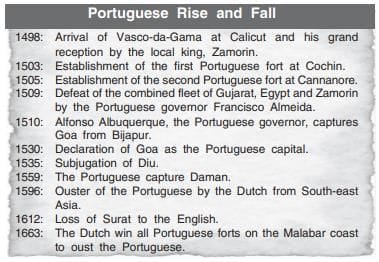
Voyage: Vasco da Gama reached Calicut (Kozhikode) in 1498.
Initial Reaction: Zamorin of Calicut allowed trade, but Vasco da Gama’s failure to pay customs showed that force was the only way to gain control.
Military Success:
Battle of Diu (1509): Defeated Egyptians, Arabs and Zamorin → established naval supremacy.
Capture of Goa (1510): By Alfonso de Albuquerque → became capital of Portuguese India.
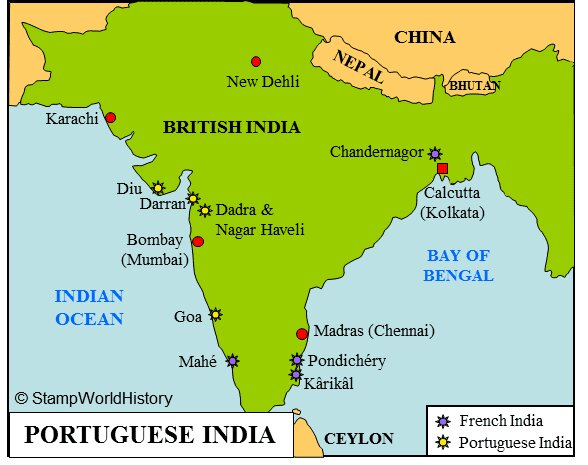
Other acquisitions: Bassein (1534), Diu (1537), forts in Daman, Dadra & Nagar Haveli, Hugli.
By end of 16th century: Controlled 50 forts and had a naval fleet of 100 ships.
Portuguese Interests in India
Spices from Malabar.
Indigo from Gujarat.
Textiles from Gujarat and Tamil ports.
Important Governors
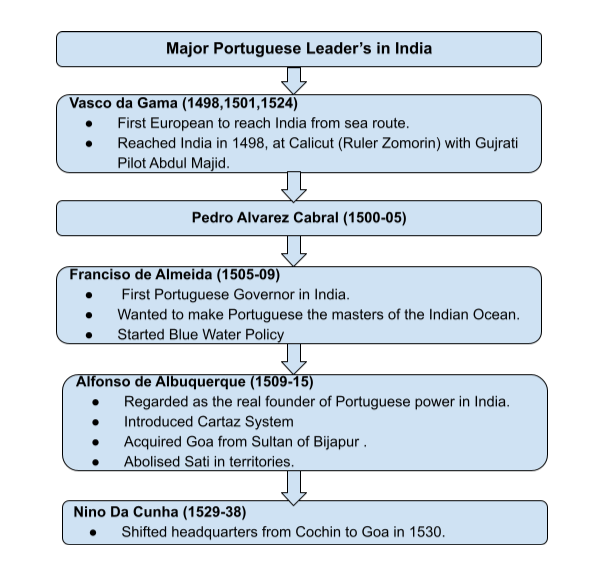
Francisco d’ Almeida (1505–1509): Blue Water Policy (naval supremacy).
Alfonso de Albuquerque (1509–1515): Real founder of Portuguese empire in India, captured Goa, encouraged intermarriage, banned sati.
Nino da Cunha: Occupied Bassein and Diu.
Impacts of Portuguese Rule
Positive Impacts
New Sea Route: Linked Europe directly with India.
Weakened Arab Monopoly: Enhanced Indo-European trade.
Military Innovations: Gunpowder, artillery, naval tactics.
Cultural Contributions:
Printing press (1556, Goa) → St. Paul’s College.
Introduction of Western education.
Missionary Activity: Schools, hospitals, some human development.
Negative Impacts
Colonial Legacy: Opened the door for later European powers (Dutch, English, French).
Divide and Rule: Exploited local rivalries (Cochin vs Calicut).
Exploitative Cartaz System: Taxed traders for “protection”.
Slave Trade: Social disruption.
Religious Conflicts: Conversion drives led to tensions.
Mughal–Portuguese Relations
Battle of Diu (1509): Defeated Gujarat Sultanate (Mughal ally).
Embassy to Akbar (1572): Tried for political alliances.
Jesuit Missions: Active in Akbar’s court (e.g., Father Antonio Monserrate).
Capture of Hugli (1632): Shah Jahan expelled Portuguese for piracy & slave trade.
Decline of Portuguese Power
Local Resistance: Vijayanagara, Mughals opposed expansion.
European Rivals: Dutch, English, French entered Indian trade.
Defeats:
Battle of Swally (1612): Lost Surat to British.
1661: Bombay handed to British via marriage alliance.
1663: Dutch expelled them from Malabar forts.
Weak Resources: Small nation, limited manpower.
Internal Corruption: Mismanagement of colonies.
Religious Tensions: Aggressive conversion policies alienated locals.
Indo–Portuguese Relations after Independence
Diplomatic Beginnings: Relations cordial till 1950, then soured as Portugal refused to cede Goa, Daman & Diu, Dadra & Nagar Haveli.
Breakdown: By 1955, diplomatic ties cut.
End of Portuguese Rule:
Operation Vijay (1961): Indian forces liberated Goa and other enclaves.
Instrument of Surrender (1961): End of 450 years of Portuguese colonialism.
Treaty of 1974 (effective 1975): Portugal recognised India’s sovereignty.
Diaspora: Around 1.25 lakh Indians live in Portugal today.
Support: Portugal backs India’s UNSC permanent seat & Nuclear Suppliers Group bid.
Economic Ties: Bilateral trade ~USD 1.2 billion (2022–23).
Defence Cooperation: MoU signed in 2017.
Cultural & Youth Exchange: KIP & KGP programmes.