
Secondary particulate matter and Delhi winter pollution
Context
Study commissioned by the Commission for Air Quality Management (CAQM) for the National Capital Region.
Prepared following Supreme Court directions (January 6) to identify major causes of worsening AQI.
It is a meta-analysis (synthesis of existing studies), not a fresh field study.
Major contributors to Delhi’s winter air pollution
Secondary particulate matter: 27% (largest contributor)
Transport emissions: 23%
Biomass burning: 20%
Includes crop residue burning and municipal solid waste burning
Dust: 15%
Industry: 9%
No new pollution sources were identified.
Why secondary particulate matter is critical
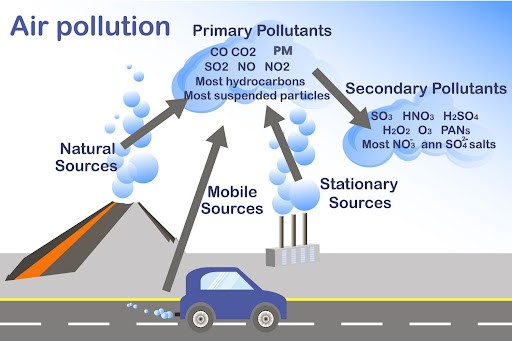
Primary particulate matter is directly emitted (e.g., NOx, SO₂, VOCs).
Secondary particulate matter forms in the atmosphere due to chemical reactions involving:
Sulphur dioxide (SO₂)
Nitrogen oxides (NOx)
Ammonia (NH₃)
Chemical processes involved
SO₂ (primarily from coal combustion and brick kilns) → oxidised to sulphuric acid (H₂SO₄)
NOx → oxidised to nitric acid (HNO₃)
H₂SO₄ + NH₃ → ammonium sulphate aerosols
HNO₃ + NH₃ → ammonium nitrate aerosols
Ammonia plays a key enabling role in secondary PM formation.
25%–60% of PM2.5 consists of sulphates and nitrates formed this way.
Nearly 80% of ammonia over India comes from fertilisers and livestock excreta.
“The total NH3 emission in India is found to be 10.54 Tg in 2022, where synthetic fertilizer application and livestock excreta are the dominant contributors with 4.9 Tg per year and 3.2 Tg per year respectively,”
Institutional and policy aspects
CAQM acknowledged variation in methodologies across earlier studies.
A new emissions inventory and source apportionment study is planned with:
Automotive Research Association of India
Indian Institute of Technology Delhi
The Energy Resources Institute
Indian Institute of Tropical Meteorology
Base year: 2026
In late 2024, CAQM suspended the Decision Support System (DSS) due to poor forecasting accuracy for sudden AQI deterioration.
About CAQM
Commission for Air Quality Management is a statutory body.
Established under the Commission for Air Quality Management in National Capital Region and Adjoining Areas Act 2021.
Objective: To address air pollution issues impacting Delhi-NCR and adjoining areas.
Mandate
Better coordination, research, identification, and resolution of air quality problems.
Prevention and control of air pollution affecting:
National Capital Territory (NCT) of Delhi
NCR and adjoining areas
Ensures inter-state coordination on air quality management.
Geographic jurisdiction
Covers:
Delhi
Punjab
Haryana
Rajasthan
Uttar Pradesh
Focus on sources that impact air quality of Delhi-NCR, even if located outside Delhi.
Powers and functions
Restrict or prohibit activities influencing air quality.
Conduct investigations and research on environmental pollution.
Prepare codes, guidelines, and standards for air pollution control.
Issue binding directions, including:
Inspections
Regulations
Compliance orders
All orders and directions of CAQM are legally binding.
Directly accountable to Parliament.
Composition
Chairperson
Government official of rank of Secretary or Chief Secretary.
Tenure: 3 years or till 70 years of age, whichever is earlier.
Ex-officio members (5)
Chief Secretaries or Environment Secretaries of:
Delhi
Punjab
Haryana
Rajasthan
Uttar Pradesh
Full-time members
Three technical members.
Non-government members
Three members from NGOs.
Technical representation from institutions
Central Pollution Control Board
Indian Space Research Organisation
NITI Aayog
Prelims Practice MCQs
Q. With reference to air pollution in Delhi, consider the following statements:
Secondary particulate matter is directly emitted from vehicles and industries.
Ammonia plays a crucial role in the formation of secondary PM2.5.
Sulphates and nitrates form a significant fraction of PM2.5 in winter.
Which of the statements given above are correct?
a) 1 and 2 only
b) 2 and 3 only
c) 1 and 3 only
d) 1, 2 and 3
Answer: b
Explanation:
Statement 1 is incorrect: secondary PM forms in the atmosphere, not emitted directly.
Statements 2 and 3 are correct.
Q. According to the CAQM synthesis report, which source contributes the most to Delhi’s winter air pollution?
a) Transport
b) Biomass burning
c) Secondary particulate matter
d) Dust
Answer: c
Explanation:
Secondary particulate matter contributes about 27%, the highest share.
Q. Which of the following chemical pairs correctly leads to the formation of ammonium aerosols?
a) SO₂ + NO₂
b) CO + NH₃
c) H₂SO₄ / HNO₃ + NH₃
d) O₃ + VOCs
Answer: c
Explanation:
Sulphuric and nitric acids react with ammonia to form ammonium sulphate and ammonium nitrate.