
Socialism and Secularism – The Spirit of the Indian Constitution
Context
-
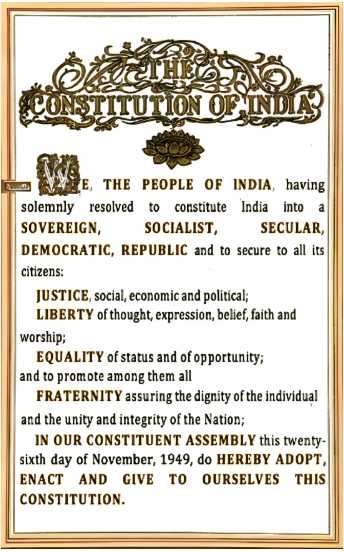
RSS General Secretary recently called for removing socialism and secularism from the Preamble, citing their insertion via the 42nd Constitutional Amendment Act, 1976 during the Emergency.
SOCIALISM in the Constitution
Reflected in:
-
Preamble (post-42nd Amendment):
-
Promises “Justice – social, economic and political” and “Equality of status and of opportunity.”
-
-
Fundamental Rights:
-
Article 14: Equality before law.
-
Article 15: Prohibits discrimination on religion, race, caste, sex, place of birth.
-
Article 16: Equality of opportunity in public employment.
-
-
Directive Principles of State Policy:
-
Article 38: Promote welfare state and reduce inequality.
-
Article 39: Equitable distribution of resources.
-
Article 41: Right to work, education, and public assistance.
-
Article 42: Just and humane conditions of work and maternity relief.
-
Article 43: Living wage and decent conditions of life.
-
Purpose:
These embody the spirit of socialism — commitment to social justice, equity, and elimination of exploitation.
Even before the 42nd Amendment, these provisions reflected socialist ideals.
SECULARISM in the Constitution
Reflected in:
-
Original Preamble (even before 1976):
-
“Liberty of thought, expression, belief, faith and worship”
-
“Fraternity assuring the dignity of the individual”
-
-
Fundamental Rights:
-
Articles 25 to 28: Right to freedom of religion.
-
Article 29 & 30: Cultural and Educational Rights, protecting minorities.
-
-
Article 25(2)(a):
-
Allowed the state to regulate secular activities associated with religious practices (indicating secularism pre-1976).
-
-
Supreme Court Judgments:
-
Secularism declared part of the Basic Structure of the Constitution.
-
Key Judicial Interpretation
Kesavananda Bharati Case (1973):
-
Introduced Basic Structure Doctrine.
-
Parliament cannot alter the fundamental structure of the Constitution.
-
Socialism and secularism added in 1976 were consistent with the Basic Structure, hence valid.
Founding Vision
-
Constituent Assembly Debates and Objective Resolution affirm that socialism and secularism were core principles from inception.
-
The Constitution is built on equality, liberty, dignity, non-discrimination, and religious neutrality.
Dr. B.R. Ambedkar’s Vision (Nov 25, 1949 Speech)
- Stressed equality as a foundational pillar — supporting both socialism and secularism.
- Warned against undermining democracy or returning to casteist or theocratic systems
Socialism and secularism are inseparable from the Indian Constitution — their removal will not erase the essence of justice, equality, liberty, and fraternity.
-
All those who cherish the legacy of India’s freedom movement must defend these values and resist authoritarian moves.
-
The Constitution is a living document meant to protect every citizen, and attacking these principles is an attack on India’s soul.